Naik Aanand D, Kallen Michael A, Walder Annette, Street Richard L
Houston Center for Quality of Care and Utilization Studies, Michael E. DeBakey VA Medical Center (152), 2002 Holcombe Blvd, Houston, TX 77030, USA.
Circulation. 2008 Mar 18;117(11):1361-8. doi: 10.1161/CIRCULATIONAHA.107.724005. Epub 2008 Mar 3.
Communication between patients and clinicians using collaborative goals and treatment plans may overcome barriers to achieving hypertension control in routine diabetes mellitus care. We assessed the interrelation of patient-clinician communication factors to determine their independent associations with hypertension control in diabetes care.
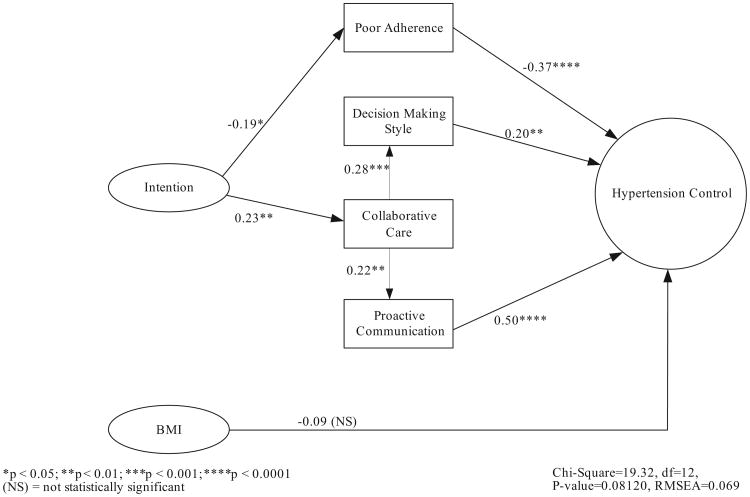
We identified 566 older adults with diabetes mellitus and hypertension at the DeBakey VA Medical Center in Houston, Tex. Clinical and pharmacy data were collected, and a patient questionnaire was sent to all participants. A total of 212 individuals returned surveys. Logistic regression analyses were performed to assess the effect of patient characteristics, self-management behaviors, and communication factors on hypertension control. Three communication factors had significant associations with hypertension control. Two factors, patients' endorsement of a shared decision-making style (odds ratio 1.61, 95% confidence interval 1.01 to 2.57) and proactive communication with one's clinician about abnormal results of blood pressure self-monitoring (odds ratio 1.89, 95% confidence interval 1.10 to 3.26), had direct, independent associations in multivariate regression. Path analysis was used to investigate the direct and indirect effects of communication factors and hypertension control. Decision-making style (beta=0.20, P<0.01) and proactive communication (beta=0.50, P<0.0001) again demonstrated direct effects on hypertension control. A third factor, clinicians' use of collaborative communication when setting treatment goals, had a total effect on hypertension control of 0.16 (P<0.05) through its direct effects on decision-making style (beta=0.28, P<0.001) and proactive communication (beta=0.22, P<0.01).
Three communication factors were found to have significant associations with hypertension control. Patient-clinician communication that facilitates collaborative blood pressure goals and patients' input related to the progress of treatment may improve rates of hypertension control in diabetes care independent of medication adherence.
在常规糖尿病护理中,患者与临床医生通过共同制定目标和治疗计划进行沟通,可能会克服实现高血压控制的障碍。我们评估了患者与临床医生沟通因素之间的相互关系,以确定它们与糖尿病护理中高血压控制的独立关联。
我们在德克萨斯州休斯顿的德贝基退伍军人事务医疗中心识别出566名患有糖尿病和高血压的老年人。收集了临床和药学数据,并向所有参与者发送了患者问卷。共有212人回复了调查问卷。进行逻辑回归分析,以评估患者特征、自我管理行为和沟通因素对高血压控制的影响。三个沟通因素与高血压控制有显著关联。其中两个因素,即患者对共同决策方式的认可(比值比1.61,95%置信区间1.01至2.57)以及就血压自我监测异常结果主动与临床医生沟通(比值比1.89,95%置信区间1.10至3.26),在多变量回归中具有直接、独立的关联。采用路径分析来研究沟通因素与高血压控制的直接和间接影响。决策方式(β=0.20,P<0.01)和主动沟通(β=0.50,P<0.0001)再次显示出对高血压控制的直接影响。第三个因素,即临床医生在设定治疗目标时使用协作沟通,通过其对决策方式(β=0.28,P<0.001)和主动沟通(β=0.22,P<0.01)的直接影响,对高血压控制的总效应为0.16(P<0.05)。
发现三个沟通因素与高血压控制有显著关联。促进共同血压目标以及患者参与治疗进展相关讨论的患者 - 临床医生沟通,可能会提高糖尿病护理中高血压的控制率,而与药物依从性无关。