Al Zabadi Hamzeh, Ferrari Luc, Laurent Anne-Marie, Tiberguent Aziz, Paris Christophe, Zmirou-Navier Denis
INSERM-ERI 11, Nancy University Medical School, 9 av de la Forêt de Haye, BP 184, 54505 Vandoeuvre-les-Nancy Cedex, France.
BMC Cancer. 2008 Mar 6;8:67. doi: 10.1186/1471-2407-8-67.
Sewage workers provide an essential service in the protection of public and environmental health. However, they are exposed to varied mixtures of chemicals; some are known or suspected to be genotoxics or carcinogens. Thus, trying to relate adverse outcomes to single toxicant is inappropriate. We aim to investigate if sewage workers are at increased carcinogenic risk as evaluated by biomarkers of exposure and early biological effects.
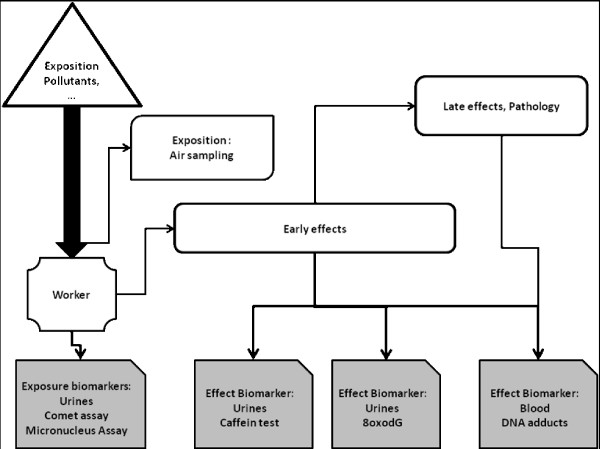
METHODS/DESIGN: This cross sectional study will compare exposed sewage workers to non-exposed office workers. Both are voluntaries from Paris municipality, males, aged (20-60) years, non-smokers since at least six months, with no history of chronic or recent illness, and have similar socioeconomic status. After at least 3 days of consecutive work, blood sample and a 24-hour urine will be collected. A caffeine test will be performed, by administering coffee and collecting urines three hours after. Subjects will fill in self-administered questionnaires; one covering the professional and lifestyle habits while the a second one is alimentary. The blood sample will be used to assess DNA adducts in peripheral lymphocytes. The 24-hour urine to assess urinary 8-oxo-7, 8-dihydro-2'-deoxy-Guanosine (8-oxo-dG), and the in vitro genotoxicity tests (comet and micronucleus) using HeLa S3 or HepG2 cells. In parallel, occupational air sampling will be conducted for some Polycyclic Aromatic Hydrocarbons and Volatile Organic Compounds. A weekly sampling chronology at the offices of occupational medicine in Paris city during the regular medical visits will be followed. This protocol has been accepted by the French Est III Ethical Comitee with the number 2007-A00685-48.
Biomarkers of exposure and of early biological effects may help overcome the limitations of environmental exposure assessment in very complex occupational or environmental settings.
污水处理工人在保护公众和环境卫生方面提供着至关重要的服务。然而,他们会接触到各种各样的化学物质混合物;其中一些已知或疑似具有基因毒性或致癌性。因此,试图将不良后果与单一毒物联系起来是不合适的。我们旨在通过接触生物标志物和早期生物学效应评估污水处理工人是否面临更高的致癌风险。
方法/设计:这项横断面研究将把接触污水的工人与未接触的办公室工作人员进行比较。两者均为来自巴黎市的志愿者,男性,年龄在(20 - 60)岁之间,至少六个月不吸烟,无慢性或近期疾病史,且社会经济地位相似。在连续工作至少3天后,采集血液样本和24小时尿液样本。进行咖啡因测试,即饮用咖啡并在三小时后收集尿液。受试者将填写自我管理的问卷;一份涵盖职业和生活方式习惯,另一份涉及饮食情况。血液样本将用于评估外周淋巴细胞中的DNA加合物。24小时尿液样本用于评估尿8 - 氧代 - 7,8 - 二氢 - 2'-脱氧鸟苷(8 - 氧代 - dG),并使用HeLa S3或HepG2细胞进行体外基因毒性测试(彗星试验和微核试验)。同时,将对一些多环芳烃和挥发性有机化合物进行职业空气采样。在巴黎市职业医学办公室定期就诊期间,将遵循每周采样时间表。该方案已获得法国东部第三伦理委员会批准,编号为2007 - A00685 - 48。
接触生物标志物和早期生物学效应生物标志物可能有助于克服在非常复杂的职业或环境环境中进行环境暴露评估的局限性。