Tildesley Michael J, Deardon Rob, Savill Nicholas J, Bessell Paul R, Brooks Stephen P, Woolhouse Mark E J, Grenfell Bryan T, Keeling Matt J
Department of Biological Sciences and Mathematics Institute, University of Warwick, Gibbet Hill Road, Coventry CV4 7AL, UK.
Proc Biol Sci. 2008 Jun 22;275(1641):1459-68. doi: 10.1098/rspb.2008.0006.
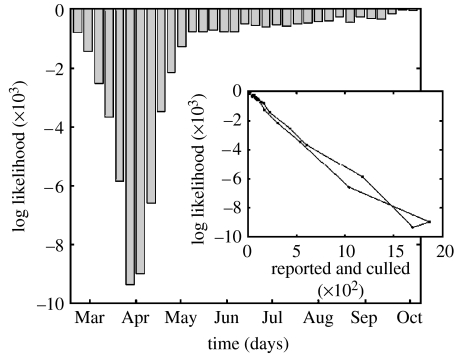
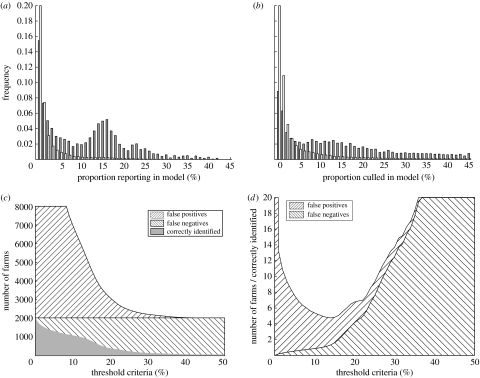
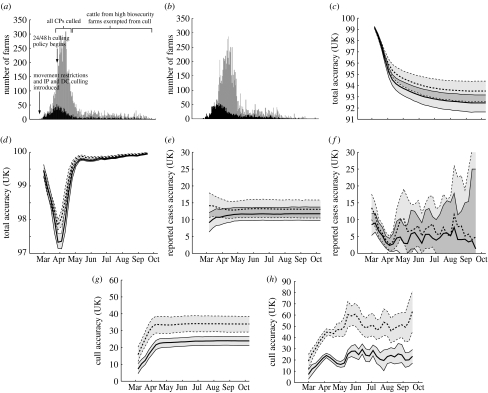
Since 2001 models of the spread of foot-and-mouth disease, supported by the data from the UK epidemic, have been expounded as some of the best examples of problem-driven epidemic models. These claims are generally based on a comparison between model results and epidemic data at fairly coarse spatio-temporal resolution. Here, we focus on a comparison between model and data at the individual farm level, assessing the potential of the model to predict the infectious status of farms in both the short and long terms. Although the accuracy with which the model predicts farms reporting infection is between 5 and 15%, these low levels are attributable to the expected level of variation between epidemics, and are comparable to the agreement between two independent model simulations. By contrast, while the accuracy of predicting culls is higher (20-30%), this is lower than expected from the comparison between model epidemics. These results generally support the contention that the type of the model used in 2001 was a reliable representation of the epidemic process, but highlight the difficulties of predicting the complex human response, in terms of control strategies to the perceived epidemic risk.
自2001年以来,以英国疫情数据为支撑的口蹄疫传播模型,已被阐述为问题驱动型疫情模型的一些最佳范例。这些说法通常基于模型结果与时空分辨率相当粗糙的疫情数据之间的比较。在此,我们聚焦于个体农场层面的模型与数据比较,评估该模型在短期和长期预测农场感染状况的潜力。尽管该模型预测报告感染农场的准确率在5%至15%之间,但这些低水平归因于不同疫情之间预期的变异程度,并且与两次独立模型模拟之间的一致性相当。相比之下,虽然预测扑杀的准确率较高(20% - 30%),但低于模型疫情之间比较所预期的水平。这些结果总体上支持了2001年所使用模型类型是疫情过程可靠表征的论点,但凸显了在预测针对感知到的疫情风险的控制策略方面复杂人类反应的困难。