Foolad Majid R
Department of Horticulture, The Pennsylvania State University, University Park, 16802, USA.
Int J Plant Genomics. 2007;2007:64358. doi: 10.1155/2007/64358.
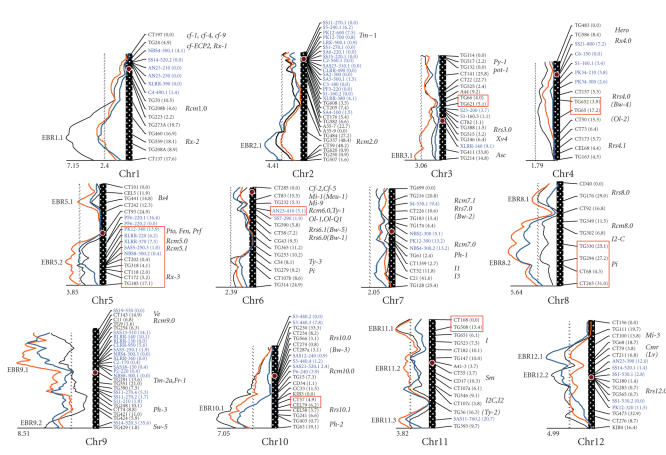
The cultivated tomato, Lycopersicon esculentum, is the second most consumed vegetable worldwide and a well-studied crop species in terms of genetics, genomics, and breeding. It is one of the earliest crop plants for which a genetic linkage map was constructed, and currently there are several molecular maps based on crosses between the cultivated and various wild species of tomato. The high-density molecular map, developed based on an L. esculentum x L. pennellii cross, includes more than 2200 markers with an average marker distance of less than 1 cM and an average of 750 kbp per cM. Different types of molecular markers such as RFLPs, AFLPs, SSRs, CAPS, RGAs, ESTs, and COSs have been developed and mapped onto the 12 tomato chromosomes. Markers have been used extensively for identification and mapping of genes and QTLs for many biologically and agriculturally important traits and occasionally for germplasm screening, fingerprinting, and marker-assisted breeding. The utility of MAS in tomato breeding has been restricted largely due to limited marker polymorphism within the cultivated species and economical reasons. Also, when used, MAS has been employed mainly for improving simply-inherited traits and not much for improving complex traits. The latter has been due to unavailability of reliable PCR-based markers and problems with linkage drag. Efforts are being made to develop high-throughput markers with greater resolution, including SNPs. The expanding tomato EST database, which currently includes approximately 214 000 sequences, the new microarray DNA chips, and the ongoing sequencing project are expected to aid development of more practical markers. Several BAC libraries have been developed that facilitate map-based cloning of genes and QTLs. Sequencing of the euchromatic portions of the tomato genome is paving the way for comparative and functional analysis of important genes and QTLs.
栽培番茄(Lycopersicon esculentum)是全球消费量第二大的蔬菜,也是在遗传学、基因组学和育种方面得到深入研究的作物品种。它是最早构建遗传连锁图谱的作物之一,目前有多个基于栽培番茄与各种野生番茄杂交的分子图谱。基于栽培番茄(L. esculentum)与潘那利番茄(L. pennellii)杂交构建的高密度分子图谱包含2200多个标记,平均标记间距小于1厘摩,每厘摩平均为750千碱基对。已经开发了不同类型的分子标记,如限制性片段长度多态性(RFLP)、扩增片段长度多态性(AFLP)、简单序列重复(SSR)、酶切扩增多态性序列(CAPS)、抗病基因类似物(RGA)、表达序列标签(EST)和保守寡核苷酸序列(COS),并将其定位到12条番茄染色体上。这些标记已广泛用于许多生物学和农业重要性状的基因和数量性状位点(QTL)的鉴定和定位,偶尔也用于种质筛选、指纹图谱分析和标记辅助育种。由于栽培种内标记多态性有限以及经济原因,标记辅助选择(MAS)在番茄育种中的应用受到很大限制。此外,即使使用MAS,也主要用于改良简单遗传性状,而在改良复杂性状方面应用不多。这是由于缺乏可靠的基于聚合酶链反应(PCR)的标记以及连锁累赘问题。目前正在努力开发具有更高分辨率的高通量标记,包括单核苷酸多态性(SNP)。不断扩大的番茄EST数据库目前包含约214000个序列,新的微阵列DNA芯片以及正在进行的测序项目有望有助于开发更实用的标记。已经开发了几个细菌人工染色体(BAC)文库,这有助于基于图谱的基因和QTL克隆。番茄基因组常染色质部分的测序为重要基因和QTL的比较和功能分析铺平了道路。