Schmidt-Glenewinkel Hannah, Vacheva Ivayla, Hoeller Daniela, Dikic Ivan, Eils Roland
Division Theoretical Bioinformatics, German Cancer Research Center (DKFZ), 69120 Heidelberg, Germany.
BMC Syst Biol. 2008 Apr 7;2:32. doi: 10.1186/1752-0509-2-32.
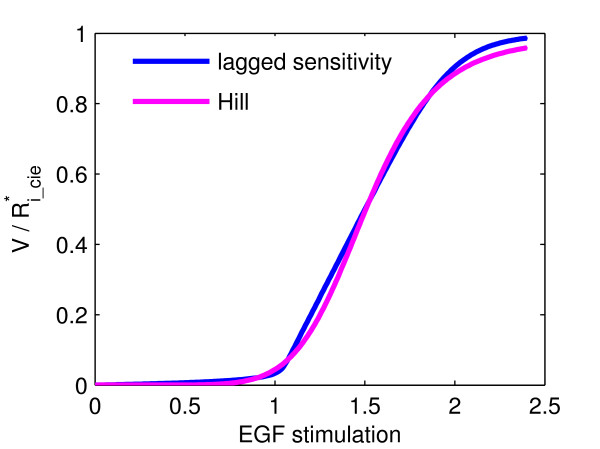
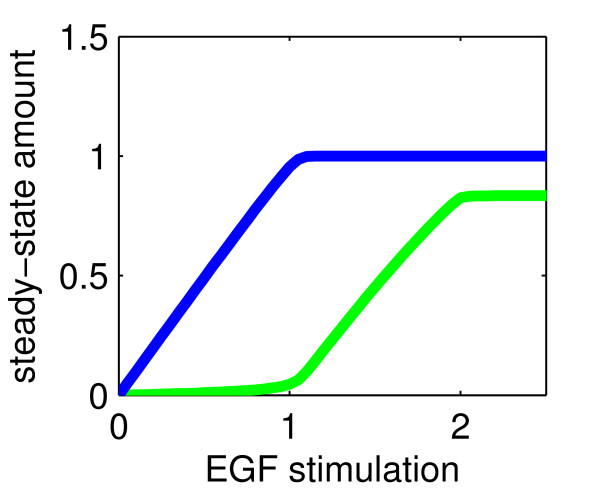
The Epidermal Growth Factor (EGF) receptor has been shown to internalize via clathrin-independent endocytosis (CIE) in a ligand concentration dependent manner. From a modeling point of view, this resembles an ultrasensitive response, which is the ability of signaling networks to suppress a response for low input values and to increase to a pre-defined level for inputs exceeding a certain threshold. Several mechanisms to generate this behaviour have been described theoretically, the underlying assumptions of which, however, have not been experimentally demonstrated for the EGF receptor internalization network.
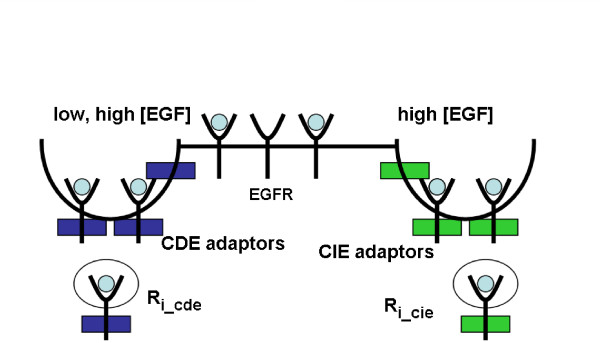
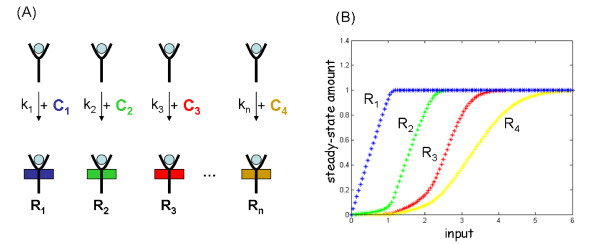
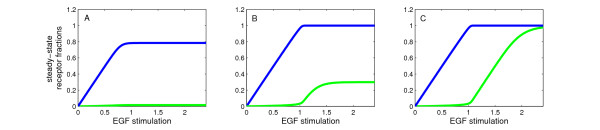
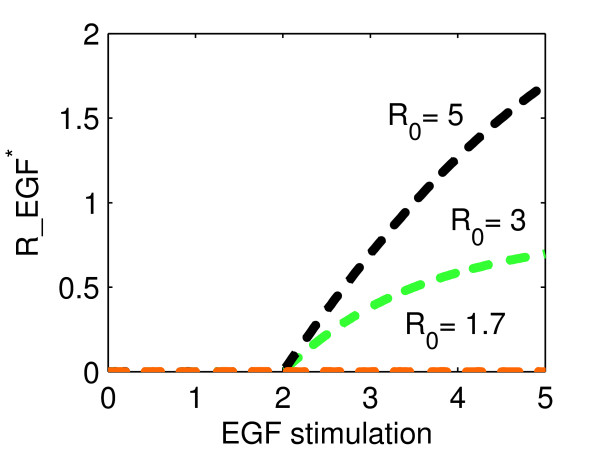
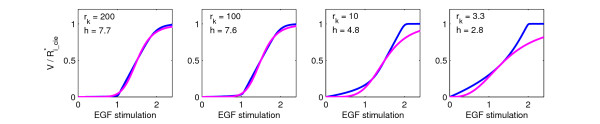
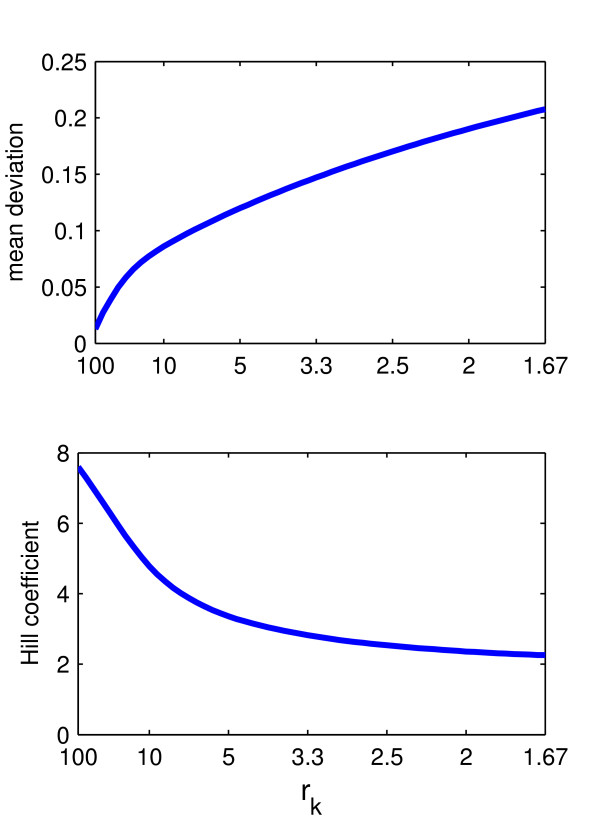
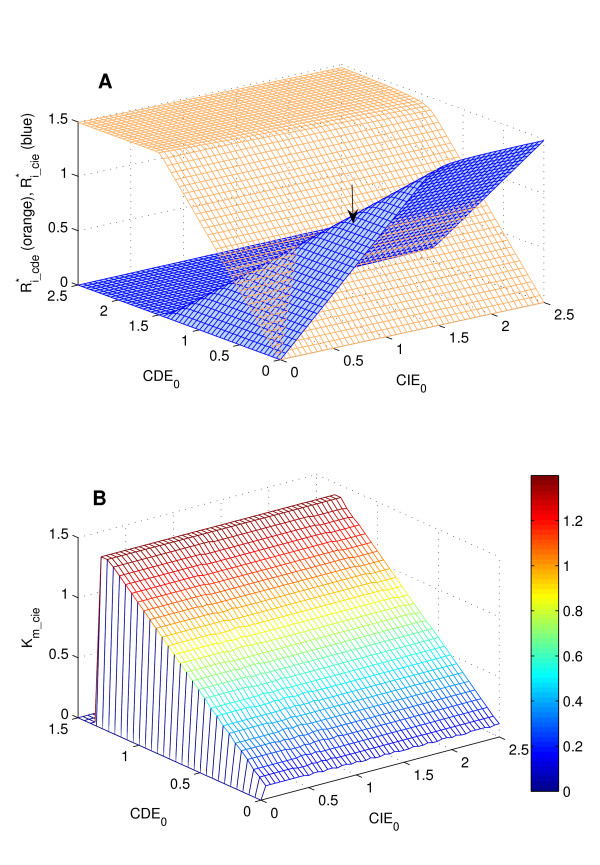
Here, we present a mathematical model of receptor sorting into alternative pathways that explains the EGF-concentration dependent response of CIE. The described mechanism involves a saturation effect of the dominant clathrin-dependent endocytosis pathway and implies distinct steady-states into which the system is forced for low vs high EGF stimulations. The model is minimal since no experimentally unjustified reactions or parameter assumptions are imposed. We demonstrate the robustness of the sorting effect for large parameter variations and give an analytic derivation for alternative steady-states that are reached. Further, we describe extensibility of the model to more than two pathways which might play a role in contexts other than receptor internalization.
Our main result is that a scenario where different endocytosis routes consume the same form of receptor corroborates the observation of a clear-cut, stimulus dependent sorting. This is especially important since a receptor modification discriminating between the pathways has not been found experimentally. The model is not restricted to EGF receptor internalization and might account for ultrasensitivity in other cellular contexts.
表皮生长因子(EGF)受体已被证明可通过网格蛋白非依赖型内吞作用(CIE)以配体浓度依赖的方式内化。从建模的角度来看,这类似于一种超敏反应,即信号网络能够抑制低输入值的反应,并在输入超过特定阈值时增加到预定义水平。理论上已经描述了几种产生这种行为的机制,然而,其潜在假设尚未在EGF受体内化网络中得到实验证明。
在这里,我们提出了一个受体分选到替代途径的数学模型,该模型解释了CIE的EGF浓度依赖性反应。所描述的机制涉及主要的网格蛋白依赖型内吞途径的饱和效应,并意味着系统在低EGF刺激和高EGF刺激下被迫进入不同的稳态。该模型是最小化的,因为没有强加任何未经实验验证的反应或参数假设。我们证明了分选效应在大参数变化下的稳健性,并给出了达到的替代稳态的解析推导。此外,我们描述了该模型可扩展到两个以上途径,这些途径可能在受体内化以外的其他情况下发挥作用。
我们的主要结果是,不同的内吞途径消耗相同形式受体的情况证实了清晰的、刺激依赖型分选的观察结果。这尤其重要,因为尚未通过实验发现区分这些途径的受体修饰。该模型不限于EGF受体内化,可能解释其他细胞环境中的超敏反应。