Ilyushina Natalia A, Govorkova Elena A, Gray Thomas E, Bovin Nicolai V, Webster Robert G
Division of Virology, Department of Infectious Diseases, St. Jude Children's Research Hospital, Memphis, Tennessee, United States of America.
PLoS Pathog. 2008 Apr 11;4(4):e1000043. doi: 10.1371/journal.ppat.1000043.
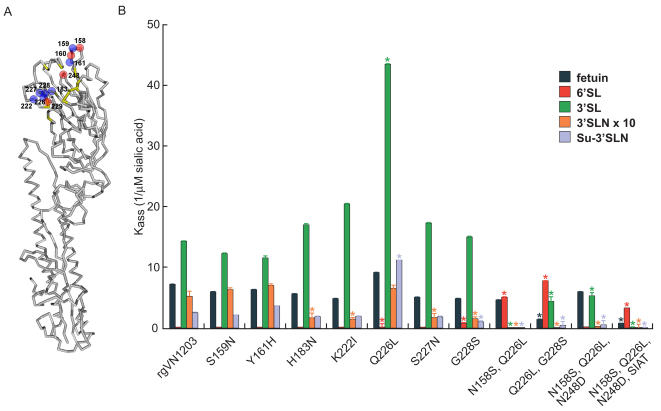
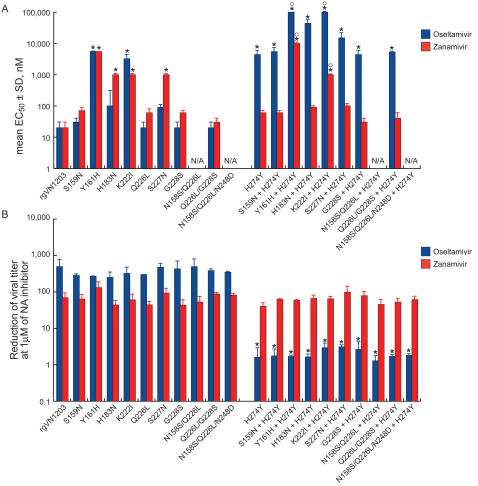
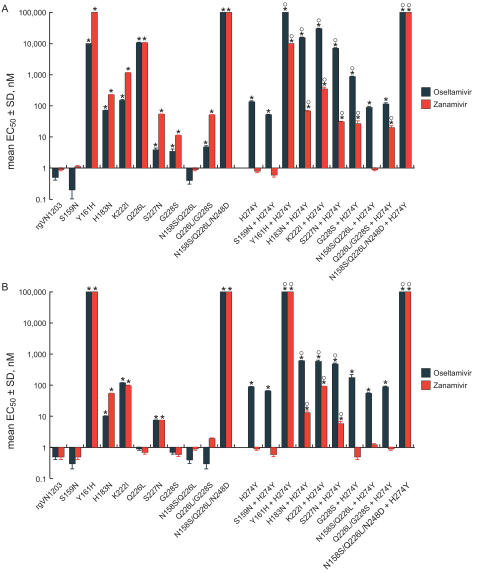
If highly pathogenic H5N1 influenza viruses acquire affinity for human rather than avian respiratory epithelium, will their susceptibility to neuraminidase (NA) inhibitors (the likely first line of defense against an influenza pandemic) change as well? Adequate pandemic preparedness requires that this question be answered. We generated and tested 31 recombinants of A/Vietnam/1203/04 (H5N1) influenza virus carrying single, double, or triple mutations located within or near the receptor binding site in the hemagglutinin (HA) glycoprotein that alter H5 HA binding affinity or specificity. To gain insight into how combinations of HA and NA mutations can affect the sensitivity of H5N1 virus to NA inhibitors, we also rescued viruses carrying the HA changes together with the H274Y NA substitution, which was reported to confer resistance to the NA inhibitor oseltamivir. Twenty viruses were genetically stable. The triple N158S/Q226L/N248D HA mutation (which eliminates a glycosylation site at position 158) caused a switch from avian to human receptor specificity. In cultures of differentiated human airway epithelial (NHBE) cells, which provide an ex vivo model that recapitulates the receptors in the human respiratory tract, none of the HA-mutant recombinants showed reduced susceptibility to antiviral drugs (oseltamivir or zanamivir). This finding was consistent with the results of NA enzyme inhibition assay, which appears to predict influenza virus susceptibility in vivo. Therefore, acquisition of human-like receptor specificity does not affect susceptibility to NA inhibitors. Sequence analysis of the NA gene alone, rather than analysis of both the NA and HA genes, and phenotypic assays in NHBE cells are likely to adequately identify drug-resistant H5N1 variants isolated from humans during an outbreak.
如果高致病性H5N1流感病毒获得对人类而非禽类呼吸道上皮细胞的亲和力,那么它们对神经氨酸酶(NA)抑制剂(应对流感大流行可能的一线防御药物)的敏感性是否也会改变呢?充分的大流行防范需要回答这个问题。我们构建并测试了31种A/越南/1203/04(H5N1)流感病毒重组体,这些重组体在血凝素(HA)糖蛋白的受体结合位点内或附近携带单、双或三重突变,这些突变改变了H5 HA的结合亲和力或特异性。为了深入了解HA和NA突变的组合如何影响H5N1病毒对NA抑制剂的敏感性,我们还拯救了携带HA变化以及H274Y NA替代的病毒,据报道该替代可使病毒对NA抑制剂奥司他韦产生耐药性。20种病毒在基因上是稳定的。三重N158S/Q226L/N248D HA突变(消除了158位的糖基化位点)导致了从禽类受体特异性向人类受体特异性的转变。在分化的人气道上皮(NHBE)细胞培养物中,NHBE细胞提供了一个体外模型,可重现人类呼吸道中的受体,没有一种HA突变重组体显示出对抗病毒药物(奥司他韦或扎那米韦)的敏感性降低。这一发现与NA酶抑制试验的结果一致,该试验似乎可以预测流感病毒在体内的敏感性。因此,获得类似人类的受体特异性不会影响对NA抑制剂的敏感性。仅对NA基因进行序列分析,而不是对NA和HA基因都进行分析,以及在NHBE细胞中进行表型分析,可能足以识别在疫情爆发期间从人类分离出的耐药H5N1变体。