Tolić-Nørrelykke Iva M
Max Planck Institute of Molecular Cell Biology and Genetics, Pfotenhauerstrasse 108, 01307, Dresden, Germany.
Eur Biophys J. 2008 Sep;37(7):1271-8. doi: 10.1007/s00249-008-0321-0. Epub 2008 Apr 11.
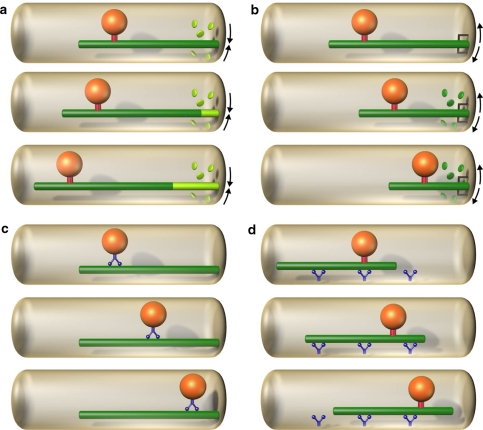
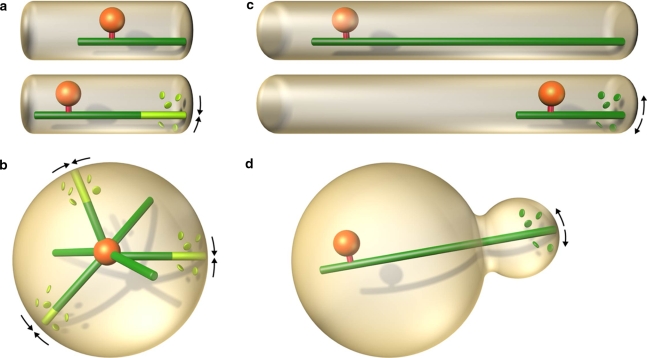
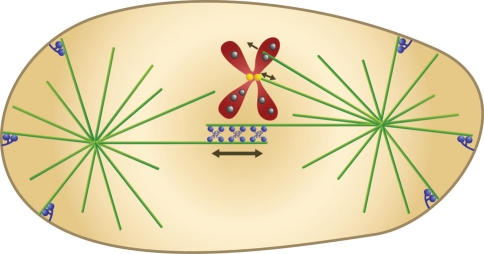
Dynamic organization of the cell interior, which is crucial for cell function, largely depends on the microtubule cytoskeleton. Microtubules move and position organelles by pushing, pulling, or sliding. Pushing forces can be generated by microtubule polymerization, whereas pulling typically involves microtubule depolymerization or molecular motors, or both. Sliding between a microtubule and another microtubule, an organelle, or the cell cortex is also powered by molecular motors. Although numerous examples of microtubule-based pushing and pulling in living cells have been observed, it is not clear why different cell types and processes employ different mechanisms. This review introduces a classification of microtubule-based positioning strategies and discusses the efficacy of pushing and pulling. The positioning mechanisms based on microtubule pushing are efficient for movements over small distances, and for centering of organelles in symmetric geometries. Mechanisms based on pulling, on the other hand, are typically more elaborate, but are necessary when the distances to be covered by the organelles are large, and when the geometry is asymmetric and complex. Thus, taking into account cell geometry and the length scale of the movements helps to identify general principles of the intracellular layout based on microtubule forces.
细胞内部的动态组织对细胞功能至关重要,其很大程度上依赖于微管细胞骨架。微管通过推、拉或滑动来移动细胞器并确定其位置。推的力量可由微管聚合产生,而拉通常涉及微管解聚或分子马达,或两者皆有。微管与另一个微管、细胞器或细胞皮层之间的滑动也是由分子马达驱动的。尽管在活细胞中已观察到许多基于微管推和拉的例子,但尚不清楚为何不同细胞类型和过程采用不同机制。本综述介绍了基于微管的定位策略分类,并讨论了推和拉的功效。基于微管推的定位机制对于短距离移动以及使细胞器在对称几何形状中居中是有效的。另一方面,基于拉的机制通常更为复杂,但当细胞器要移动的距离较大,以及几何形状不对称且复杂时是必要的。因此,考虑细胞几何形状和移动的长度尺度有助于确定基于微管力的细胞内布局的一般原则。