Department of Molecular Biophysics & Biochemistry, Yale University, New Haven, CT 06511, USA.
Shriram Center for Chemical Engineering & Bioengineering, Stanford University, CA 94305, USA.
Bioessays. 2017 Nov;39(11). doi: 10.1002/bies.201700122. Epub 2017 Sep 28.
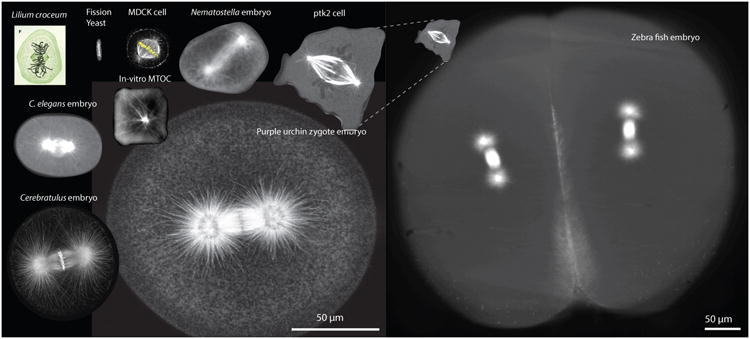
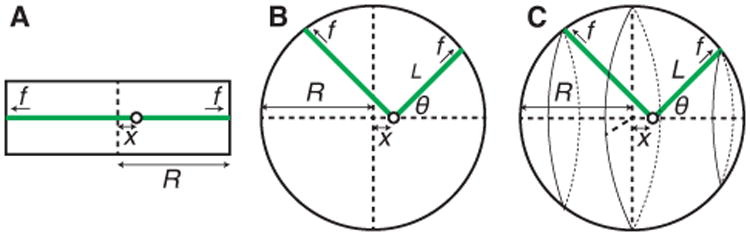
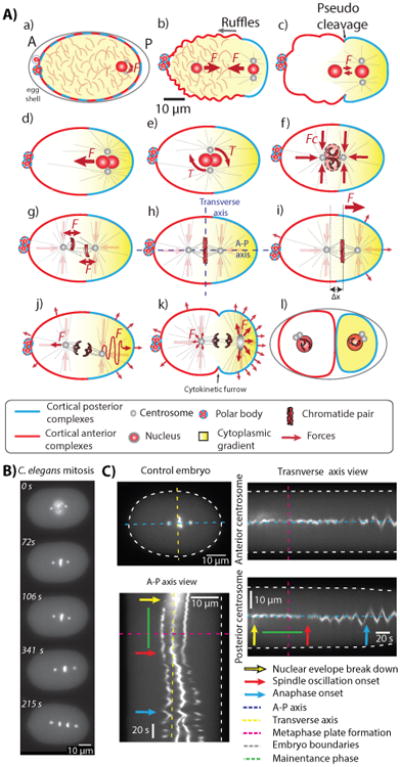
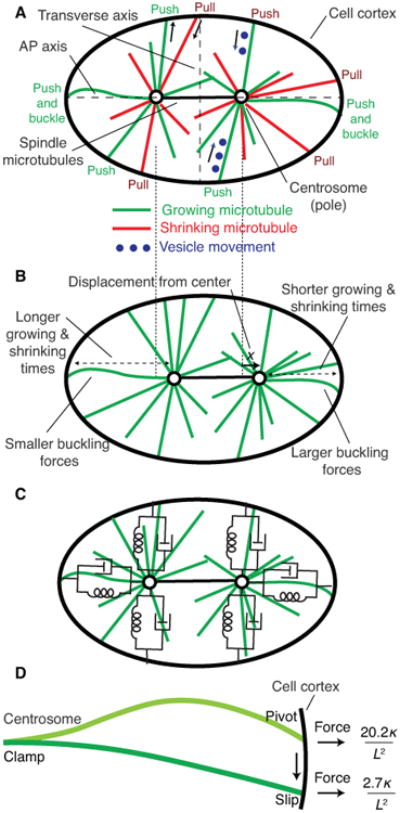
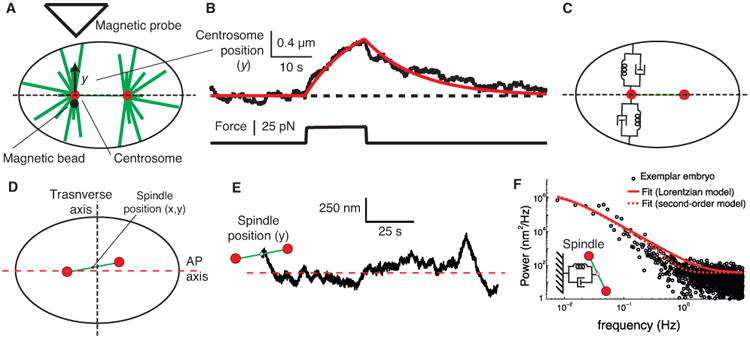
Tissues are shaped and patterned by mechanical and chemical processes. A key mechanical process is the positioning of the mitotic spindle, which determines the size and location of the daughter cells within the tissue. Recent force and position-fluctuation measurements indicate that pushing forces, mediated by the polymerization of astral microtubules against- the cell cortex, maintain the mitotic spindle at the cell center in Caenorhabditis elegans embryos. The magnitude of the centering forces suggests that the physical limit on the accuracy and precision of this centering mechanism is determined by the number of pushing microtubules rather than by thermally driven fluctuations. In cells that divide asymmetrically, anti-centering, pulling forces generated by cortically located dyneins, in conjunction with microtubule depolymerization, oppose the pushing forces to drive spindle displacements away from the center. Thus, a balance of centering pushing forces and anti-centering pulling forces localize the mitotic spindles within dividing C. elegans cells.
组织是通过机械和化学过程来塑造和形成模式的。一个关键的机械过程是有丝分裂纺锤体的定位,它决定了子细胞在组织中的大小和位置。最近的力和位置波动测量表明,由星体微管对细胞皮层的聚合介导的推压力在秀丽隐杆线虫胚胎中维持着有丝分裂纺锤体在细胞中心的位置。中心力的大小表明,这种定位机制的准确性和精密度的物理限制是由推动微管的数量决定的,而不是由热驱动的波动决定的。在不对称分裂的细胞中,由皮层定位的动力蛋白产生的反中心、牵拉力与微管解聚相结合,对抗推压力,将纺锤体从中心向外推。因此,中心推压力和反中心拉应力的平衡将有丝分裂纺锤体定位在正在分裂的秀丽隐杆线虫细胞内。