Parthasarathy Sampath, Litvinov Dmitry, Selvarajan Krithika, Garelnabi Mahdi
Ohio State University, 410 West 10th Avenue, Columbus, OH 43210, USA.
Biochim Biophys Acta. 2008 May;1781(5):221-31. doi: 10.1016/j.bbalip.2008.03.002. Epub 2008 Mar 25.
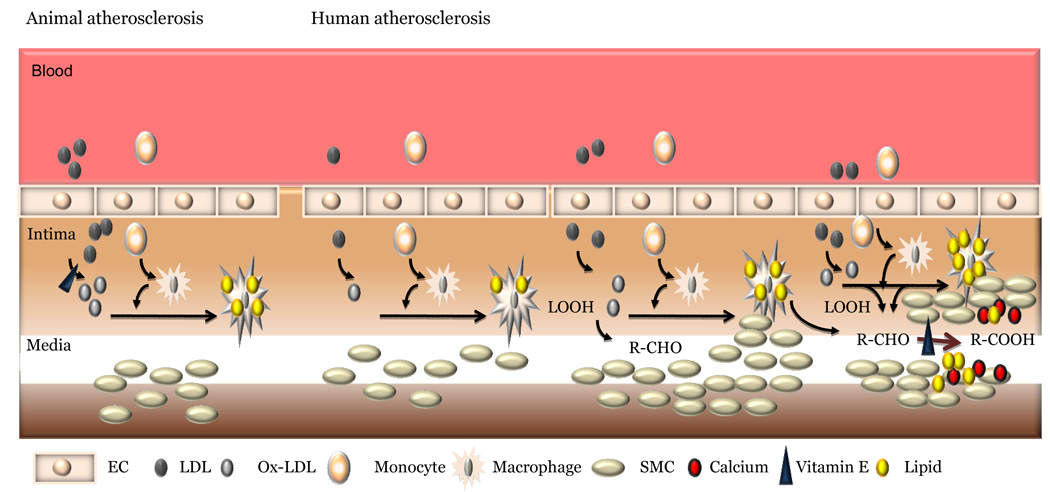
The low density lipoprotein (LDL) oxidation hypothesis has generated considerable interest in oxidative stress and how it might affect atherosclerosis. However, the failure of antioxidants, particularly vitamin E, to affect the progression of the disease in humans has convinced even staunch supporters of the hypothesis to take a step backwards and reconsider alternatives. Preponderant evidence for the hypothesis came from animal antioxidant intervention studies. In this review we point out basic differences between animal and human atherosclerosis development and suggest that human disease starts where animal studies end. While initial oxidative steps in the generation of early fatty streak lesions might be common, the differences might be in the steps involved in the decomposition of peroxidized lipids into aldehydes and their further oxidation into carboxylic acids. We suggest that these steps may not be amenable to attenuation by antioxidants and antioxidants might actually counter the stabilization of plaque by preventing the formation of carboxylic acids which are anti-inflammatory in nature. The formation of such dicarboxylic acids may also be conducive to plaque stabilization by trapping calcium. We suggest that agents that would prevent the decomposition of lipid peroxides and promote the formation and removal of lipid hydroxides, such as paraoxonase (PON 1) or apo A1/high density lipoprotein (HDL) might be more conducive to plaque regression.
低密度脂蛋白(LDL)氧化假说引发了人们对氧化应激及其如何影响动脉粥样硬化的极大兴趣。然而,抗氧化剂,尤其是维生素E,未能影响人类疾病的进展,这使得该假说的坚定支持者也不得不退一步重新考虑其他可能性。该假说的主要证据来自动物抗氧化剂干预研究。在本综述中,我们指出了动物和人类动脉粥样硬化发展的基本差异,并表明人类疾病始于动物研究结束之处。虽然早期脂肪条纹病变形成过程中的初始氧化步骤可能是相同的,但差异可能在于过氧化脂质分解为醛以及醛进一步氧化为羧酸的过程。我们认为这些步骤可能无法通过抗氧化剂来减弱,而且抗氧化剂实际上可能会通过阻止具有抗炎性质的羧酸形成来对抗斑块的稳定。这种二羧酸的形成也可能通过捕获钙而有助于斑块稳定。我们认为,能够防止脂质过氧化物分解并促进脂质氢氧化物形成和清除的物质,如对氧磷酶(PON 1)或载脂蛋白A1/高密度脂蛋白(HDL),可能更有利于斑块消退。