Heil Martin, Lion Ulrich, Boland Wilhelm
Departamento de Ingeniería Genética, CINVESTAV, Km. 9.6 Libramiento Norte, Irapuato CP 36821, Guanajuato, México.
J Chem Ecol. 2008 May;34(5):601-4. doi: 10.1007/s10886-008-9464-9. Epub 2008 Apr 12.
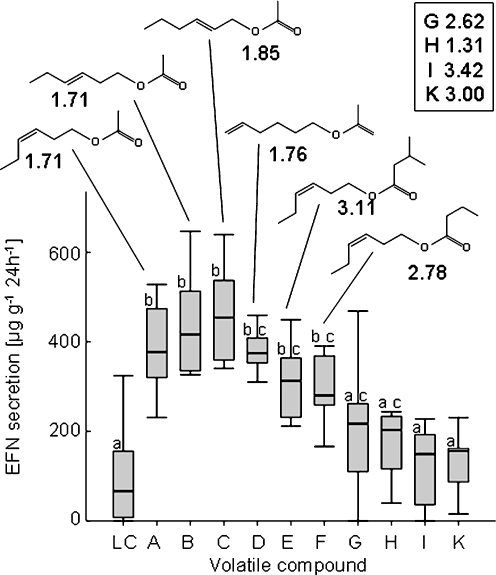
Herbivore-induced volatile organic compounds (VOCs) are widely appreciated as an indirect defense mechanism since carnivorous arthropods use VOCs as cues for host localization and then attack herbivores. Another function of VOCs is plant-plant signaling. That VOCs elicit defensive responses in neighboring plants has been reported from various species, and different compounds have been found to be active. In order to search for a structural motif that characterizes active VOCs, we used lima bean (Phaseolus lunatus), which responds to VOCs released from damaged plants with an increased secretion of extrafloral nectar (EFN). We exposed lima bean to (Z)-3-hexenyl acetate, a substance naturally released from damaged lima bean and known to induce EFN secretion, and to several structurally related compounds. (E)-3-hexenyl acetate, (E)-2-hexenyl acetate, 5-hexenyl acetate, (Z)-3-hexenylisovalerate, and (Z)-3-hexenylbutyrate all elicited significant increases in EFN secretion, demonstrating that neither the (Z)-configuration nor the position of the double-bond nor the size of the acid moiety are critical for the EFN-inducing effect. Our result is not consistent with previous concepts that postulate reactive electrophile species (Michael-acceptor-systems) for defense-induction in Arabidopsis. Instead, we postulate that physicochemical processes, including interactions with odorant binding proteins and resulting in changes in transmembrane potentials, can underlie VOCs-mediated signaling processes.
植食性动物诱导产生的挥发性有机化合物(VOCs)作为一种间接防御机制已广为人知,因为肉食性节肢动物利用VOCs作为宿主定位线索,进而攻击植食性动物。VOCs的另一个功能是植物间信号传导。已报道多种植物的VOCs能引发邻近植物的防御反应,并且发现不同的化合物具有活性。为了寻找表征活性VOCs的结构基序,我们使用了利马豆(菜豆),它对受损植物释放的VOCs会通过增加花外蜜(EFN)的分泌做出反应。我们将利马豆暴露于乙酸(Z)-3-己烯酯(一种受损利马豆自然释放且已知可诱导EFN分泌的物质)以及几种结构相关的化合物中。乙酸(E)-3-己烯酯、乙酸(E)-2-己烯酯、乙酸5-己烯酯、异戊酸(Z)-3-己烯酯和丁酸(Z)-3-己烯酯均能显著增加EFN的分泌,这表明(Z)-构型、双键位置以及酸部分的大小对于EFN诱导效应均不是关键因素。我们的结果与之前在拟南芥中假定反应性亲电物质(迈克尔受体系统)用于防御诱导的概念不一致。相反,我们假定物理化学过程,包括与气味结合蛋白的相互作用并导致跨膜电位变化,可能是VOCs介导的信号传导过程的基础。