Pescosolido Bernice A, Martin Jack K, Lang Annie, Olafsdottir Sigrun
Department of Sociology, Indiana University, Bloomington, IN 47405-7000, USA.
Soc Sci Med. 2008 Aug;67(3):431-40. doi: 10.1016/j.socscimed.2008.03.018. Epub 2008 Apr 22.
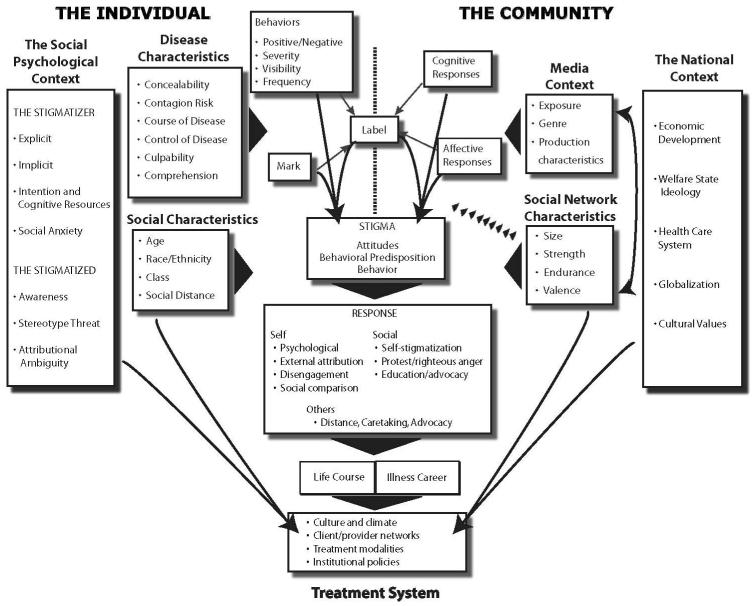
A resurgence of research and policy efforts on stigma both facilitates and forces a reconsideration of the levels and types of factors that shape reactions to persons with conditions that engender prejudice and discrimination. Focusing on the case of mental illness but drawing from theories and studies of stigma across the social sciences, we propose a framework that brings together theoretical insights from micro, meso and macro level research: Framework Integrating Normative Influences on Stigma (FINIS) starts with Goffman's notion that understanding stigma requires a language of social relationships, but acknowledges that individuals do not come to social interaction devoid of affect and motivation. Further, all social interactions take place in a context in which organizations, media and larger cultures structure normative expectations which create the possibility of marking "difference". Labelling theory, social network theory, the limited capacity model of media influence, the social psychology of prejudice and discrimination, and theories of the welfare state all contribute to an understanding of the complex web of expectations shaping stigma. FINIS offers the potential to build a broad-based scientific foundation based on understanding the effects of stigma on the lives of persons with mental illness, the resources devoted to the organizations and families who care for them, and policies and programs designed to combat stigma. We end by discussing the clear implications this framework holds for stigma reduction, even in the face of conflicting results.
对污名的研究和政策努力的复兴既促进又迫使人们重新审视那些塑造对患有导致偏见和歧视病症之人反应的因素的层面和类型。以精神疾病为例,并借鉴社会科学中有关污名的理论和研究,我们提出了一个框架,该框架整合了微观、中观和宏观层面研究的理论见解:整合污名规范影响框架(FINIS)始于戈夫曼的观点,即理解污名需要一种社会关系语言,但也承认个体进入社会互动时并非没有情感和动机。此外,所有社会互动都发生在一个背景中,在这个背景下,组织、媒体和更大的文化构建了规范期望,从而产生了标记“差异”的可能性。标签理论、社会网络理论、媒体影响的有限能力模型、偏见和歧视的社会心理学以及福利国家理论都有助于理解塑造污名的复杂期望网络。FINIS有潜力基于对污名对精神疾病患者生活的影响、投入到照顾他们的组织和家庭的资源以及旨在消除污名的政策和项目的理解,建立一个广泛的科学基础。我们最后讨论了即使面对相互矛盾的结果,这个框架对减少污名的明确启示。