
心力衰竭患者自我控制六分钟步行试验的可重复性
Reproducibility of the self-controlled six-minute walking test in heart failure patients.
作者信息
Guimarães Guilherme Veiga, Carvalho Vitor Oliveira, Bocchi Edimar Alcides
机构信息
Heart Institute, Faculdade de Medicina, Universidade de São Paulo, São Paulo, SP, Brazil.
出版信息
Clinics (Sao Paulo). 2008 Apr;63(2):201-6. doi: 10.1590/s1807-59322008000200008.
INTRODUCTION
The six-minute walk test (6WT) has been proposed to be a submaximal test, but could actually demand a high level of exercise intensity from the patient, expressed by a respiratory quotient >1.0, following the guideline recommendations. Standardizing the 6WT using the Borg scale was proposed to make sure that all patients undergo a submaximal walking test.
PURPOSE
To test the reproducibility of the six-minute treadmill cardiopulmonary walk test (6CWT) using the Borg scale and to make sure that all patients undergo a submaximal test.
METHODS
Twenty-three male heart failure patients (50+/-9 years) were included; these patients had both ischemic (5) and non-ischemic (18) heart failure with a left ventricle ejection fraction of 23+/-7%, were diagnosed as functional class NYHA II-III and were undergoing optimized drug therapy. Patients were guided to walk at a pace between "relatively easy and slightly tiring" (11 and 13 on Borg scale). The 6CWT using the Borg scale was performed two times on a treadmill with zero inclination and patient control of speed with an interval of 24 hours. During the sixth minute, we analyzed ventilation (VE, L/min), respiratory quotient, Oxygen consumption (VO2, ml/kg/min), VE/VCO2 slope, heart rate (HR, bpm), systolic blood pressure (SBP, mmHg), diastolic (DBP, mmHg) blood pressure and distance.
RESULTS
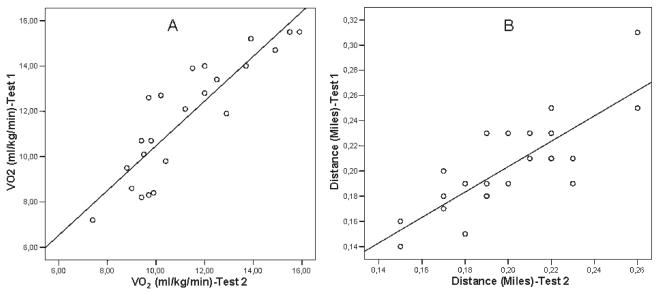
The intraclass correlation coefficients at the sixth minute were: HR (r i=0.96, p<0.0001), VE (r i=0.84, p<0.0001), SBP (r i=0.72, p=0.001), distance (r i=0.88, p<0.0001), VO2 (r i=0.92, p<0.0001), SlopeVE/VCO2 (r i=0.86, p<0.0001) and RQ<1 (r i=0.6, p=0.004).
CONCLUSION
Using the 6CWT with the Borg scale was reproducible, and it seems to be an appropriate method to evaluate the functional capacity of heart failure patients while making sure that they undergo a submaximal walking test.
引言
六分钟步行试验(6WT)被认为是一种次极量试验,但实际上按照指南建议,它可能会对患者提出较高的运动强度要求,表现为呼吸商>1.0。有人提议使用博格量表对6WT进行标准化,以确保所有患者都接受次极量步行试验。
目的
使用博格量表测试六分钟平板心肺步行试验(6CWT)的可重复性,并确保所有患者都接受次极量试验。
方法
纳入23名男性心力衰竭患者(年龄50±9岁);这些患者既有缺血性(5例)又有非缺血性(18例)心力衰竭,左心室射血分数为23±7%,被诊断为纽约心脏病协会(NYHA)心功能II-III级,且正在接受优化药物治疗。指导患者以“相对轻松和稍感疲劳”(博格量表上的11至13级)之间的速度行走。使用博格量表的6CWT在零坡度的平板上进行了两次,患者可自行控制速度,两次测试间隔24小时。在第六分钟时,我们分析了通气量(VE,升/分钟)、呼吸商、耗氧量(VO2,毫升/千克/分钟)、VE/VCO2斜率、心率(HR,次/分钟)、收缩压(SBP,毫米汞柱)、舒张压(DBP,毫米汞柱)和行走距离。
结果
第六分钟时的组内相关系数分别为:心率(ri = 0.96,p < 0.0001)、通气量(ri = 0.84,p < 0.0001)、收缩压(ri = 0.72,p = 0.001)、距离(ri = 0.88,p < 0.0001)、耗氧量(ri = 0.92,p < 0.0001)、VE/VCO2斜率(ri = 0.86,p < 0.0001)以及呼吸商<1(ri = 0.6,p = 0.004)。
结论
使用博格量表的6CWT具有可重复性,并且它似乎是一种评估心力衰竭患者功能能力的合适方法,同时能确保他们接受次极量步行试验。


 Zotero 插件