Landau N R, Page K A, Littman D R
Department of Microbiology and Immunology, University of California, San Francisco.
J Virol. 1991 Jan;65(1):162-9. doi: 10.1128/JVI.65.1.162-169.1991.
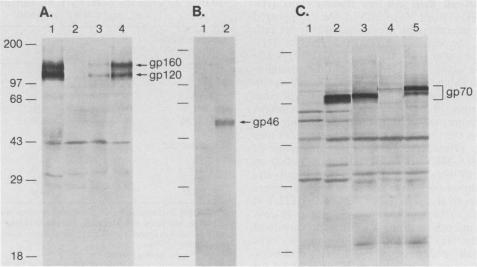
Several epidemiologic and clinical studies suggest that patients coinfected with human immunodeficiency virus (HIV), the primary etiologic agent in AIDS, and other viruses, such as cytomegalovirus or human T-cell leukemia virus (HTLV), have a more severe clinical course than those infected with HIV alone. Cells infected with two viruses can, in some cases, give rise to phenotypically mixed virions with altered or broadened cell tropism and could therefore account for some of these findings. Such pseudotypes could alter the course of disease by infecting more tissues than are normally infected by HIV. We show here that HIV type 1 (HIV-1) efficiently incorporates the HTLV type I (HTLV-I) envelope glycoprotein and that both HIV-1 and HTLV-II accept other widely divergent envelope glycoproteins to form infectious pseudotype viruses whose cellular tropisms and relative abilities to be transmitted by cell-free virions or by cell contact are determined by the heterologous envelope. We also show that the mechanism by which virions incorporate heterologous envelope glycoproteins is independent of the presence of the homologous glycoprotein or heterologous gag proteins. These results may have important implications for the mechanism of HIV pathogenesis.
多项流行病学和临床研究表明,同时感染人类免疫缺陷病毒(HIV,艾滋病的主要病原体)和其他病毒(如巨细胞病毒或人类T细胞白血病病毒(HTLV))的患者,其临床病程比仅感染HIV的患者更为严重。在某些情况下,感染两种病毒的细胞可产生表型混合的病毒粒子,其细胞嗜性发生改变或扩大,因此可以解释其中一些发现。这种假型病毒可能通过感染比HIV通常感染的更多组织来改变疾病进程。我们在此表明,1型人类免疫缺陷病毒(HIV-1)能有效地整合I型人类T细胞白血病病毒(HTLV-I)包膜糖蛋白,并且HIV-1和HTLV-II都能接受其他差异很大的包膜糖蛋白,以形成感染性假型病毒,其细胞嗜性以及通过无细胞病毒粒子或细胞接触进行传播的相对能力由异源包膜决定。我们还表明,病毒粒子整合异源包膜糖蛋白的机制与同源糖蛋白或异源gag蛋白的存在无关。这些结果可能对HIV发病机制具有重要意义。