
测试用于机器质量保证的门静脉成像仪GLAaS算法。
Testing the portal imager GLAaS algorithm for machine quality assurance.
作者信息
Nicolini G, Vanetti E, Clivio A, Fogliata A, Boka G, Cozzi L
机构信息
Oncology Institute of Southern Switzerland, Medical Physics Unit, Bellinzona, Switzerland.
出版信息
Radiat Oncol. 2008 May 21;3:14. doi: 10.1186/1748-717X-3-14.
BACKGROUND
To report about enhancements introduced in the GLAaS calibration method to convert raw portal imaging images into absolute dose matrices and to report about application of GLAaS to routine radiation tests for linac quality assurance procedures programmes.
METHODS
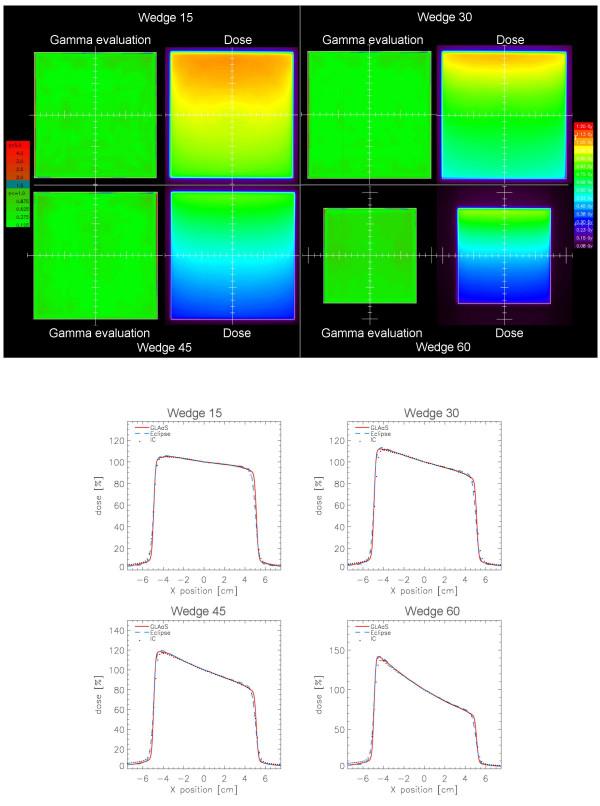
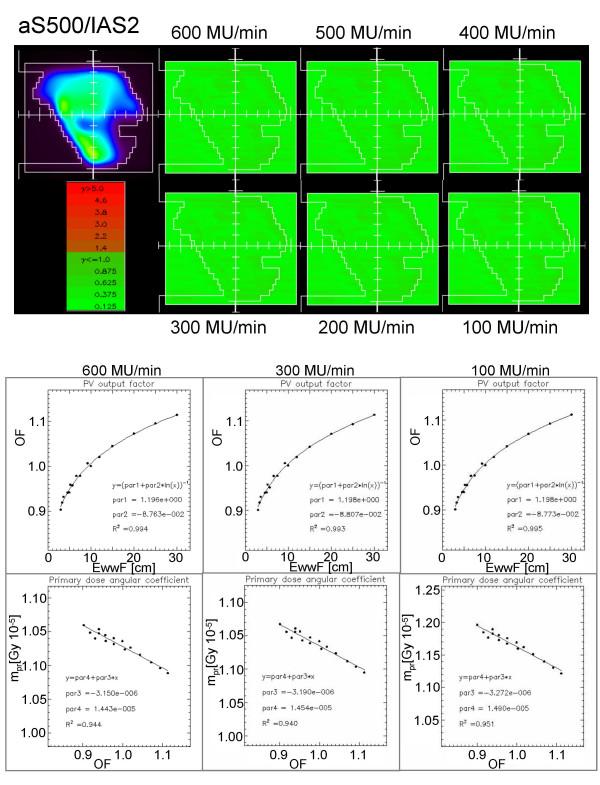
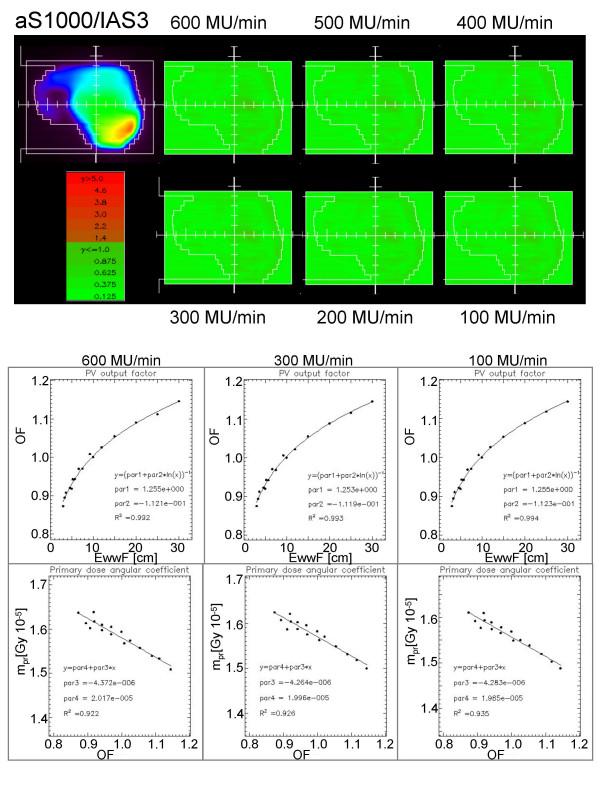
Two characteristic effects limiting the general applicability of portal imaging based dosimetry are the over-flattening of images (eliminating the "horns" and "holes" in the beam profiles induced by the presence of flattening filters) and the excess of backscattered radiation originated by the detector robotic arm supports. These two effects were corrected for in the new version of GLAaS formalism and results are presented to prove the improvements for different beams, detectors and support arms. GLAaS was also tested for independence from dose rate (fundamental to measure dynamic wedges). With the new corrections, it is possible to use GLAaS to perform standard tasks of linac quality assurance. Data were acquired to analyse open and wedged fields (mechanical and dynamic) in terms of output factors, MU/Gy, wedge factors, profile penumbrae, symmetry and homogeneity. In addition also 2D Gamma Evaluation was applied to measurement to expand the standard QA methods. GLAaS based data were compared against calculations on the treatment planning system (the Varian Eclipse) and against ion chamber measurements as consolidated benchmark. Measurements were performed mostly on 6 MV beams from Varian linacs. Detectors were the PV-as500/IAS2 and the PV-as1000/IAS3 equipped with either the robotic R- or Exact- arms.
RESULTS
Corrections for flattening filter and arm backscattering were successfully tested. Percentage difference between PV-GLAaS measurements and Eclipse calculations relative doses at the 80% of the field size, for square and rectangular fields larger than 5 x 5 cm2 showed a maximum range variation of -1.4%, + 1.7% with a mean variation of <0.5%. For output factors, average percentage difference between GLAaS and Eclipse (or ion chamber) data was -0.4 +/- 0.7 (-0.2 +/- 0.4) respectively on square fields. Minimum, maximum and average percentage difference between GLAaS and Eclipse (or ion chamber) data in the flattened field region were: 0.1 +/- 1.0, 0.7 +/- 0.8, 0.1 +/- 0.4 (1.0 +/- 1.4, -0.3 +/- 0.2, -0.1 +/- 0.2) respectively. Similar minimal deviations were observed for flatness and symmetry. For Dynamic wedges, percentage difference of MU/Gy between GLAaS and Eclipse (or ion chamber) was: -1.1 +/- 1.6 (0.4 +/- 0.7). Minimum, maximum and average percentage difference between GLAaS and Eclipse (or ion chamber) data in the flattened field region were: 0.4 +/- 1.6, -1.5 +/- 1.8, -0.1 +/- 0.3 (-2.2 +/- 2.3, 2.3 +/- 1.2, 0.8 +/- 0.3) respectively. For mechanical wedges differences of transmission factors were <1.6% (Eclipse) and <1.1% (ion chamber) for all wedges. Minimum, maximum and average percentage difference between GLAaS and Eclipse (or ion chamber) data in the flattened field region were: -1.3 +/- 0.7, -0.7 +/- 0.7, -0.2 +/- 0.2 (-0.8 +/- 0.8, 0.7 +/- 1.1, 0.2 +/- 0.3) respectively.
CONCLUSION
GLAaS includes now efficient methods to correct for missing "horns" and "holes" induced by flattening filter in the beam and to compensate for excessive backscattering from the support arm. These enhancements allowed to use GLAaS based dosimetric measurement to perform standard tasks of Linac quality assurance with reliable and consistent results. This fast method could be applied to routine practice being also fast in usage and because it allows the introduction of new analysis tools in routine QA by means, e.g., of the Gamma Index analysis.
背景
报告GLAaS校准方法中为将原始门静脉成像图像转换为绝对剂量矩阵而引入的改进,并报告GLAaS在直线加速器质量保证程序的常规辐射测试中的应用。
方法
基于门静脉成像的剂量测定法普遍适用性受限的两个特征效应是图像过度平坦化(消除由均整过滤器的存在引起的射束轮廓中的“角”和“孔”)以及探测器机械臂支架产生的反向散射辐射过多。在GLAaS形式主义的新版本中对这两种效应进行了校正,并给出结果以证明对不同射束、探测器和支撑臂的改进。还测试了GLAaS与剂量率的独立性(这是测量动态楔形的基础)。通过新的校正,可以使用GLAaS执行直线加速器质量保证的标准任务。采集数据以分析开放野和楔形野(静态和动态)的输出因子、MU/Gy、楔形因子、轮廓半值宽度、对称性和均匀性。此外,还将二维伽马评估应用于测量以扩展标准质量保证方法。将基于GLAaS的数据与治疗计划系统(瓦里安Eclipse)上的计算结果以及作为公认基准的电离室测量结果进行比较。测量主要在瓦里安直线加速器的6 MV射束上进行。探测器是配备了机器人R臂或Exact臂的PV-as500/IAS2和PV-as1,000/IAS3。
结果
成功测试了对均整过滤器和臂反向散射的校正。对于大于5×5 cm2的方形和矩形野,在野尺寸的80%处,PV-GLAaS测量值与Eclipse计算的相对剂量之间的百分比差异显示最大范围变化为-1.4%、+1.7%,平均变化<0.5%。对于输出因子,在方形野上,GLAaS与Eclipse(或电离室)数据之间的平均百分比差异分别为-0.4±0.7(-0.2±0.4)。在均整野区域中,GLAaS与Eclipse(或电离室)数据之间的最小、最大和平均百分比差异分别为:0.1±1.0、0.7±0.8、0.1±0.4(1.0±1.4、-0.3±0.2、-0.1±0.2)。对于平整度和对称性也观察到类似的最小偏差。对于动态楔形,GLAaS与Eclipse(或电离室)之间MU/Gy的百分比差异为:-1.1±1.6(0.4±0.7)。在均整野区域中,GLAaS与Eclipse(或电离室)数据之间的最小、最大和平均百分比差异分别为:0.4±1.6、-1.5±1.8、-0.1±0.3(-2.2±2.3、2.3±1.2、0.8±0.3)。对于静态楔形,所有楔形的透射因子差异<1.6%(Eclipse)和<1.1%(电离室)。在均整野区域中,GLAaS与Eclipse(或电离室)数据之间的最小、最大和平均百分比差异分别为:-1.3±0.7、-0.7±0.7、-0.2±0.2(-0.8±0.8、0.7±1.1、0.2±0.3)。
结论
GLAaS现在包括有效的方法来校正由射束中的均整过滤器引起的缺失“角”和“孔”,并补偿来自支撑臂的过多反向散射。这些改进使得基于GLAaS的剂量测量能够执行直线加速器质量保证的标准任务,结果可靠且一致。这种快速方法可应用于常规实践,使用起来也很快,并且因为它允许通过例如伽马指数分析等方式在常规质量保证中引入新的分析工具。



 Zotero 插件