LaMontagne Anthony D, Keegel Tessa, Vallance Deborah, Ostry Aleck, Wolfe Rory
McCaughey Centre: VicHealth Centre for the Promotion of Mental Health & Social Wellbeing School of Population Health, University of Melbourne Melbourne, VIC 3010, Australia.
BMC Public Health. 2008 May 27;8:181. doi: 10.1186/1471-2458-8-181.
The broad aim of this study was to assess the contribution of job strain to mental health inequalities by (a) estimating the proportion of depression attributable to job strain (low control and high demand jobs), (b) assessing variation in attributable risk by occupational skill level, and (c) comparing numbers of job strain-attributable depression cases to numbers of compensated 'mental stress' claims.
Standard population attributable risk (PAR) methods were used to estimate the proportion of depression attributable to job strain. An adjusted Odds Ratio (OR) of 1.82 for job strain in relation to depression was obtained from a recently published meta-analysis and combined with exposure prevalence data from the Australian state of Victoria. Job strain exposure prevalence was determined from a 2003 population-based telephone survey of working Victorians (n = 1101, 66% response rate) using validated measures of job control (9 items, Cronbach's alpha = 0.80) and psychological demands (3 items, Cronbach's alpha = 0.66). Estimates of absolute numbers of prevalent cases of depression and successful stress-related workers' compensation claims were obtained from publicly available Australian government sources.
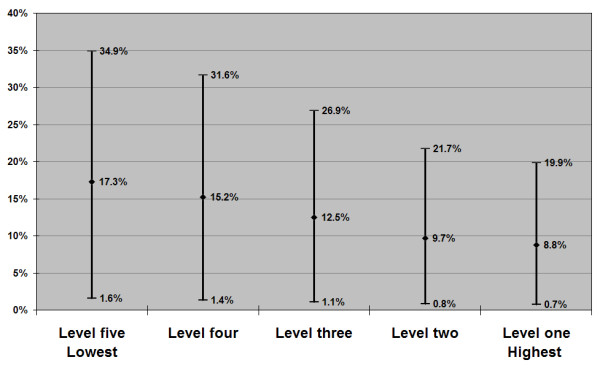
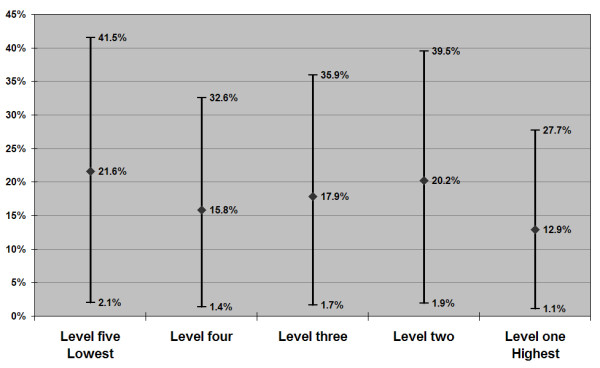
Overall job strain-population attributable risk (PAR) for depression was 13.2% for males [95% CI 1.1, 28.1] and 17.2% [95% CI 1.5, 34.9] for females. There was a clear gradient of increasing PAR with decreasing occupational skill level. Estimation of job strain-attributable cases (21,437) versus "mental stress" compensation claims (696) suggest that claims statistics underestimate job strain-attributable depression by roughly 30-fold.
Job strain and associated depression risks represent a substantial, preventable, and inequitably distributed public health problem. The social patterning of job strain-attributable depression parallels the social patterning of mental illness, suggesting that job strain is an important contributor to mental health inequalities. The numbers of compensated 'mental stress' claims compared to job strain-attributable depression cases suggest that there is substantial under-recognition and under-compensation of job strain-attributable depression. Primary, secondary, and tertiary intervention efforts should be substantially expanded, with intervention priorities based on hazard and associated health outcome data as an essential complement to claims statistics.
本研究的总体目标是通过以下方式评估工作压力对心理健康不平等的影响:(a) 估计因工作压力(低控制和高需求工作)导致的抑郁症比例;(b) 评估归因风险在职业技能水平上的差异;(c) 比较因工作压力导致的抑郁症病例数与获得赔偿的“精神压力”索赔数。
采用标准的人群归因风险(PAR)方法来估计因工作压力导致的抑郁症比例。从最近发表的一项荟萃分析中获得工作压力与抑郁症相关的调整后比值比(OR)为1.82,并将其与澳大利亚维多利亚州的暴露患病率数据相结合。工作压力暴露患病率通过2003年对维多利亚州在职人员进行的基于人群的电话调查确定(n = 1101,应答率66%),使用经过验证的工作控制量表(9项,Cronbach's α = 0.80)和心理需求量表(3项,Cronbach's α = 0.66)。抑郁症现患病例数和与压力相关的成功工伤赔偿索赔数的估计值来自澳大利亚政府公开可用的资料。
男性因工作压力导致的抑郁症总体人群归因风险(PAR)为13.2% [95%可信区间1.1, 28.1],女性为17.2% [95%可信区间1.5, 34.9]。随着职业技能水平的降低,PAR呈现明显的上升梯度。因工作压力导致的病例估计数(21,437例)与“精神压力”赔偿索赔数(696例)相比,表明索赔统计数据将因工作压力导致的抑郁症低估了约30倍。
工作压力及相关的抑郁症风险是一个重大的、可预防的且分布不均的公共卫生问题。因工作压力导致的抑郁症的社会模式与精神疾病的社会模式相似,这表明工作压力是心理健康不平等的一个重要因素。与因工作压力导致的抑郁症病例相比,获得赔偿的“精神压力”索赔数表明,因工作压力导致的抑郁症存在大量认识不足和赔偿不足的情况。应大幅扩大一级、二级和三级干预措施,干预重点应基于风险和相关健康结果数据,作为对索赔统计数据的重要补充。