Dagleish Mark P, Martin Stuart, Steele Philip, Finlayson Jeanie, Sisó Sílvia, Hamilton Scott, Chianini Francesca, Reid Hugh W, González Lorenzo, Jeffrey Martin
Moredun Research Institute, Pentlands Science Park, Bush Loan, Penicuik, Near Edinburgh, EH26 0PZ, UK.
BMC Vet Res. 2008 May 28;4:17. doi: 10.1186/1746-6148-4-17.
Bovine spongiform encephalopathy (BSE), a member of the transmissible spongiform encephalopathies (TSE), primarily affects cattle. Transmission is via concentrate feed rations contaminated with infected meat and bone meal (MBM). In addition to cattle, other food animal species are susceptible to BSE and also pose a potential threat to human health as consumption of infected meat products is the cause of variant Creutzfeldt-Jakob disease in humans, which is invariably fatal. In the UK, farmed and free ranging deer were almost certainly exposed to BSE infected MBM in proprietary feeds prior to legislation banning its inclusion. Therefore, although BSE has never been diagnosed in any deer species, a possible risk to human health remains via ingestion of cervine products. Chronic wasting disease (CWD), also a TSE, naturally infects several cervid species in North America and is spreading rapidly in both captive and free-ranging populations.
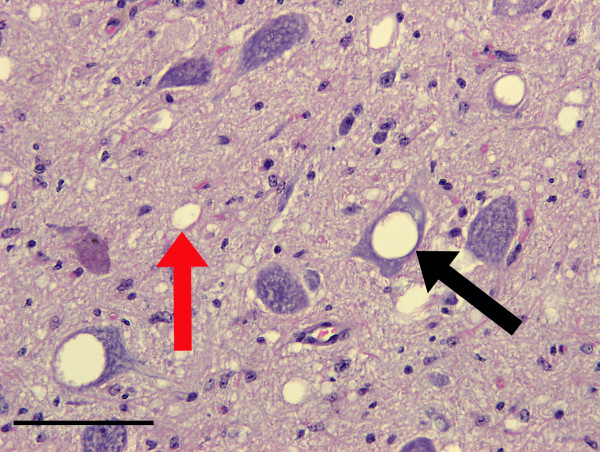
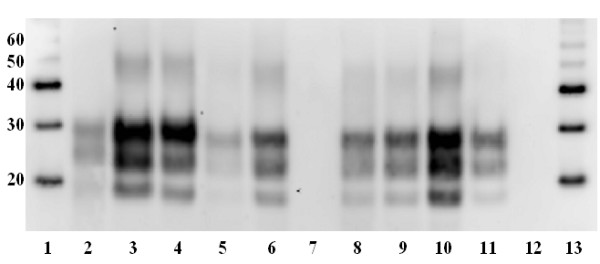
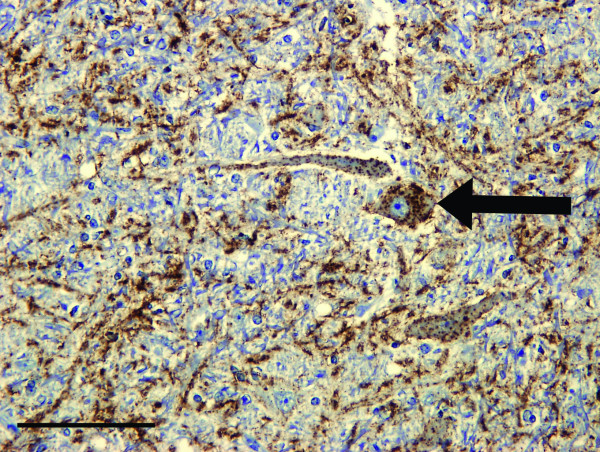
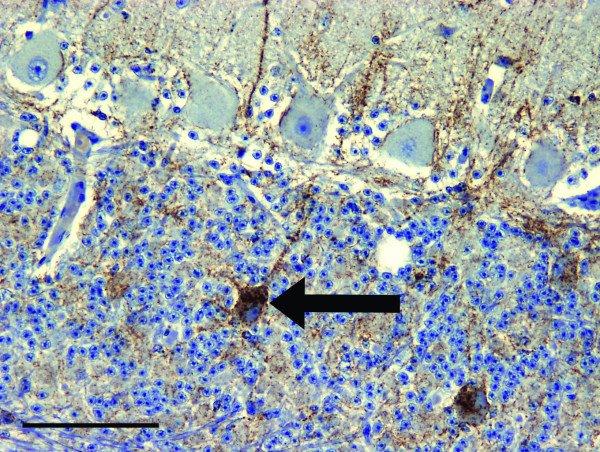
Here we show that European red deer (Cervus elaphus elaphus) are susceptible to intra-cerebral (i/c) challenge with BSE positive cattle brain pool material resulting in clinical neurological disease and weight loss by 794-1290 days and the clinical signs are indistinguishable to those reported in deer with CWD. Spongiform changes typical of TSE infections were present in brain and accumulation of the disease-associated abnormal prion protein (PrPd) was present in the central and peripheral nervous systems, but not in lymphoid or other tissues. Western immunoblot analysis of brain material showed a similar glycosylation pattern to that of BSE derived from infected cattle and experimentally infected sheep with respect to protease-resistant PrP isoforms. However, the di-, mono- and unglycosylated bands migrated significantly (p < 0.001) further in the samples from the clinically affected deer when compared to BSE infected brains of cattle and sheep.
This study shows that deer are susceptible to BSE by intra-cerebral inoculation and display clinical signs and vacuolar pathology that are similar to those of CWD. These findings highlight the importance of preventing the spread to Europe of CWD from North America as this may necessitate even more extensive testing of animal tissues destined for human consumption within the EU. Although the absence of PrPd in lymphoid and other non-neurological tissues potentially limits the risk of transmission to humans, the replication of TSE agents in peripheral tissues following intra-cerebral challenge is often limited. Thus the assessment of risk posed by cervine BSE as a human pathogen or for environmental contamination should await the outcome of ongoing oral challenge experiments.
牛海绵状脑病(BSE)是传染性海绵状脑病(TSE)的一种,主要影响牛。传播途径是通过被感染肉骨粉(MBM)污染的浓缩饲料。除牛之外,其他食用动物物种也易感染BSE,并且由于食用受感染的肉制品会导致人类患变异型克雅氏病(这种病无一例外是致命的),所以也对人类健康构成潜在威胁。在英国,在立法禁止在饲料中添加感染性肉骨粉之前,圈养和放养的鹿几乎肯定在专用饲料中接触过感染BSE的肉骨粉。因此,尽管从未在任何鹿种中诊断出BSE,但通过食用鹿产品,对人类健康仍可能存在风险。慢性消耗病(CWD)也是一种TSE,在北美自然感染几种鹿科动物,并且在圈养和放养种群中都在迅速传播。
我们在此表明,欧洲马鹿(Cervus elaphus elaphus)经脑内(i/c)接种BSE阳性牛脑池材料后易感,在794 - 1290天出现临床神经疾病和体重减轻,其临床症状与患CWD的鹿所报告的症状无法区分。脑内出现了TSE感染典型的海绵状变化,并且在中枢和外周神经系统中存在与疾病相关的异常朊病毒蛋白(PrPd)的积累,但在淋巴组织或其他组织中未出现。对脑材料进行的蛋白质免疫印迹分析显示,就抗蛋白酶PrP异构体而言,其糖基化模式与源自感染牛和经实验感染羊的BSE相似。然而,与感染BSE的牛和羊的脑相比,临床患病鹿的样品中双糖基化、单糖基化和非糖基化条带迁移得明显更远(p < 0.001)。
本研究表明,鹿经脑内接种易感染BSE,并表现出与CWD相似的临床症状和空泡病变。这些发现凸显了防止CWD从北美传播到欧洲的重要性,因为这可能需要对欧盟内供人类食用的动物组织进行更广泛的检测。尽管在淋巴组织和其他非神经组织中不存在PrPd可能会降低传播给人类的风险,但脑内接种后TSE病原体在周围组织中的复制通常是有限的。因此,作为人类病原体或对环境污染而言,鹿源性BSE所构成风险的评估应等待正在进行的口服接种实验的结果。