Research Institute for Tropical Medicine, Alabang, Manila, Philippines.
PLoS Negl Trop Dis. 2008 May 28;2(5):e243. doi: 10.1371/journal.pntd.0000243.
Recommended treatment for severe rabies exposure in unvaccinated individuals includes wound cleaning, administration of rabies immunoglobulins (RIG), and rabies vaccination. We conducted a survey of rabies treatment outcomes in the Philippines.
This was a case series involving 7,660 patients (4 months to 98 years of age) given purified equine RIG (pERIG) at the Research Institute for Tropical Medicine (Muntinlupa, Philippines) from July 2003 to August 2004 following Category II or III exposures. Data on local and systemic adverse reactions (AR) within 28 days and biting animal status were recorded; outcome data were obtained by telephone or home visit 6-29 months post-exposure.
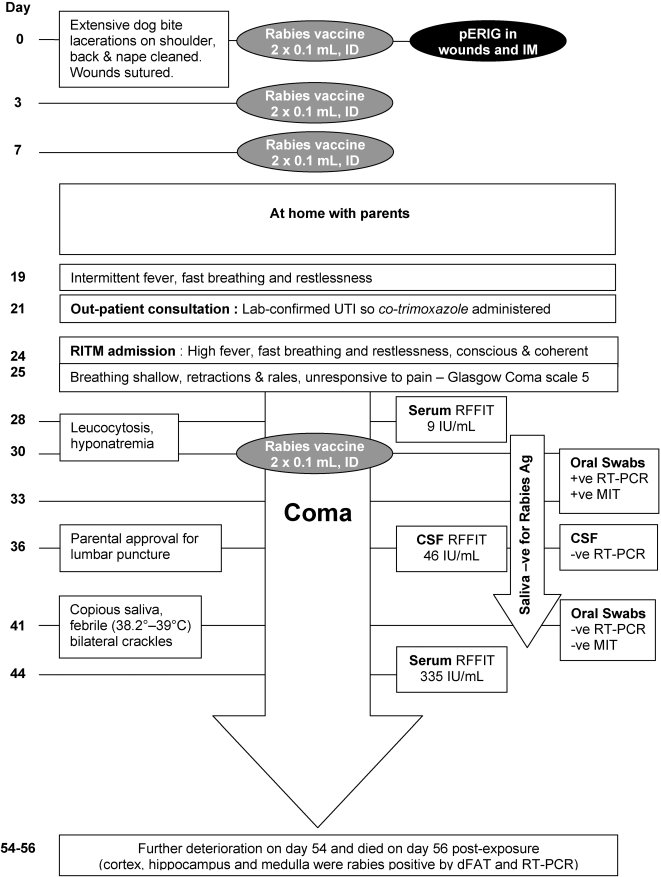
Follow-up data were collected for 6,464 patients. Of 151 patients with laboratory-confirmed rabies exposure, 143 were in good health 6-48 months later, seven could not be contacted, and one 4-year-old girl died. Of 16 deaths in total, 14 were unrelated to rabies exposure or treatment. Two deaths were considered PEP failures: the 4-year old girl, who had multiple deep lacerated wounds from a rabid dog of the nape, neck, and shoulders requiring suturing on the day of exposure, and an 8-year-old boy who only received rabies PEP on the day of exposure.
This extensive review of outcomes in persons with Category III exposure shows the recommended treatment schedule at RITM using pERIG is well tolerated, while survival of 143 laboratory-confirmed rabies exposures confirms the intervention efficacy. Two PEP intervention failures demonstrate that sustained education and training is essential in rabies management.
对于未接种疫苗的重度狂犬病暴露者,推荐的治疗方法包括伤口清洗、狂犬病免疫球蛋白(RIG)的使用以及狂犬病疫苗的接种。我们对菲律宾的狂犬病治疗结果进行了一项调查。
这是一项病例系列研究,涉及 7660 名患者(4 个月至 98 岁),他们于 2003 年 7 月至 2004 年 8 月期间在菲律宾蒙廷卢帕的热带医学研究所(Research Institute for Tropical Medicine)接受了纯化马源狂犬病免疫球蛋白(pERIG)治疗,这些患者的暴露情况属于 II 类或 III 类。记录了 28 天内局部和全身不良反应(AR)以及咬伤人的动物状况的数据;通过电话或家访获得暴露后 6-29 个月的结局数据。
共收集到 6464 名患者的随访数据。在 151 名经实验室证实的狂犬病暴露患者中,143 名在 6-48 个月后身体健康,7 名无法联系,1 名 4 岁女孩死亡。在总共 16 例死亡中,有 14 例与狂犬病暴露或治疗无关。两名死亡被认为是 PEP 失败:一名 4 岁女孩被患有狂犬病的狗从颈背部和肩部多处严重撕裂伤,需要在暴露当天进行缝合,另一名 8 岁男孩仅在暴露当天接受了狂犬病 PEP。
对 III 类暴露者结局的广泛回顾表明,RITM 使用 pERIG 的推荐治疗方案具有良好的耐受性,而 143 例经实验室证实的狂犬病暴露者的存活证明了干预的有效性。两次 PEP 干预失败表明,在狂犬病管理中持续的教育和培训至关重要。