Hanson Kara, Nathan Rose, Marchant Tanya, Mponda Hadji, Jones Caroline, Bruce Jane, Stephen Godlove, Mulligan Jo, Mshinda Hassan, Schellenberg Joanna Armstrong
London School of Hygiene and Tropical Medicine, Keppel Street, London WC1E 7HT, UK.
BMC Public Health. 2008 Jun 10;8:205. doi: 10.1186/1471-2458-8-205.
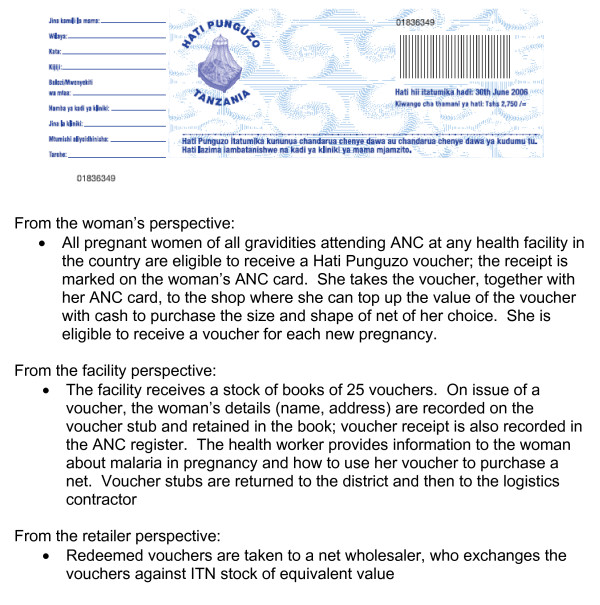
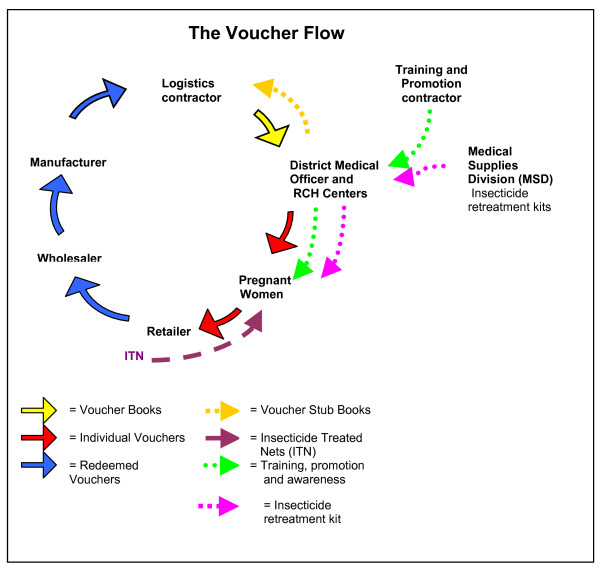
The Tanzania National Voucher Scheme (TNVS) uses the public health system and the commercial sector to deliver subsidised insecticide-treated nets (ITNs) to pregnant women. The system began operation in October 2004 and by May 2006 was operating in all districts in the country. Evaluating complex public health interventions which operate at national level requires a multidisciplinary approach, novel methods, and collaboration with implementers to support the timely translation of findings into programme changes. This paper describes this novel approach to delivering ITNs and the design of the monitoring and evaluation (M&E).
A comprehensive and multidisciplinary M&E design was developed collaboratively between researchers and the National Malaria Control Programme. Five main domains of investigation were identified: (1) ITN coverage among target groups, (2) provision and use of reproductive and child health services, (3) "leakage" of vouchers, (4) the commercial ITN market, and (5) cost and cost-effectiveness of the scheme.
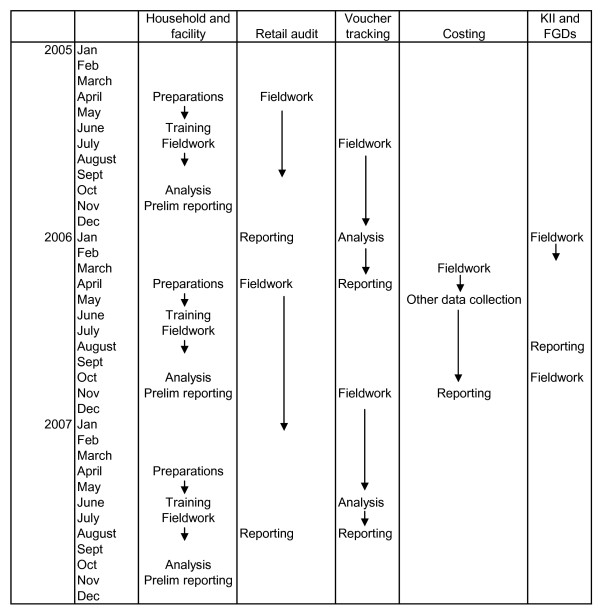
The evaluation plan combined quantitative (household and facility surveys, voucher tracking, retail census and cost analysis) and qualitative (focus groups and in-depth interviews) methods. This plan was defined in collaboration with implementing partners but undertaken independently. Findings were reported regularly to the national malaria control programme and partners, and used to modify the implementation strategy over time.
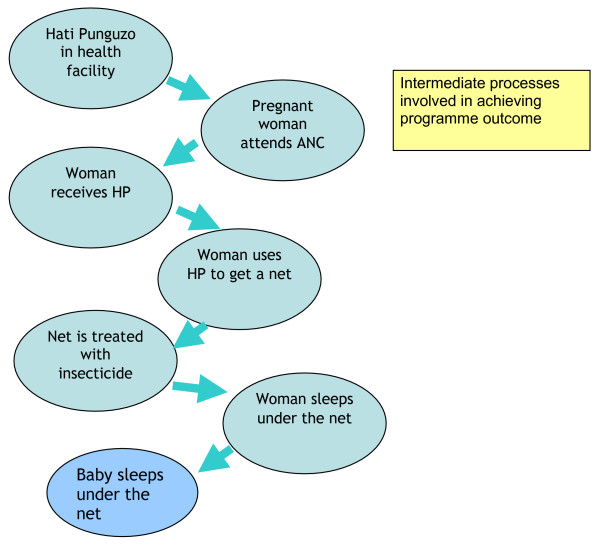
The M&E of the TNVS is a potential model for generating information to guide national and international programmers about options for delivering priority interventions. It is independent, comprehensive, provides timely results, includes information on intermediate processes to allow implementation to be modified, measures leakage as well as coverage, and measures progress over time.
坦桑尼亚国家代金券计划(TNVS)利用公共卫生系统和商业部门为孕妇提供补贴的驱虫蚊帐(ITN)。该系统于2004年10月开始运作,到2006年5月已在该国所有地区开展业务。评估在国家层面开展的复杂公共卫生干预措施需要多学科方法、新颖的手段,并与实施者合作,以支持将研究结果及时转化为项目变更。本文描述了这种提供驱虫蚊帐的新颖方法以及监测与评估(M&E)的设计。
研究人员与国家疟疾控制计划合作制定了一项全面的多学科监测与评估设计。确定了五个主要调查领域:(1)目标群体中的驱虫蚊帐覆盖率;(2)生殖和儿童健康服务的提供与使用;(3)代金券的“流失”;(4)商业驱虫蚊帐市场;(五)该计划的成本和成本效益。
评估计划结合了定量(家庭和机构调查、代金券追踪、零售普查和成本分析)和定性(焦点小组和深入访谈)方法。该计划是与实施伙伴合作确定的,但独立进行。研究结果定期报告给国家疟疾控制计划和伙伴,并用于随着时间推移修改实施战略。
TNVS的监测与评估是一个潜在的模式,可为国家和国际项目人员提供信息,以指导他们选择实施优先干预措施的方案。它独立、全面,能及时提供结果,包括有关中间过程的信息以便修改实施方式,能衡量流失率和覆盖率,并能衡量随时间的进展情况。