Ohuma E O, Okiro E A, Bett A, Abwao J, Were S, Samuel D, Vyse A, Gay N, Brown D W G, Nokes D J
Centre for Geographic Medicine Research - Coast, Kenya Medical Research Institute, Kilifi, Kenya.
Epidemiol Infect. 2009 Feb;137(2):227-33. doi: 10.1017/S0950268808000848. Epub 2008 Jun 10.
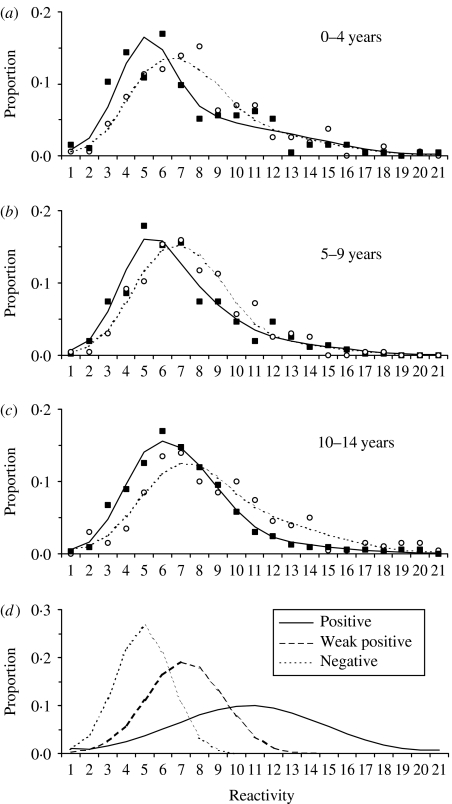
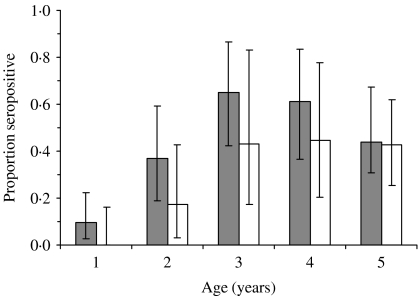
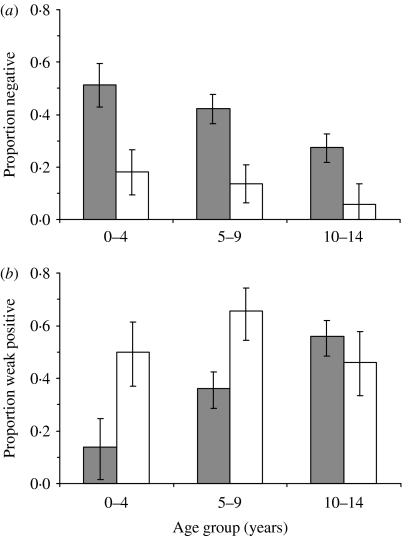
We evaluated the effectiveness of a measles vaccine campaign in rural Kenya, based on oral-fluid surveys and mixture-modelling analysis. Specimens were collected from 886 children aged 9 months to 14 years pre-campaign and from a comparison sample of 598 children aged 6 months post-campaign. Quantitative measles-specific antibody data were obtained by commercial kit. The estimated proportions of measles-specific antibody negative in children aged 0-4, 5-9 and 10-14 years were 51%, 42% and 27%, respectively, pre- campaign and 18%, 14% and 6%, respectively, post-campaign. We estimate a reduction in the proportion susceptible of 65-78%, with approximately 85% of the population recorded to have received vaccine. The proportion of 'weak' positive individuals rose from 35% pre-campaign to 54% post-campaign. Our results confirm the effectiveness of the campaign in reducing susceptibility to measles and demonstrate the potential of oral-fluid studies to monitor the impact of measles vaccination campaigns.
我们基于口服液体调查和混合模型分析,评估了肯尼亚农村地区麻疹疫苗接种运动的效果。在接种运动前,从886名9个月至14岁的儿童中采集样本,在接种运动后6个月,从598名6个月大的儿童组成的对照样本中采集样本。通过商业试剂盒获得定量的麻疹特异性抗体数据。在接种运动前,0至4岁、5至9岁和10至14岁儿童中麻疹特异性抗体阴性的估计比例分别为51%、42%和27%,在接种运动后分别为18%、14%和6%。我们估计易感染比例降低了65%至78%,记录显示约85%的人口接种了疫苗。“弱阳性”个体的比例从接种运动前的35%上升至接种运动后的54%。我们的结果证实了该接种运动在降低麻疹易感性方面的有效性,并证明了口服液体研究在监测麻疹疫苗接种运动影响方面的潜力。