Hsiang C-Y, Ho T-Y
Department of Microbiology, China Medical University, Taichung, Taiwan.
Br J Pharmacol. 2008 Sep;155(2):227-35. doi: 10.1038/bjp.2008.242. Epub 2008 Jun 16.
Most antiviral therapies directed against herpes simplex virus (HSV) infections are limited to a small group of nucleoside analogues that target the viral polymerase. Extensive clinical use of these drugs has led to the emergence of resistant viral strains, mainly in immunocompromised patients. This highlights the need for the development of new anti-herpesviral drugs with novel targets. Herein the effects of a plant anthraquinone, emodin, on the HSV-1 alkaline nuclease activity and virus yields were investigated.
HSV-1 alkaline nuclease activity was examined by nuclease activity assay. Inhibition of virus yields was measured by plaque reduction assay and immunohistochemical staining. Interaction between emodin and alkaline nuclease was analysed by docking technology.
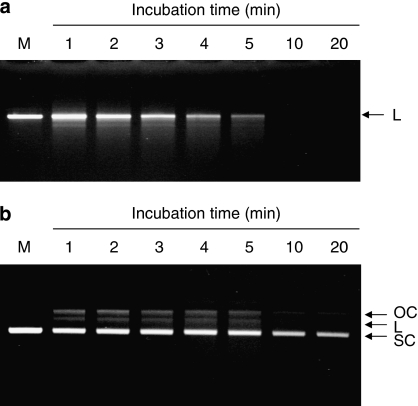
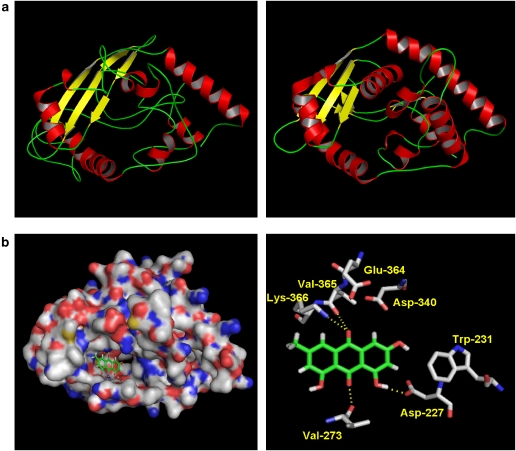
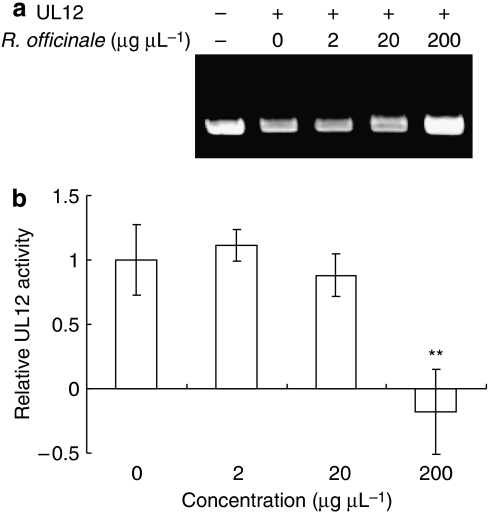
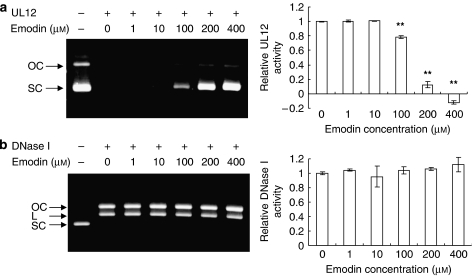
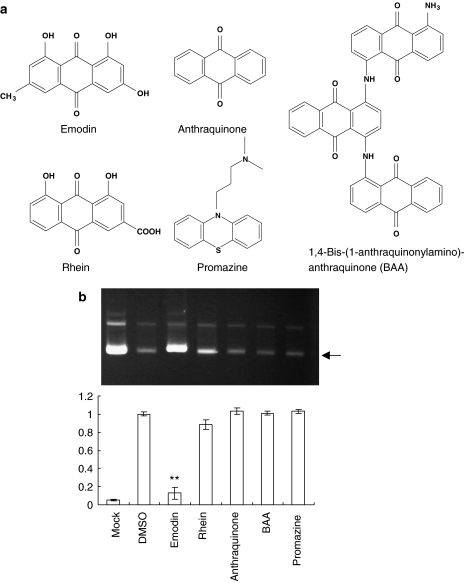
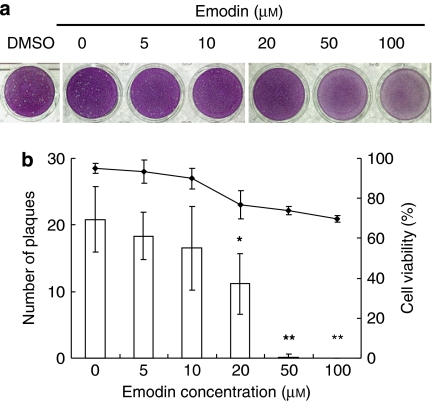
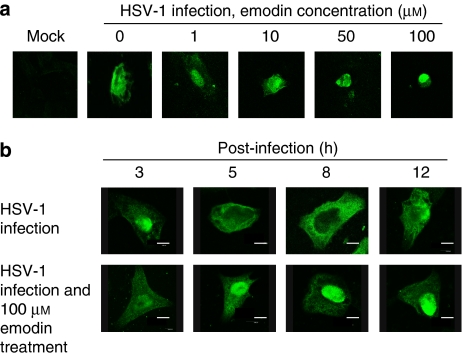
Emodin specifically inhibited the nuclease activity of HSV-1 UL12 alkaline nuclease in a biochemical assay. Plaque reduction assay revealed that emodin reduced the plaque formation with an EC(50) of 21.5+/-4.4 muM. Immunohistochemical staining using the anti-nucleocapsid protein antibody demonstrated that emodin induced the accumulation of viral nucleocapsids in the nucleus in a dose-dependent manner. Docking analysis further suggested that the inhibitory effect of emodin on the UL12 activity may result from the interaction between emodin and critical catalytic amino acid residues of UL12.
Our findings suggest that emodin is a potent anti-HSV agent that inhibits the yields of HSV-1 via the suppression of a novel target, UL12.
大多数针对单纯疱疹病毒(HSV)感染的抗病毒疗法仅限于一小类靶向病毒聚合酶的核苷类似物。这些药物的广泛临床应用导致了耐药病毒株的出现,主要出现在免疫功能低下的患者中。这凸显了开发具有新靶点的新型抗疱疹病毒药物的必要性。在此,研究了一种植物蒽醌大黄素对HSV-1碱性核酸酶活性和病毒产量的影响。
通过核酸酶活性测定法检测HSV-1碱性核酸酶活性。通过蚀斑减少测定法和免疫组织化学染色测量病毒产量的抑制情况。利用对接技术分析大黄素与碱性核酸酶之间的相互作用。
在生化测定中,大黄素特异性抑制HSV-1 UL12碱性核酸酶的核酸酶活性。蚀斑减少测定显示,大黄素减少蚀斑形成,半数有效浓度(EC50)为21.5±4.4 μM。使用抗核衣壳蛋白抗体的免疫组织化学染色表明,大黄素以剂量依赖的方式诱导病毒核衣壳在细胞核中积累。对接分析进一步表明,大黄素对UL12活性的抑制作用可能源于大黄素与UL12关键催化氨基酸残基之间的相互作用。
我们的研究结果表明,大黄素是一种有效的抗HSV药物,通过抑制一个新靶点UL12来抑制HSV-1的产量。