Reischer G H, Haider J M, Sommer R, Stadler H, Keiblinger K M, Hornek R, Zerobin W, Mach R L, Farnleitner A H
Institute of Chemical Engineering, Gene Technology Group, Vienna University of Technology, Getreidemarkt 9/166-5-2, A-1060 Vienna, Austria.
Environ Microbiol. 2008 Oct;10(10):2598-608. doi: 10.1111/j.1462-2920.2008.01682.x. Epub 2008 Jun 28.
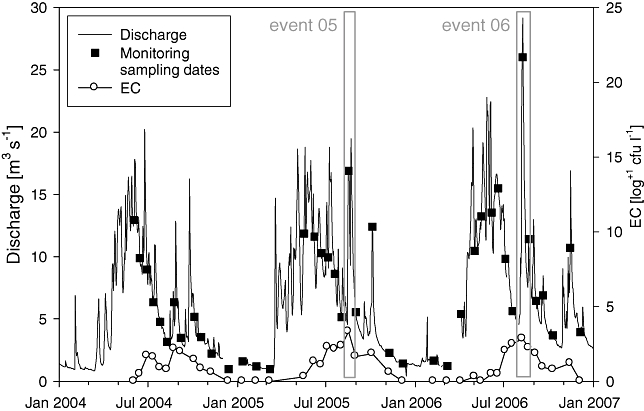
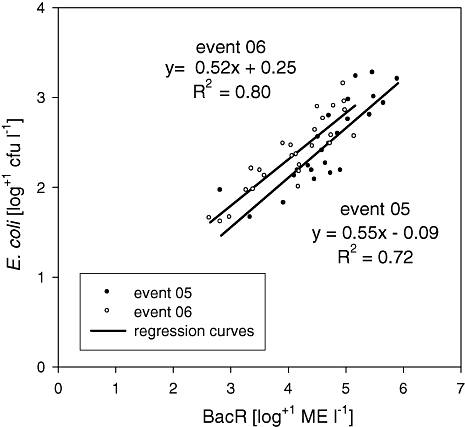
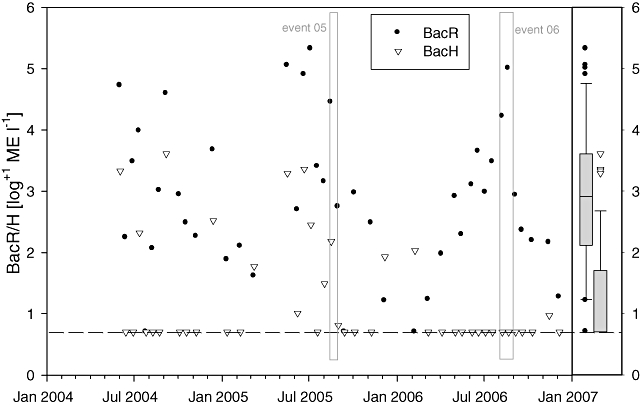
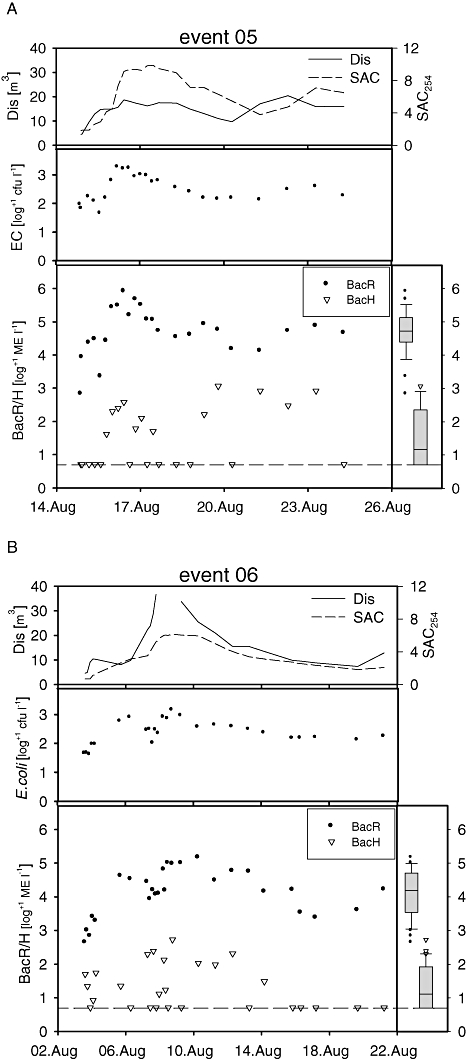
The impairment of water quality by faecal pollution is a global public health concern. Microbial source tracking methods help to identify faecal sources but the few recent quantitative microbial source tracking applications disregarded catchment hydrology and pollution dynamics. This quantitative microbial source tracking study, conducted in a large karstic spring catchment potentially influenced by humans and ruminant animals, was based on a tiered sampling approach: a 31-month water quality monitoring (Monitoring) covering seasonal hydrological dynamics and an investigation of flood events (Events) as periods of the strongest pollution. The detection of a ruminant-specific and a human-specific faecal Bacteroidetes marker by quantitative real-time PCR was complemented by standard microbiological and on-line hydrological parameters. Both quantitative microbial source tracking markers were detected in spring water during Monitoring and Events, with preponderance of the ruminant-specific marker. Applying multiparametric analysis of all data allowed linking the ruminant-specific marker to general faecal pollution indicators, especially during Events. Up to 80% of the variation of faecal indicator levels during Events could be explained by ruminant-specific marker levels proving the dominance of ruminant faecal sources in the catchment. Furthermore, soil was ruled out as a source of quantitative microbial source tracking markers. This study demonstrates the applicability of quantitative microbial source tracking methods and highlights the prerequisite of considering hydrological catchment dynamics in source tracking study design.
粪便污染对水质的损害是一个全球公共卫生问题。微生物源追踪方法有助于识别粪便来源,但最近很少有定量微生物源追踪应用考虑集水区水文和污染动态。这项定量微生物源追踪研究在一个可能受人类和反刍动物影响的大型岩溶泉集水区进行,基于分层采样方法:为期31个月的水质监测(监测)涵盖季节性水文动态,并对洪水事件(事件)进行调查,洪水事件是污染最严重的时期。通过定量实时PCR检测反刍动物特异性和人类特异性粪便拟杆菌标记物,并辅以标准微生物学和在线水文参数。在监测和事件期间,在泉水中检测到了两种定量微生物源追踪标记物,其中反刍动物特异性标记物占优势。对所有数据进行多参数分析,可将反刍动物特异性标记物与一般粪便污染指标联系起来,尤其是在事件期间。事件期间粪便指示物水平高达80%的变化可由反刍动物特异性标记物水平解释,这证明了反刍动物粪便来源在集水区的主导地位。此外,排除了土壤作为定量微生物源追踪标记物的来源。本研究证明了定量微生物源追踪方法的适用性,并强调了在源追踪研究设计中考虑水文集水区动态的必要性。