Hincapie Juan Gabriel, Blana Dimitra, Chadwick Edward K, Kirsch Robert F
Department of Biomedical Engineering, Case Western Reserve University, Cleveland, OH 44106, USA.
IEEE Trans Neural Syst Rehabil Eng. 2008 Jun;16(3):255-63. doi: 10.1109/TNSRE.2008.922681.
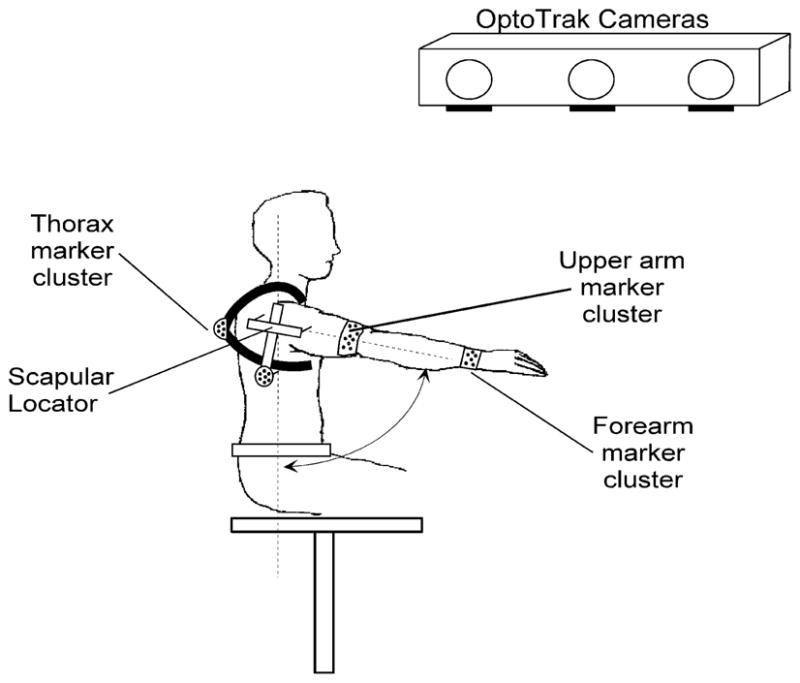
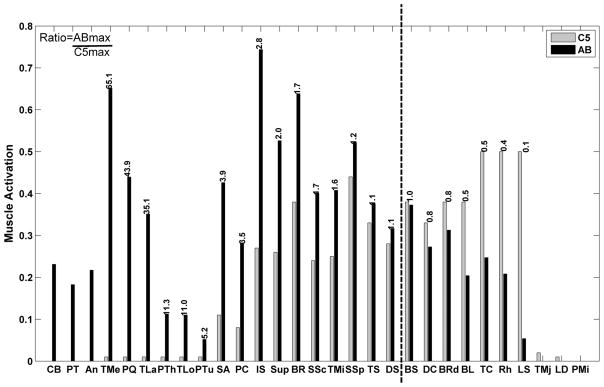
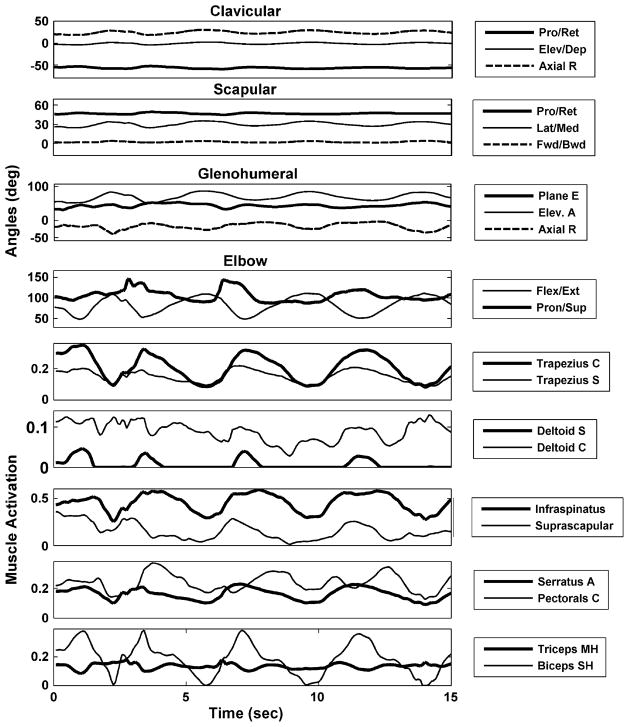
Individuals with C5/C6 spinal cord injury (SCI) have a number of paralyzed muscles in their upper extremities that can be electrically activated in a coordinated manner to restore function. The selection of a practical subset of paralyzed muscles for stimulation depends on the specific condition of the individual, the functions targeted for restoration, and surgical considerations. This paper presents a musculoskeletal model-based approach for optimizing the muscle set used for functional electrical stimulation (FES) of the shoulder and elbow in this population. Experimentally recorded kinematics from able-bodied subjects served as inputs to a musculoskeletal model of the shoulder and elbow, which was modified to reflect the reduced muscle force capacities of an individual with C5 SCI but also the potential of using FES to activate paralyzed muscles. A large number of inverse dynamic simulations mimicking typical activities of daily living were performed that included 1) muscles with retained voluntary control and 2) many different combinations of stimulated paralyzed muscles. These results indicate that a muscle set consisting of the serratus anterior, infraspinatus and triceps would enable the greatest range of relevant movements. This set will become the initial target in a C5SCI neuroprosthesis to restore shoulder and elbow function.
患有C5/C6脊髓损伤(SCI)的个体上肢有许多麻痹肌肉,这些肌肉可以通过电刺激以协调的方式激活,从而恢复功能。选择用于刺激的麻痹肌肉的实际子集取决于个体的具体情况、目标恢复功能以及手术考量。本文提出了一种基于肌肉骨骼模型的方法,用于优化该人群中用于肩部和肘部功能性电刺激(FES)的肌肉组合。从健全受试者实验记录的运动学数据作为肩部和肘部肌肉骨骼模型的输入,该模型经过修改,以反映C5脊髓损伤个体降低的肌肉力量能力,同时也反映了使用FES激活麻痹肌肉的潜力。进行了大量模拟典型日常生活活动的逆动力学模拟,其中包括1)具有保留自主控制能力的肌肉,以及2)许多不同组合的受刺激麻痹肌肉。这些结果表明,由前锯肌、冈下肌和肱三头肌组成的肌肉组合能够实现最大范围的相关运动。该组合将成为C5脊髓损伤神经假体恢复肩部和肘部功能的初始目标。