Barkin Shari L, Finch Stacia A, Ip Edward H, Scheindlin Benjamin, Craig Joseph A, Steffes Jennifer, Weiley Victoria, Slora Eric, Altman David, Wasserman Richard C
Department of Pediatrics, Vanderbilt University Medical Center, Nashville, Tennessee, USA.
Pediatrics. 2008 Jul;122(1):e15-25. doi: 10.1542/peds.2007-2611.
The objective of this study was to determine whether patients' families' violence-prevention behaviors would be affected by their primary care practitioner's use of a violence-prevention clinical intervention during the routine well-child examination.
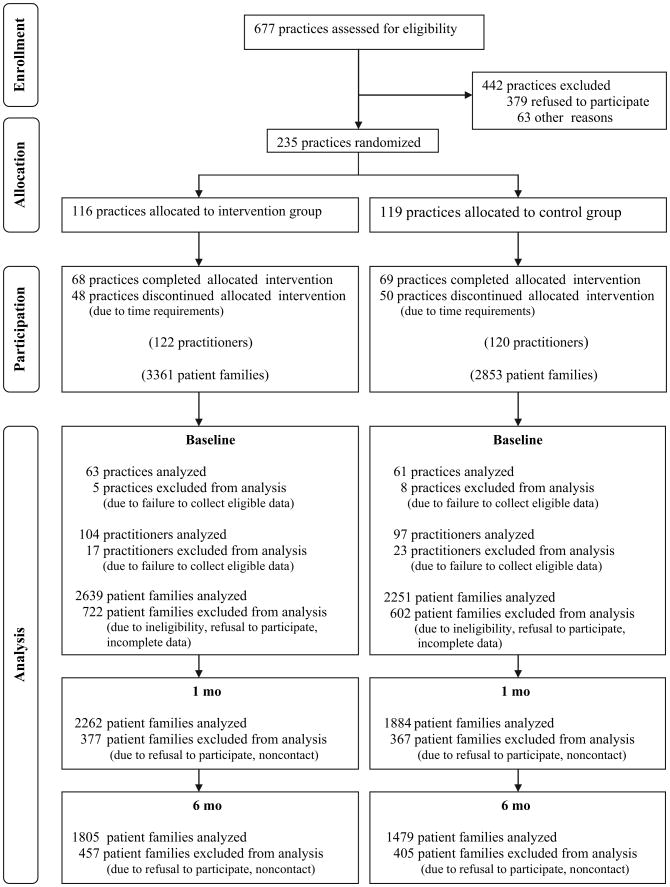
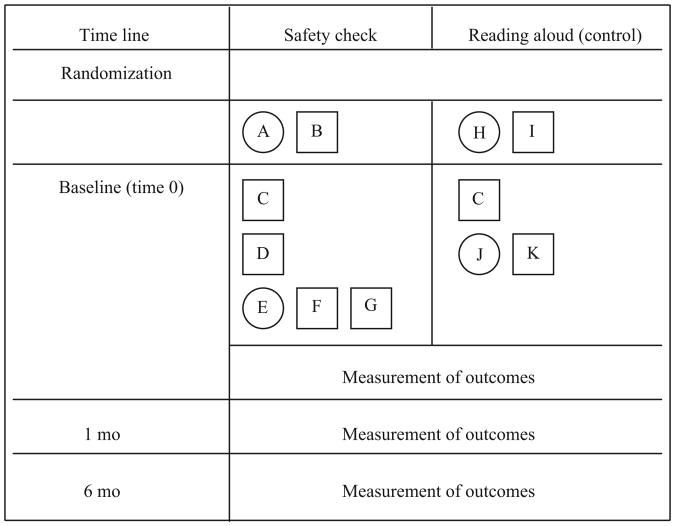
In this cluster-randomized, controlled trial (2002-2006), 137 Pediatric Research in Office Settings practices were randomly assigned and initiated patient recruitment for either an office-based violence-prevention intervention or a control group (educational handout on literacy promotion provided). Primary caregivers of children who were aged 2 to 11 years and presented for a well-child visit were surveyed at baseline and 1 and 6 months. Practitioners were trained to (1) review a parent previsit summary regarding patient-family behavior and parental concern about media use, discipline strategies, and children's exposure to firearms, (2) counsel using brief principles of motivational interviewing, (3) identify and provide local agency resources for anger and behavior management when indicated, and (4) instruct patient-families on use of tangible tools (minute timers to monitor media time/timeouts and firearm cable locks to store firearms more safely where children live or play). Main outcomes were change over time in self-reported media use <120 minutes per day, use of timeouts, and use of firearm cable locks.
Generalized estimating equation analysis revealed a significant effect at 6 months for decreased media use and safer firearm storage. The intervention group compared with the control group showed an increase in limiting media use to <120 minutes per day. There was no significant effect for timeout use. There was a substantial increase in storing firearms with cable locks for the intervention group versus a decrease for the control group.
This randomized, controlled trial demonstrated decreased media exposure and increased safe firearm storage as a result of a brief office-based violence-prevention approach.
本研究的目的是确定在常规儿童健康检查期间,初级保健医生使用预防暴力临床干预措施是否会影响患者家庭的预防暴力行为。
在这项整群随机对照试验(2002 - 2006年)中,137个门诊儿科研究机构被随机分配,并开始为基于办公室的预防暴力干预组或对照组(提供关于促进识字的教育手册)招募患者。对年龄在2至11岁前来进行儿童健康检查的儿童的主要照顾者在基线、1个月和6个月时进行调查。医生接受培训,内容包括:(1)查看关于患者家庭行为以及家长对媒体使用、管教策略和儿童接触枪支情况的访前家长总结;(2)运用动机性访谈的简要原则进行咨询;(3)在需要时识别并提供当地愤怒和行为管理机构资源;(4)指导患者家庭使用实用工具(分钟计时器来监控媒体使用时间/暂停时间,以及枪支电缆锁,以便在儿童生活或玩耍的地方更安全地存放枪支)。主要结局指标是自我报告的每天媒体使用时间<120分钟、暂停时间的使用以及枪支电缆锁的使用随时间的变化。
广义估计方程分析显示,在6个月时,媒体使用减少和枪支更安全存放有显著效果。与对照组相比,干预组将媒体使用限制在每天<120分钟的情况有所增加。暂停时间的使用没有显著效果。干预组使用电缆锁存放枪支的情况大幅增加,而对照组则减少。
这项随机对照试验表明,一种简短的基于办公室的预防暴力方法可减少媒体接触并增加枪支安全存放。