Jhung Michael A, Thompson Angela D, Killgore George E, Zukowski Walter E, Songer Glenn, Warny Michael, Johnson Stuart, Gerding Dale N, McDonald L Clifford, Limbago Brandi M
Centers for Disease Control and Prevention, Atlanta, Georgia, USA.
Emerg Infect Dis. 2008 Jul;14(7):1039-45. doi: 10.3201/eid1407.071641.
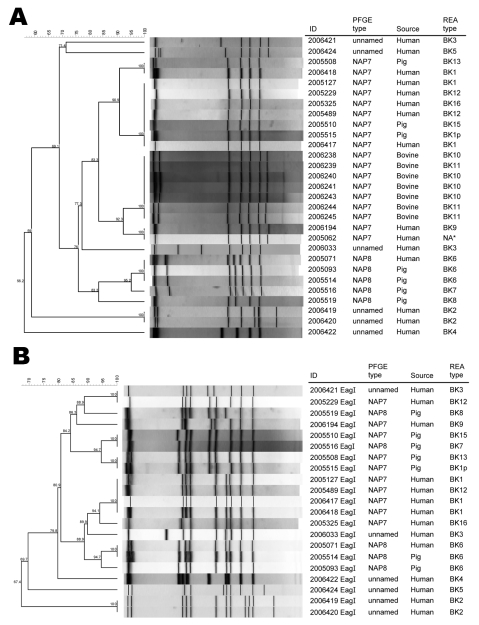
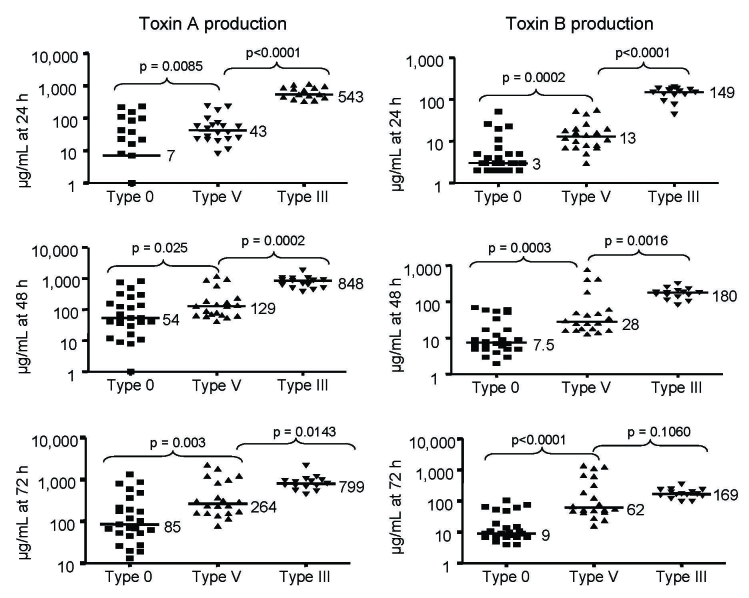
Clostridium difficile is a recognized pathogen in neonatal pigs and may contribute to enteritis in calves. Toxinotype V strains have been rare causes of human C. difficile-associated disease (CDAD). We examined toxinotype V in human disease, the genetic relationship of animal and human toxinotype V strains, and in vitro toxin production of these strains. From 2001 through 2006, 8 (1.3%) of 620 patient isolates were identified as toxinotype V; before 2001, 7 (<0.02%) of approximately 6,000 isolates were identified as toxinotype V. Six (46.2%) of 13 case-patients for whom information was available had community-associated CDAD. Molecular characterization showed a high degree of similarity between human and animal toxinotype V isolates; all contained a 39-bp tcdC deletion and most produced binary toxin. Further study is needed to understand the epidemiology of CDAD caused by toxinotype V C. difficile, including the potential of foodborne transmission to humans.
艰难梭菌是新生仔猪中一种公认的病原体,可能导致犊牛肠炎。毒素型V菌株一直是人类艰难梭菌相关性疾病(CDAD)的罕见病因。我们研究了毒素型V在人类疾病中的情况、动物和人类毒素型V菌株的遗传关系以及这些菌株的体外毒素产生情况。从2001年到2006年,620例患者分离株中有8株(1.3%)被鉴定为毒素型V;在2001年之前,约6000株分离株中有7株(<0.02%)被鉴定为毒素型V。在有信息可查的13例病例患者中,有6例(46.2%)患有社区相关性CDAD。分子特征显示,人类和动物毒素型V分离株之间具有高度相似性;所有分离株都含有一个39bp的tcdC缺失,且大多数产生二元毒素。需要进一步研究以了解由毒素型V艰难梭菌引起的CDAD的流行病学,包括食源性传播给人类的可能性。