Institut für Mikrobiologie und Hygiene, Charité Universitätsmedizin Berlin, Berlin, Germany.
PLoS Negl Trop Dis. 2008 Jul 9;2(7):e261. doi: 10.1371/journal.pntd.0000261.
Leishmania infantum is the causative agent of visceral and cutaneous leishmaniasis in the Mediterranean region, South America, and China. MON-1 L. infantum is the predominating zymodeme in all endemic regions, both in humans and dogs, the reservoir host. In order to answer important epidemiological questions it is essential to discriminate strains of MON-1.
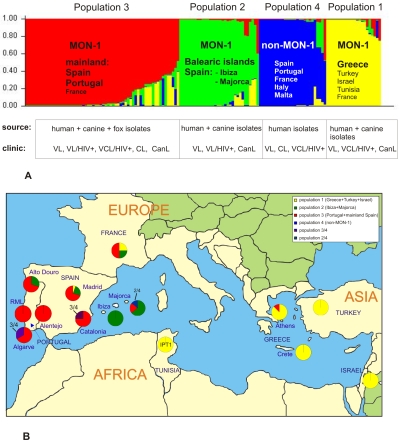
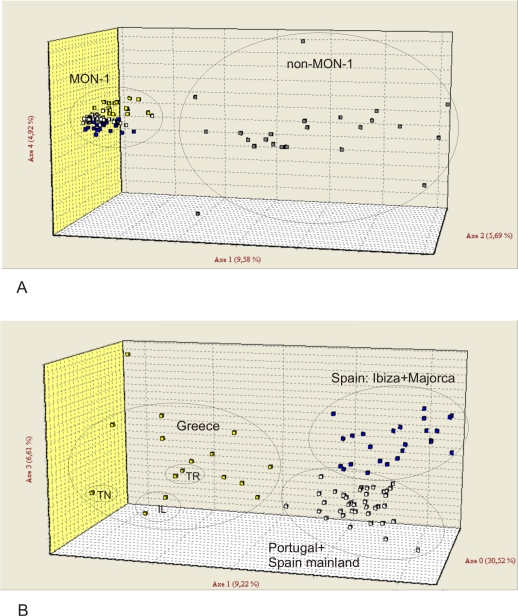
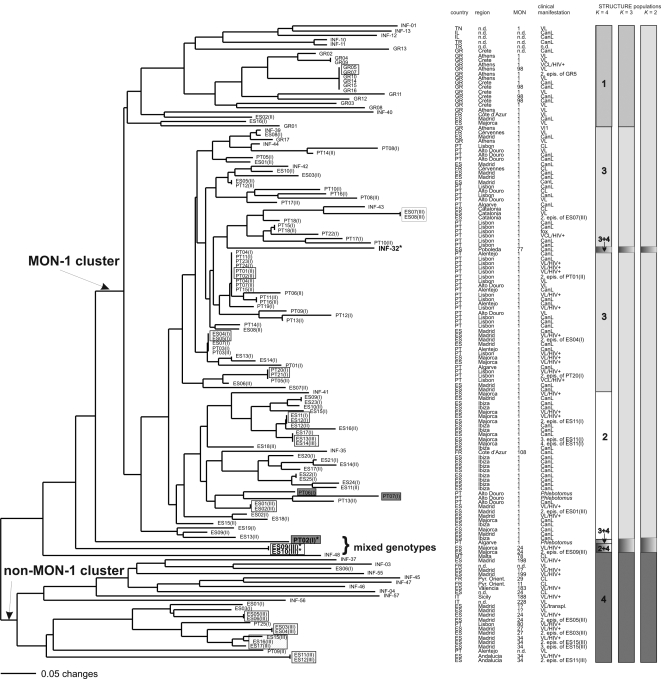
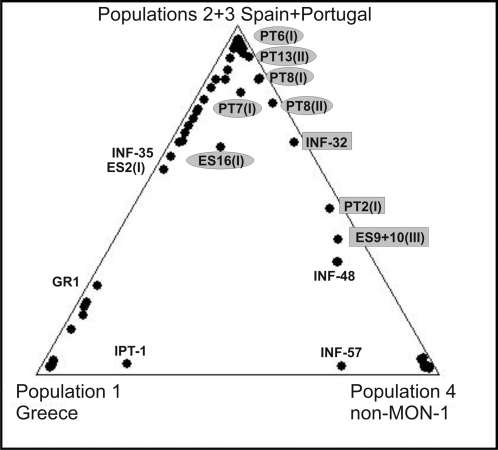
METHODOLOGY/PRINCIPAL FINDINGS: We have used a set of 14 microsatellite markers to analyse 141 strains of L. infantum mainly from Spain, Portugal, and Greece of which 107 strains were typed by MLEE as MON-1. The highly variable microsatellites have the potential to discriminate MON-1 strains from other L. infantum zymodemes and even within MON-1 strains. Model- and distance-based analysis detected a considerable amount of structure within European L. infantum. Two major monophyletic groups-MON-1 and non-MON-1-could be distinguished, with non-MON-1 being more polymorphic. Strains of MON-98, 77, and 108 were always part of the MON-1 group. Among MON-1, three geographically determined and genetically differentiated populations could be identified: (1) Greece; (2) Spain islands-Majorca/Ibiza; (3) mainland Portugal/Spain. All four populations showed a predominantly clonal structure; however, there are indications of occasional recombination events and gene flow even between MON-1 and non-MON-1. Sand fly vectors seem to play an important role in sustaining genetic diversity. No correlation was observed between Leishmania genotypes, host specificity, and clinical manifestation. In the case of relapse/re-infection, only re-infections by a strain with a different MLMT profile can be unequivocally identified, since not all strains have individual MLMT profiles.
In the present study for the first time several key epidemiological questions could be addressed for the MON-1 zymodeme, because of the high discriminatory power of microsatellite markers, thus creating a basis for further epidemiological investigations.
利什曼原虫是地中海地区、南美洲和中国内脏利什曼病和皮肤利什曼病的病原体。在人类和狗等储存宿主中,主要流行型 MON-1 利什曼原虫是所有流行地区的优势虫种。为了回答重要的流行病学问题,必须区分 MON-1 的菌株。
方法/主要发现:我们使用了一套 14 个微卫星标记来分析主要来自西班牙、葡萄牙和希腊的 141 株利什曼原虫,其中 107 株通过 MLEE 分型为 MON-1。高度可变的微卫星具有区分 MON-1 菌株与其他利什曼原虫流行型甚至 MON-1 菌株内菌株的潜力。模型和基于距离的分析检测到欧洲利什曼原虫内部存在相当大的结构。可以区分出两个主要的单系群-MON-1 和非 MON-1-非 MON-1 更为多态。MON-98、77 和 108 株菌总是属于 MON-1 组。在 MON-1 中,可以识别出三个具有地理决定和遗传分化的种群:(1)希腊;(2)西班牙岛屿-马略卡岛/伊比萨岛;(3)葡萄牙/西班牙本土。所有四个种群均表现出主要的克隆结构;然而,存在偶尔重组事件和基因流的迹象,甚至在 MON-1 和非 MON-1 之间。沙蝇媒介似乎在维持遗传多样性方面发挥了重要作用。利什曼原虫基因型、宿主特异性和临床表现之间没有观察到相关性。在复发/再感染的情况下,只有通过具有不同 MLMT 谱的菌株的再感染才能明确识别,因为并非所有菌株都具有个体 MLMT 谱。
在本研究中,由于微卫星标记具有高度的区分能力,首次可以解决 MON-1 流行型的几个关键流行病学问题,为进一步的流行病学研究奠定了基础。