Gorlyn Marianne, Keilp John G, Grunebaum Michael F, Taylor Bonnie P, Oquendo Maria A, Bruder Gerard E, Stewart Jonathan W, Zalsman Gil, Mann J John
Department of Neuroscience, New York State Psychiatric Institute, New York, NY, USA.
J Neural Transm (Vienna). 2008 Aug;115(8):1213-9. doi: 10.1007/s00702-008-0084-x. Epub 2008 Jul 16.
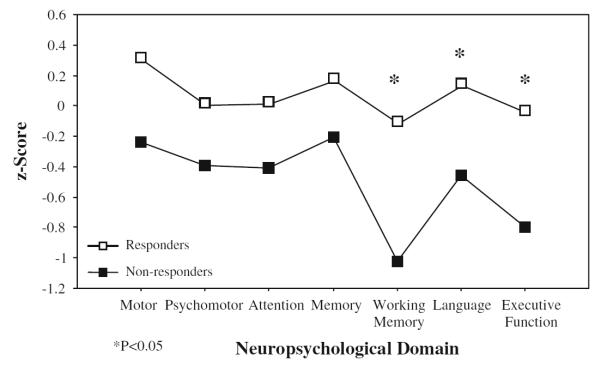
Studies suggest that neuropsychological measures may provide prognostic information regarding SSRI treatment response, yet it is unclear which specific cognitive domains are the most effectual predictors. The aim of this study was to characterize the cognitive profile associated with SSRI nonresponse using a comprehensive set of neuropsychological tests. Participants (N = 32) met criteria for current major depressive episode. Assessment followed pre-treatment medication washout. Clinical response was measured after 3-month open-label SSRI treatment. Groups did not differ by demographic characteristics, intelligence or depression severity. Responders outperformed nonresponders across all cognitive domains, with the largest differences observed in executive, language and working memory functions. Results indicate poorer global cognitive functioning is predictive of treatment nonresponse. Deficits were most pronounced in tests demanding greater mental search and manipulation rather than speeded motor output. Cognitive slowing may mediate the working memory and executive function deficits found in nonresponders. These findings can inform exploration for pharmacogenetic endophenotypes.
研究表明,神经心理学测量可能为选择性5-羟色胺再摄取抑制剂(SSRI)治疗反应提供预后信息,但尚不清楚哪些特定认知领域是最有效的预测指标。本研究的目的是使用一套全面的神经心理学测试来描述与SSRI无反应相关的认知概况。参与者(N = 32)符合当前重度抑郁发作的标准。评估在治疗前药物洗脱后进行。在3个月的开放标签SSRI治疗后测量临床反应。两组在人口统计学特征、智力或抑郁严重程度方面无差异。在所有认知领域,反应者的表现均优于无反应者,在执行、语言和工作记忆功能方面观察到的差异最大。结果表明,较差的整体认知功能可预测治疗无反应。在要求更多心理搜索和操作而非快速运动输出的测试中,缺陷最为明显。认知减慢可能介导了无反应者中发现的工作记忆和执行功能缺陷。这些发现可为药物遗传学内表型的探索提供参考。