Mishra V, Barrere B, Hong R, Khan S
Demographic and Health Research Division, Macro International Inc, 11785 Beltsville Drive, Calverton, Maryland 20705, USA.
Sex Transm Infect. 2008 Aug;84 Suppl 1(Suppl_1):i63-i70. doi: 10.1136/sti.2008.030411.
To evaluate HIV seroprevalence estimates from demographic and health surveys (DHS) and AIDS indicator surveys (AIS) for potential bias because of non-response and exclusion of non-household population groups.
Data are from 14 DHS/AIS surveys with HIV testing, conducted during 2003-6. Blood samples were collected and analysed for HIV using standard laboratory and quality control procedures. HIV prevalence among non-tested adults was predicted based on multivariate statistical models of HIV for those who were interviewed and tested, using a common set of predictor variables. Estimates of the size of non-household populations in national censuses were used to assess potential bias because of their exclusion in the household surveys under different assumptions about proportion of adults and HIV prevalence in non-household populations.
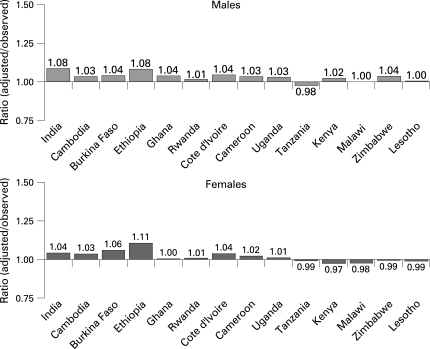
Non-tested men had significantly higher predicted HIV prevalence than those tested in eight of the 14 countries, while non-tested women had significantly higher predicted prevalence than those tested in seven of the 14 countries. Effects of non-response were somewhat stronger in lower-prevalence countries. The overall effect of non-response on observed national HIV estimates was small and insignificant in all countries. Estimated effects of exclusion of non-household population groups were generally small, even in concentrated epidemics in India and Cambodia under the scenario that 75% of the non-household population was adults having 20 times greater HIV prevalence than adults in household surveys.
Non-response and the exclusion of non-household population groups tend to have small, insignificant effects on national HIV seroprevalence estimates obtained from household surveys.
评估人口与健康调查(DHS)和艾滋病指标调查(AIS)中HIV血清流行率估计值是否因无应答以及非住户人群被排除在外而存在潜在偏差。
数据来自2003年至2006年期间进行的14项包含HIV检测的DHS/AIS调查。采集血样并使用标准实验室和质量控制程序进行HIV分析。基于对接受访谈和检测者的HIV多变量统计模型,使用一组共同的预测变量预测未检测成年人中的HIV流行率。利用全国人口普查中非住户人口规模的估计值,在关于非住户人口中成年人比例和HIV流行率的不同假设下,评估因住户调查中排除这些人群而产生的潜在偏差。
在14个国家中的8个国家,未检测男性的预测HIV流行率显著高于检测者,而在14个国家中的7个国家,未检测女性的预测流行率显著高于检测者。在低流行率国家,无应答的影响稍强。在所有国家,无应答对观察到的全国HIV估计值的总体影响较小且不显著。即使在印度和柬埔寨的集中流行情况下,假设75%的非住户人口为成年人且其HIV流行率是住户调查中成年人的20倍,排除非住户人群的估计影响通常也较小。
无应答以及排除非住户人群对通过住户调查获得的全国HIV血清流行率估计值往往产生较小且不显著的影响。