Marston M, Harriss K, Slaymaker E
Centre for Population Studies, London School of Hygiene and Tropical Medicine, London WC1B 3DP, UK.
Sex Transm Infect. 2008 Aug;84 Suppl 1(Suppl_1):i71-i77. doi: 10.1136/sti.2008.030353.
To measure the bias in national estimates of HIV prevalence in population-based surveys caused by mobility and refusal to test.
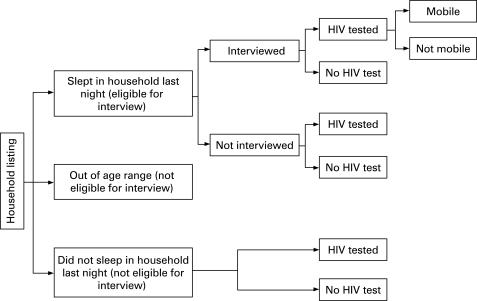
Data from nine demographic and health surveys and AIDS indicator surveys were used. Non-responders were divided into three groups: (i) "refusals" who were interviewed but not tested; (ii) "refusals" who were present in the household but not interviewed or tested; and (iii) "absentees" who were absent from the household. Correction for HIV status was made for the non-responders using multiple imputation methods with logistic regression models based on a common set of household-level and individual-level sociodemographic and behavioural factors for those tested and stratified by mobility status.
The non-response groups were corrected to have higher risks of HIV than those who participated in the HIV tests, although these were only detected to be statistically significant in some of the countries. In Lesotho, the corrected prevalence for the absent household members was significantly higher than for those who were present in the household. However, the adjusted prevalences differed by less than a percentage point from the prevalences observed among those who were tested, so the overall effects of non-response on national estimates of HIV prevalence are minimal.
The results indicate that the mobility of absentees does not substantially bias estimates of HIV prevalence from population-based surveys. None the less, if levels of non-response are high or if non-responders differ greatly from those who participate in HIV testing with respect to HIV status, non-response could still bias national estimates of HIV prevalence.
测量在基于人群的调查中,由流动性和拒绝检测导致的全国艾滋病毒流行率估计值的偏差。
使用了来自九次人口与健康调查以及艾滋病指标调查的数据。未应答者被分为三组:(i)“拒绝者”,即接受了访谈但未接受检测的人;(ii)“拒绝者”,即居住在家庭中但未接受访谈或检测的人;(iii)“缺席者”,即不在家庭中的人。对于未应答者,采用多重填补方法和逻辑回归模型,根据一组共同的家庭层面和个人层面的社会人口学及行为因素对接受检测者进行艾滋病毒状况校正,并按流动性状况进行分层。
校正后的未应答组感染艾滋病毒的风险高于参与艾滋病毒检测的人群,尽管仅在部分国家发现这些差异具有统计学意义。在莱索托,校正后的缺席家庭成员的流行率显著高于居住在家庭中的成员。然而,调整后的流行率与接受检测者中观察到的流行率相差不到一个百分点,因此未应答对全国艾滋病毒流行率估计值的总体影响极小。
结果表明,缺席者的流动性不会对基于人群的调查中艾滋病毒流行率的估计值产生实质性偏差。尽管如此,如果未应答水平较高,或者未应答者在艾滋病毒状况方面与参与艾滋病毒检测者有很大差异,未应答仍可能使全国艾滋病毒流行率估计值产生偏差。