Li Jiong-Tang, Zhang Yong, Kong Lei, Liu Qing-Rong, Wei Liping
Center for Bioinformatics, National Laboratory of Protein Engineering and Plant Genetic Engineering, College of Life Sciences, Peking University, Beijing, 100871, PR China.
Nucleic Acids Res. 2008 Sep;36(15):4833-44. doi: 10.1093/nar/gkn470. Epub 2008 Jul 24.
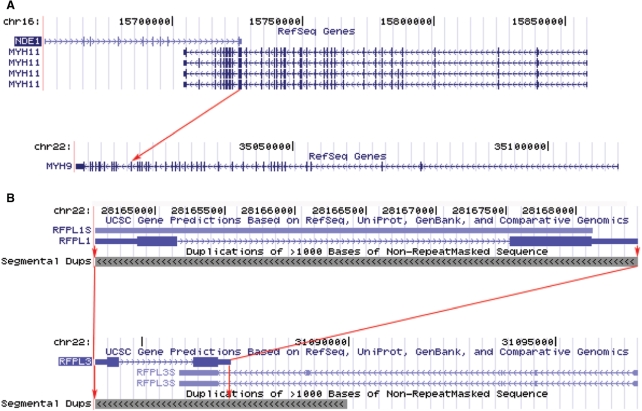
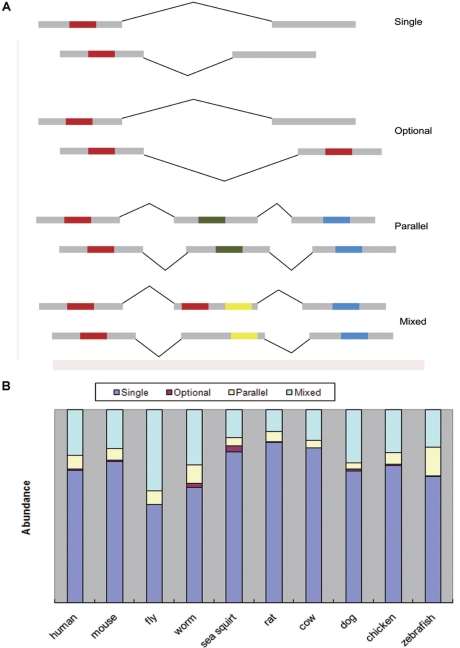
Natural antisense transcripts are at least partially complementary to their sense transcripts. Cis-Sense/Antisense pairs (cis-SAs) have been extensively characterized and known to play diverse regulatory roles, whereas trans-Sense/Antisense pairs (trans-SAs) in animals are poorly studied. We identified long trans-SAs in human and nine other animals, using ESTs to increase coverage significantly over previous studies. The percentage of transcriptional units (TUs) involved in trans-SAs among all TUs was as high as 4.13%. Particularly 2896 human TUs (or 2.89% of all human TUs) were involved in 3327 trans-SAs. Sequence complementarities over multiple segments with predicted RNA hybridization indicated that some trans-SAs might have sophisticated RNA-RNA pairing patterns. One-fourth of human trans-SAs involved noncoding TUs, suggesting that many noncoding RNAs may function by a trans-acting antisense mechanism. TUs in trans-SAs were statistically significantly enriched in nucleic acid binding, ion/protein binding and transport and signal transduction functions and pathways; a significant number of human trans-SAs showed concordant or reciprocal expression pattern; a significant number of human trans-SAs were conserved in mouse. This evidence suggests important regulatory functions of trans-SAs. In 30 cases, trans-SAs were related to cis-SAs through paralogues, suggesting a possible mechanism for the origin of trans-SAs. All trans-SAs are available at http://trans.cbi.pku.edu.cn/.
天然反义转录本与其正义转录本至少部分互补。顺式正义/反义对(cis-SAs)已得到广泛研究,并已知发挥多种调控作用,而动物中的反式正义/反义对(trans-SAs)研究较少。我们利用ESTs在人类和其他九种动物中鉴定出长链反式SAs,与之前的研究相比,ESTs显著提高了覆盖范围。在所有转录单元(TUs)中,涉及反式SAs的转录单元百分比高达4.13%。特别是2896个人类TUs(占所有人TUs的2.89%)参与了3327个反式SAs。多个片段上的序列互补性以及预测的RNA杂交表明,一些反式SAs可能具有复杂的RNA-RNA配对模式。四分之一的人类反式SAs涉及非编码TUs,这表明许多非编码RNA可能通过反式作用反义机制发挥功能。反式SAs中的TUs在核酸结合、离子/蛋白质结合与转运以及信号转导功能和途径方面在统计学上显著富集;大量人类反式SAs表现出一致或相反的表达模式;大量人类反式SAs在小鼠中保守。这些证据表明反式SAs具有重要的调控功能。在30个案例中,反式SAs通过旁系同源物与顺式SAs相关,这提示了反式SAs起源的一种可能机制。所有反式SAs可在http://trans.cbi.pku.edu.cn/获取。