Loeffler Markus, Le'Negrate Gaelle, Krajewska Maryla, Reed John C
Burnham Institute for Medical Research, 10901 North Torrey Pines Rd, La Jolla, CA 92037, USA.
J Natl Cancer Inst. 2008 Aug 6;100(15):1113-6. doi: 10.1093/jnci/djn205. Epub 2008 Jul 29.
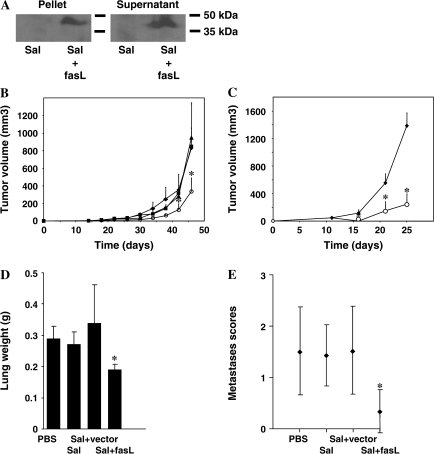
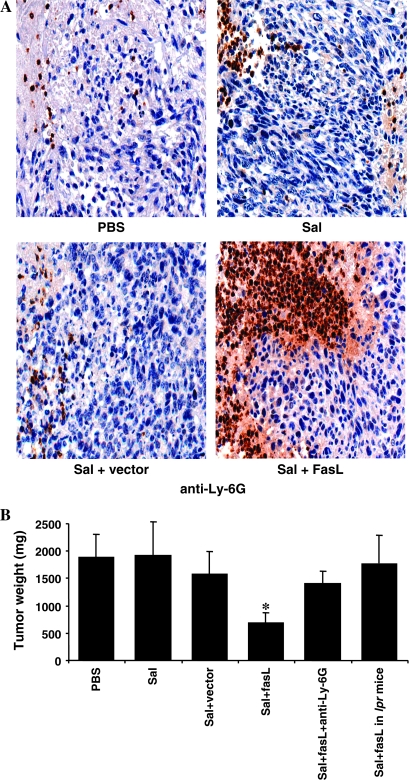
Intravenous administration of bacteria leads to their accumulation in tumors and to sporadic tumor regression. We therefore explored the hypothesis that Salmonella typhimurium engineered to express the proapoptotic cytokine Fas ligand (FasL) would exhibit enhanced antitumor activity. Immunocompetent mice carrying tumors derived from syngeneic murine D2F2 breast carcinoma or CT-26 colon carcinoma cells were treated intravenously with FasL-expressing S. typhimurium or with phosphate-buffered saline (PBS; control). Treatment with FasL-expressing S. typhimurium inhibited growth of primary tumors by an average of 59% for D2F2 tumors and 82% for CT-26 tumors (eg, at 25 days after initial treatment, mean volume of PBS-treated CT-26 colon carcinomas = 1385 mm(3) and of S. typhimurium FasL-treated CT-26 tumors = 243 mm(3), difference = 1142 mm(3), 95% confidence interval = 800 mm(3) to 1484 mm(3), P < .001). Pulmonary D2F2 metastases (as measured by lung weight) were reduced by 34% in S. typhimurium FasL-treated mice compared with PBS-treated mice. FasL-expressing S. typhimurium had similar effects on growth of murine B16 melanoma tumors in wild-type mice but not in lpr/lpr mice, which lack Fas, or in mice with disrupted host inflammatory responses. Antitumor activity was achieved without overt toxicity. These preclinical results raise the possibility that using attenuated S. typhimurium to deliver FasL to tumors may be an effective and well-tolerated therapeutic strategy for some cancers.
静脉注射细菌会导致它们在肿瘤中积聚,并引发散发性肿瘤消退。因此,我们探讨了一种假说,即经过基因工程改造以表达促凋亡细胞因子Fas配体(FasL)的鼠伤寒沙门氏菌会表现出增强的抗肿瘤活性。用表达FasL的鼠伤寒沙门氏菌或磷酸盐缓冲盐水(PBS;对照)对携带源自同基因小鼠D2F2乳腺癌或CT-26结肠癌细胞的肿瘤的免疫活性小鼠进行静脉治疗。用表达FasL的鼠伤寒沙门氏菌治疗可抑制原发性肿瘤的生长,对于D2F2肿瘤平均抑制59%,对于CT-26肿瘤平均抑制82%(例如,在初始治疗后25天,PBS处理的CT-26结肠癌平均体积 = 1385 mm³,鼠伤寒沙门氏菌FasL处理的CT-26肿瘤平均体积 = 243 mm³,差异 = 1142 mm³,95%置信区间 = 800 mm³至1484 mm³,P <.001)。与PBS处理的小鼠相比,鼠伤寒沙门氏菌FasL处理的小鼠肺D2F2转移瘤(以肺重量衡量)减少了34%。表达FasL的鼠伤寒沙门氏菌对野生型小鼠体内的鼠B16黑色素瘤肿瘤生长有类似影响,但对缺乏Fas的lpr/lpr小鼠或宿主炎症反应被破坏的小鼠没有影响。在没有明显毒性的情况下实现了抗肿瘤活性。这些临床前结果增加了一种可能性,即使用减毒鼠伤寒沙门氏菌将FasL递送至肿瘤可能是某些癌症的一种有效且耐受性良好的治疗策略。