Panbianco Costanza, Weinkove David, Zanin Esther, Jones David, Divecha Nullin, Gotta Monica, Ahringer Julie
The Gurdon Institute and Department of Genetics, University of Cambridge, Tennis Court Road, Cambridge CB21QN, UK.
Dev Cell. 2008 Aug;15(2):198-208. doi: 10.1016/j.devcel.2008.06.002.
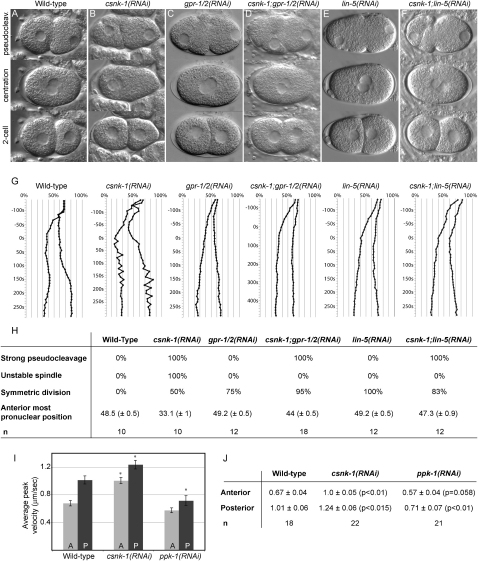
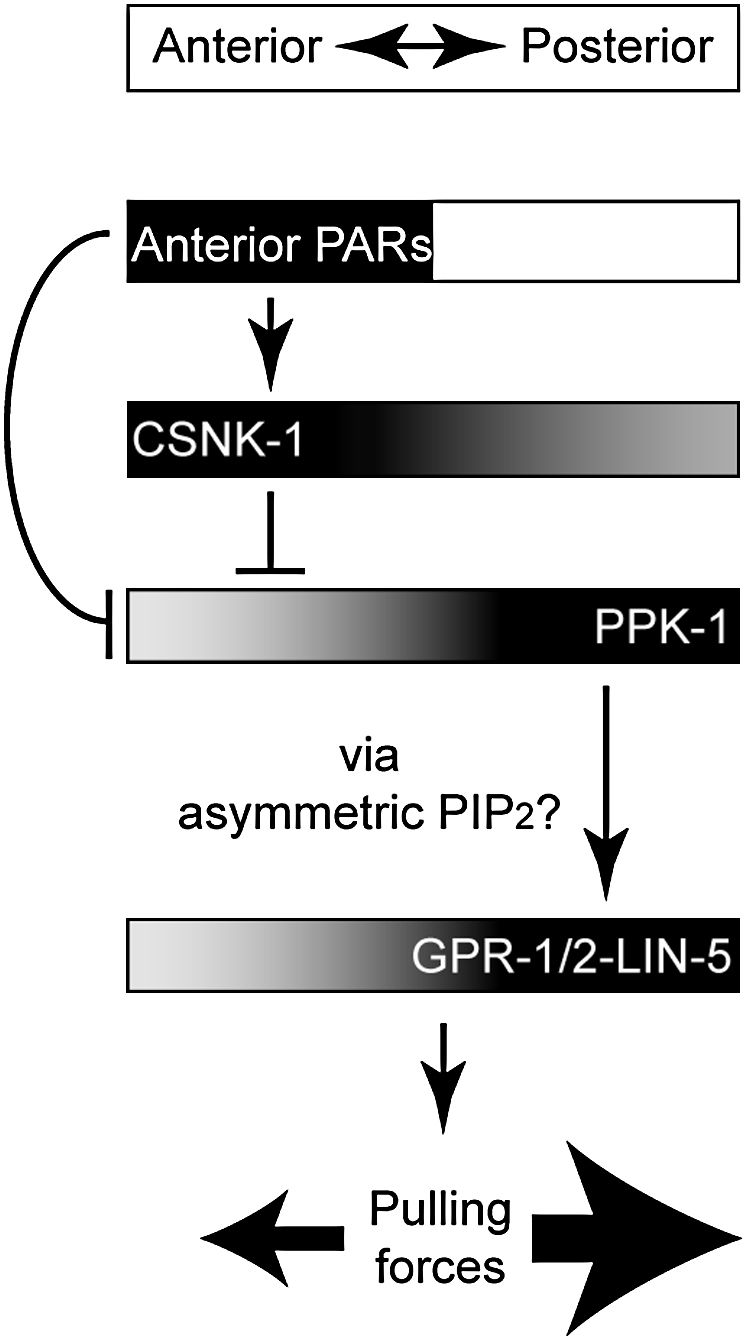
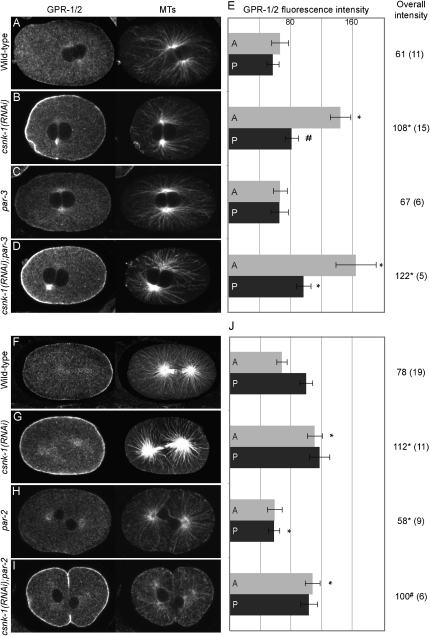
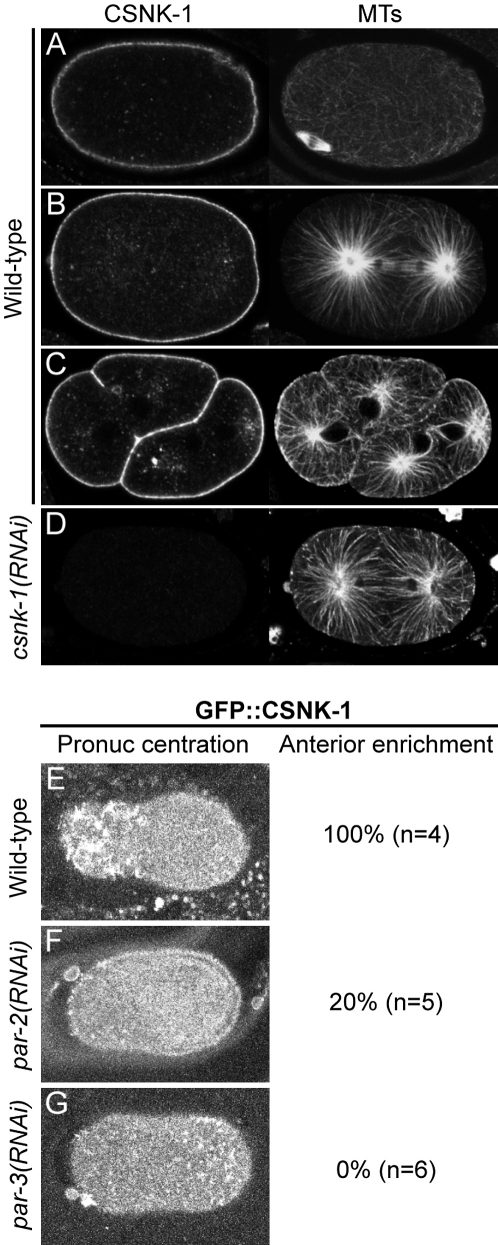
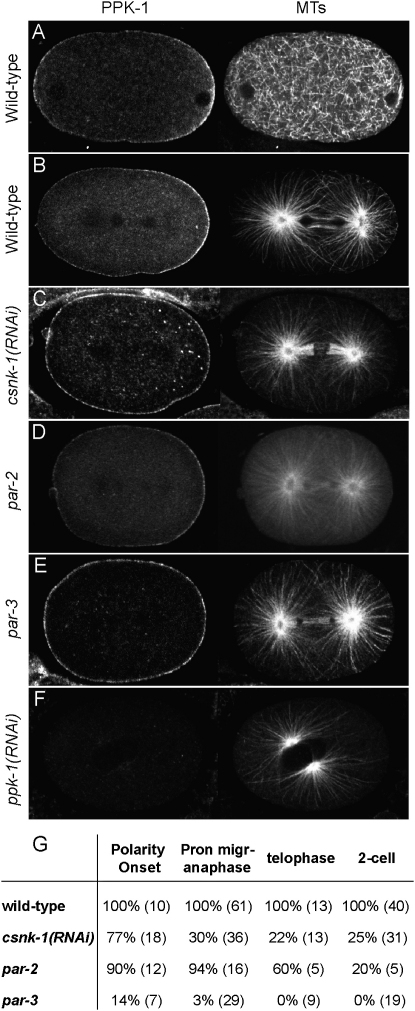
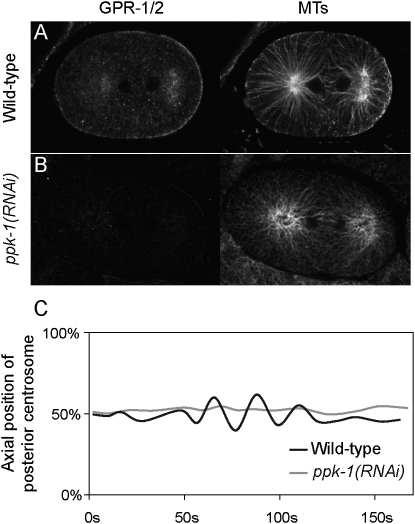
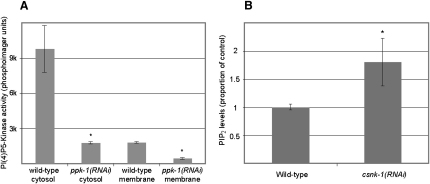
Spindle positioning is an essential feature of asymmetric cell division. The conserved PAR proteins together with heterotrimeric G proteins control spindle positioning in animal cells, but how these are linked is not known. In C. elegans, PAR protein activity leads to asymmetric spindle placement through cortical asymmetry of Galpha regulators GPR-1/2. Here, we establish that the casein kinase 1 gamma CSNK-1 and a PIP(2) synthesis enzyme (PPK-1) transduce PAR polarity to asymmetric Galpha regulation. PPK-1 is posteriorly enriched in the one-celled embryo through PAR and CSNK-1 activities. Loss of CSNK-1 causes uniformly high PPK-1 levels, high symmetric cortical levels of GPR-1/2 and LIN-5, and increased spindle pulling forces. In contrast, knockdown of ppk-1 leads to low GPR-1/2 levels and decreased spindle forces. Furthermore, loss of CSNK-1 leads to increased levels of PIP(2). We propose that asymmetric generation of PIP(2) by PPK-1 directs the posterior enrichment of GPR-1/2 and LIN-5, leading to posterior spindle displacement.
纺锤体定位是不对称细胞分裂的一个基本特征。保守的PAR蛋白与异源三聚体G蛋白共同控制动物细胞中的纺锤体定位,但它们之间是如何联系的尚不清楚。在秀丽隐杆线虫中,PAR蛋白活性通过Gα调节因子GPR-1/2的皮质不对称性导致纺锤体不对称放置。在这里,我们确定酪蛋白激酶1γ CSNK-1和一种磷脂酰肌醇-4,5-二磷酸(PIP(2))合成酶(PPK-1)将PAR极性转导为不对称的Gα调节。PPK-1通过PAR和CSNK-1的活性在单细胞胚胎中后富集。CSNK-1的缺失导致PPK-1水平均匀升高、GPR-1/2和LIN-5的对称皮质水平升高以及纺锤体拉力增加。相反,敲低ppk-1会导致GPR-1/2水平降低和纺锤体力量下降。此外,CSNK-1的缺失导致PIP(2)水平升高。我们提出,PPK-1不对称生成PIP(2)指导GPR-1/2和LIN-5的后富集,导致纺锤体向后移位。