Zuccato Ettore, Chiabrando Chiara, Castiglioni Sara, Bagnati Renzo, Fanelli Roberto
Department of Environmental Health Sciences, Istituto di Ricerche Farmacologiche Mario Negri, Milano, Italy.
Environ Health Perspect. 2008 Aug;116(8):1027-32. doi: 10.1289/ehp.11022.
The social and medical problems of drug abuse are a matter of increasing global concern. To tackle drug abuse in changing scenarios, international drug agencies need fresh methods to monitor trends and patterns of illicit drug consumption.
We tested a sewage epidemiology approach, using levels of excreted drug residues in wastewater, to monitor collective use of the major drugs of abuse in near real time.
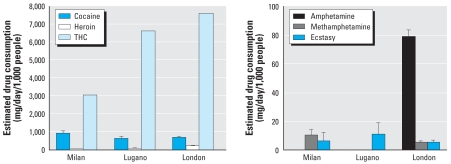
Selected drug target residues derived from use of cocaine, opiates, cannabis, and amphetamines were measured by mass spectrometry in wastewater collected at major sewage treatment plants in Milan (Italy), Lugano (Switzerland), and London (United Kingdom). The amounts of drug residues conveyed to the treatment plants, reflecting the amounts collectively excreted with urine, were used to estimate consumption of the active parent drugs.
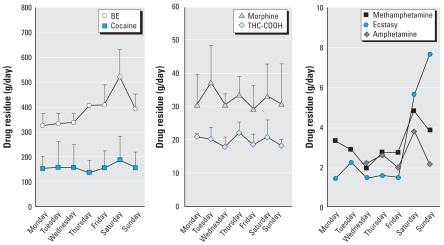
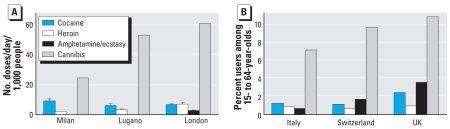
Reproducible and characteristic profiles of illicit drug use were obtained in the three cities, thus for the first time quickly revealing changes in local consumption (e.g., cocaine consumption rose significantly on weekends in Milan). Profiles of local drug consumption based on waste-water measurements are in line with national annual prevalence estimates.
Patterns and trends of drug abuse in local communities can be promptly monitored by this tool, a convenient new complement to more complex, lengthy survey methods. In principle, searching the sewage for excreted compounds relevant to public health issues appears to have the potential to become a convenient source of real-time epidemiologic information.
药物滥用所带来的社会和医学问题日益引起全球关注。为应对不断变化的形势下的药物滥用问题,国际药物机构需要新的方法来监测非法药物消费的趋势和模式。
我们测试了一种污水流行病学方法,利用废水中排泄的药物残留水平,近乎实时地监测主要滥用药物的集体使用情况。
通过质谱法测定了从意大利米兰、瑞士卢加诺和英国伦敦的主要污水处理厂采集的废水中源自可卡因、阿片类药物、大麻和苯丙胺使用的选定药物目标残留。输送到处理厂的药物残留量反映了随尿液集体排泄的量,用于估计活性母体药物的消费量。
在这三个城市获得了可重复且具有特征性的非法药物使用概况,从而首次快速揭示了当地消费的变化(例如,米兰周末可卡因消费量显著上升)。基于废水测量的当地药物消费概况与国家年度流行率估计相符。
通过该工具可以迅速监测当地社区药物滥用的模式和趋势,这是对更复杂、耗时的调查方法的一种便捷新补充。原则上,在污水中寻找与公共卫生问题相关的排泄化合物似乎有可能成为实时流行病学信息的便捷来源。