Pessiglione Mathias, Petrovic Predrag, Daunizeau Jean, Palminteri Stefano, Dolan Raymond J, Frith Chris D
Wellcome Trust Centre for NeuroImaging, Institute of Neurology, University College London, 12 Queen Square, London WC1N3BG, UK.
Neuron. 2008 Aug 28;59(4):561-7. doi: 10.1016/j.neuron.2008.07.005.
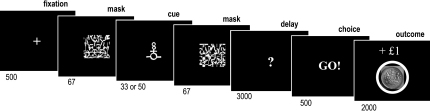
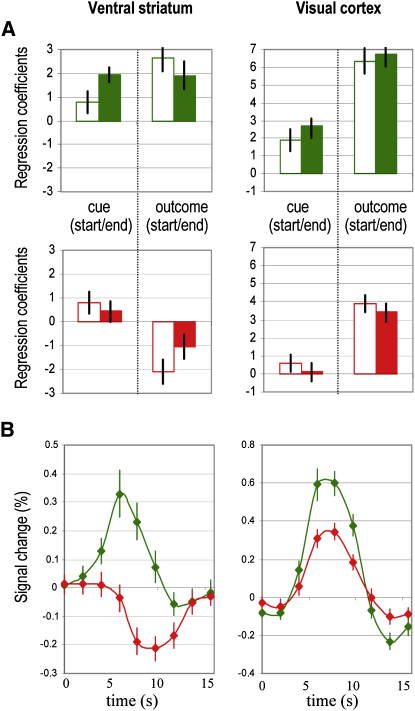
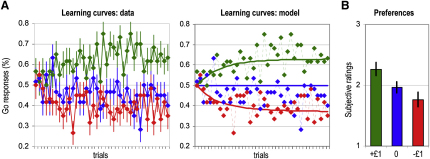
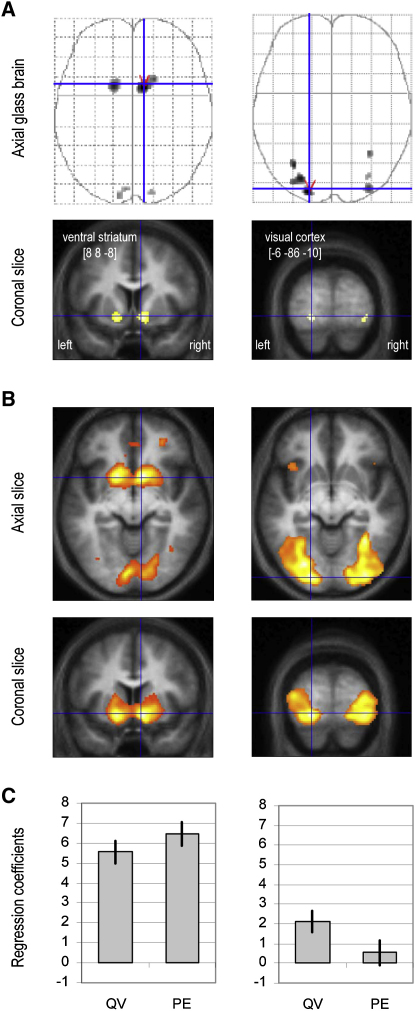
How the brain uses success and failure to optimize future decisions is a long-standing question in neuroscience. One computational solution involves updating the values of context-action associations in proportion to a reward prediction error. Previous evidence suggests that such computations are expressed in the striatum and, as they are cognitively impenetrable, represent an unconscious learning mechanism. Here, we formally test this by studying instrumental conditioning in a situation where we masked contextual cues, such that they were not consciously perceived. Behavioral data showed that subjects nonetheless developed a significant propensity to choose cues associated with monetary rewards relative to punishments. Functional neuroimaging revealed that during conditioning cue values and prediction errors, generated from a computational model, both correlated with activity in ventral striatum. We conclude that, even without conscious processing of contextual cues, our brain can learn their reward value and use them to provide a bias on decision making.
大脑如何利用成功与失败来优化未来决策,这是神经科学中一个长期存在的问题。一种计算解决方案涉及根据奖励预测误差按比例更新情境-行动关联的值。先前的证据表明,此类计算在纹状体中表现出来,并且由于它们在认知上不可穿透,代表了一种无意识的学习机制。在这里,我们通过研究在掩盖情境线索使其无法被有意识感知的情况下的工具性条件作用来正式测试这一点。行为数据表明,尽管如此,受试者相对于惩罚而言,仍显著倾向于选择与金钱奖励相关的线索。功能神经成像显示,在条件作用过程中,由计算模型生成的线索值和预测误差均与腹侧纹状体的活动相关。我们得出结论,即使没有对情境线索进行有意识的处理,我们的大脑也能够学习它们的奖励价值,并利用它们为决策提供偏差。