McQueen Amy, Tiro Jasmin A, Vernon Sally W
Division of Health Behavior Research, Washington University School of Medicine, St. Louis, MO 63108, USA.
Cancer Epidemiol Biomarkers Prev. 2008 Sep;17(9):2231-7. doi: 10.1158/1055-9965.EPI-08-0176.
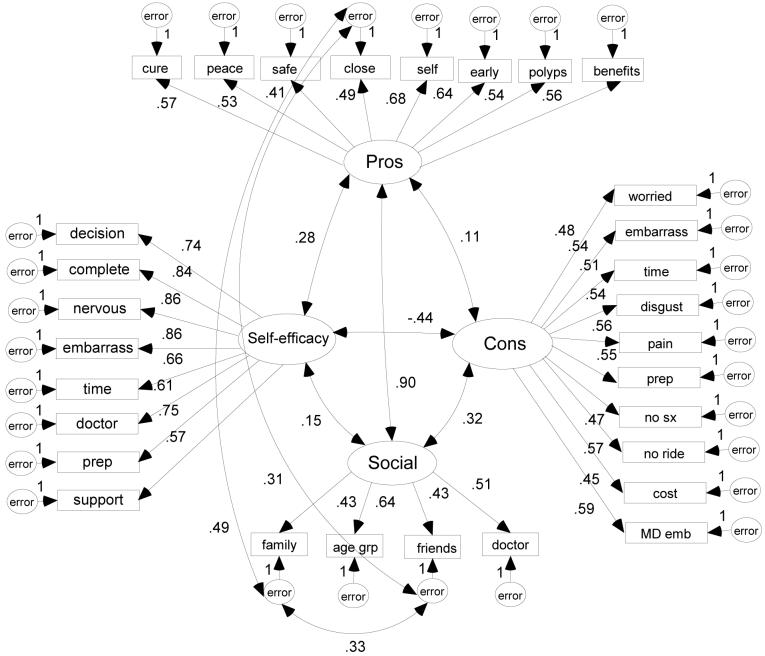
Understanding individuals' perceptions of colorectal cancer screening (CRCS) is important for developing effective interventions to increase adherence to screening guidelines. Theory-based cognitive and psychosocial constructs have been associated with CRCS in the literature, but few studies have evaluated the psychometric properties of such measures. We hypothesized a correlated four-factor model, including CRCS perceived pros, cons, social influence, and self-efficacy. We also examined measurement invariance across subgroups based on gender, race (white; African American), and prior CRCS experience (never; overdue for repeat screening). We used baseline (n = 1,250) and 2-week (n = 1,036) follow-up survey data from participants in a behavioral intervention trial designed to increase CRCS. Only minor modifications were made to the hypothesized model to improve fit, and the final model was confirmed with a random half of the sample, as well as with follow-up data. Results support the hypothesized unidimensional construct measures and suggest that the items may be appropriate for all subgroups examined. Greater variance in responses to items assessing the perceived cons of CRCS was found among African Americans compared with whites, suggesting that race may moderate the association between perceived cons and CRCS in this sample. Pros, cons, social influence, and self-efficacy are associated with CRCS; therefore, using scales with known psychometric properties strengthens researchers' ability to draw conclusions about group differences and changes over time and to compare their results with other studies. Replication studies in other populations are needed to provide further evidence of construct validity for the scales reported here.
了解个体对结直肠癌筛查(CRCS)的认知对于制定有效的干预措施以提高对筛查指南的依从性至关重要。基于理论的认知和心理社会结构在文献中已与CRCS相关联,但很少有研究评估这些测量方法的心理测量特性。我们假设了一个相关的四因素模型,包括CRCS感知的益处、弊端、社会影响和自我效能感。我们还基于性别、种族(白人;非裔美国人)和先前的CRCS经历(从未;重复筛查逾期)检查了各亚组间的测量不变性。我们使用了来自一项旨在增加CRCS的行为干预试验参与者的基线(n = 1250)和2周随访(n = 1036)调查数据。对假设模型仅进行了微小修改以改善拟合度,最终模型在样本的随机一半以及随访数据中得到了验证。结果支持了假设的单维结构测量方法,并表明这些项目可能适用于所有检查的亚组。与白人相比,非裔美国人对评估CRCS感知弊端的项目的回答差异更大,这表明在该样本中种族可能会调节感知弊端与CRCS之间的关联。益处、弊端、社会影响和自我效能感与CRCS相关;因此,使用具有已知心理测量特性的量表可增强研究人员得出关于群体差异和随时间变化的结论以及将其结果与其他研究进行比较的能力。需要在其他人群中进行重复研究,以提供此处报告的量表结构效度的进一步证据。