• 文献检索
  • 文档翻译
  • 深度研究
  • 学术资讯
  • Suppr Zotero 插件Zotero 插件
  • 邀请有礼
  • 套餐&价格
  • 历史记录
应用&插件
Suppr Zotero 插件Zotero 插件浏览器插件Mac 客户端Windows 客户端微信小程序
定价
高级版会员购买积分包购买API积分包
服务
文献检索文档翻译深度研究API 文档MCP 服务
关于我们
关于 Suppr公司介绍联系我们用户协议隐私条款
关注我们

Suppr 超能文献

核心技术专利:CN118964589B侵权必究
粤ICP备2023148730 号-1Suppr @ 2026

文献检索

告别复杂PubMed语法,用中文像聊天一样搜索,搜遍4000万医学文献。AI智能推荐,让科研检索更轻松。

立即免费搜索

文件翻译

保留排版,准确专业,支持PDF/Word/PPT等文件格式,支持 12+语言互译。

免费翻译文档

深度研究

AI帮你快速写综述,25分钟生成高质量综述,智能提取关键信息,辅助科研写作。

立即免费体验

利用基因表达谱数据鉴定细胞周期通路中用于乳腺癌预后的基因特征。

Identification of a gene signature in cell cycle pathway for breast cancer prognosis using gene expression profiling data.

作者信息

Liu Jiangang, Campen Andrew, Huang Shuguang, Peng Sheng-Bin, Ye Xiang, Palakal Mathew, Dunker A Keith, Xia Yuni, Li Shuyu

机构信息

Lilly Research Laboratories, Eli Lilly and Company, Indianapolis, IN 46285, USA.

出版信息

BMC Med Genomics. 2008 Sep 11;1:39. doi: 10.1186/1755-8794-1-39.

DOI:10.1186/1755-8794-1-39
PMID:18786252
原文链接:https://pmc.ncbi.nlm.nih.gov/articles/PMC2551605/
Abstract

BACKGROUND

Numerous studies have used microarrays to identify gene signatures for predicting cancer patient clinical outcome and responses to chemotherapy. However, the potential impact of gene expression profiling in cancer diagnosis, prognosis and development of personalized treatment may not be fully exploited due to the lack of consensus gene signatures and poor understanding of the underlying molecular mechanisms.

METHODS

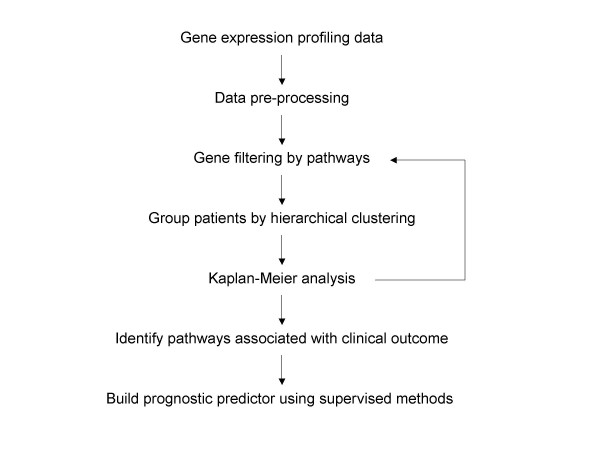
We developed a novel approach to derive gene signatures for breast cancer prognosis in the context of known biological pathways. Using unsupervised methods, cancer patients were separated into distinct groups based on gene expression patterns in one of the following pathways: apoptosis, cell cycle, angiogenesis, metastasis, p53, DNA repair, and several receptor-mediated signaling pathways including chemokines, EGF, FGF, HIF, MAP kinase, JAK and NF-kappaB. The survival probabilities were then compared between the patient groups to determine if differential gene expression in a specific pathway is correlated with differential survival.

RESULTS

Our results revealed expression of cell cycle genes is strongly predictive of breast cancer outcomes. We further confirmed this observation by building a cell cycle gene signature model using supervised methods. Validated in multiple independent datasets, the cell cycle gene signature is a more accurate predictor for breast cancer clinical outcome than the previously identified Amsterdam 70-gene signature that has been developed into a FDA approved clinical test MammaPrint.

CONCLUSION

Taken together, the gene expression signature model we developed from well defined pathways is not only a consistently powerful prognosticator but also mechanistically linked to cancer biology. Our approach provides an alternative to the current methodology of identifying gene expression markers for cancer prognosis and drug responses using the whole genome gene expression data.

摘要

背景

众多研究已使用微阵列来识别预测癌症患者临床结局及化疗反应的基因特征。然而,由于缺乏一致的基因特征且对潜在分子机制理解不足,基因表达谱在癌症诊断、预后及个性化治疗发展中的潜在影响可能未得到充分利用。

方法

我们开发了一种新方法,在已知生物学途径的背景下推导乳腺癌预后的基因特征。使用无监督方法,根据以下途径之一中的基因表达模式将癌症患者分为不同组:细胞凋亡、细胞周期、血管生成、转移、p53、DNA修复,以及包括趋化因子、表皮生长因子(EGF)、成纤维细胞生长因子(FGF)、缺氧诱导因子(HIF)、丝裂原活化蛋白激酶(MAP激酶)、Janus激酶(JAK)和核因子κB(NF-κB)在内的几种受体介导的信号通路。然后比较患者组之间的生存概率,以确定特定途径中的差异基因表达是否与差异生存相关。

结果

我们的结果显示细胞周期基因的表达强烈预测乳腺癌结局。我们通过使用监督方法构建细胞周期基因特征模型进一步证实了这一观察结果。在多个独立数据集中得到验证,与先前确定的已发展成为美国食品药品监督管理局(FDA)批准的临床检测方法MammaPrint的阿姆斯特丹70基因特征相比,细胞周期基因特征是乳腺癌临床结局更准确的预测指标。

结论

综上所述,我们从明确界定的途径开发的基因表达特征模型不仅是一个始终强大的预后指标,而且在机制上与癌症生物学相关。我们的方法为目前使用全基因组基因表达数据识别癌症预后和药物反应的基因表达标志物的方法提供了一种替代方案。
https://cdn.ncbi.nlm.nih.gov/pmc/blobs/e038/2551605/d12150871fa8/1755-8794-1-39-3.jpg
https://cdn.ncbi.nlm.nih.gov/pmc/blobs/e038/2551605/803991032072/1755-8794-1-39-1.jpg
https://cdn.ncbi.nlm.nih.gov/pmc/blobs/e038/2551605/3a934109896c/1755-8794-1-39-2.jpg
https://cdn.ncbi.nlm.nih.gov/pmc/blobs/e038/2551605/d12150871fa8/1755-8794-1-39-3.jpg
https://cdn.ncbi.nlm.nih.gov/pmc/blobs/e038/2551605/803991032072/1755-8794-1-39-1.jpg
https://cdn.ncbi.nlm.nih.gov/pmc/blobs/e038/2551605/3a934109896c/1755-8794-1-39-2.jpg
https://cdn.ncbi.nlm.nih.gov/pmc/blobs/e038/2551605/d12150871fa8/1755-8794-1-39-3.jpg

相似文献

1
Identification of a gene signature in cell cycle pathway for breast cancer prognosis using gene expression profiling data.利用基因表达谱数据鉴定细胞周期通路中用于乳腺癌预后的基因特征。
BMC Med Genomics. 2008 Sep 11;1:39. doi: 10.1186/1755-8794-1-39.
2
Distinct molecular mechanisms underlying clinically relevant subtypes of breast cancer: gene expression analyses across three different platforms.乳腺癌临床相关亚型背后不同的分子机制:跨三个不同平台的基因表达分析
BMC Genomics. 2006 May 26;7:127. doi: 10.1186/1471-2164-7-127.
3
Combining biological gene expression signatures in predicting outcome in breast cancer: An alternative to supervised classification.结合生物基因表达特征预测乳腺癌预后:监督分类的替代方法。
Eur J Cancer. 2008 Oct;44(15):2319-29. doi: 10.1016/j.ejca.2008.07.015. Epub 2008 Aug 18.
4
Genes and functions from breast cancer signatures.乳腺癌标志物的基因和功能。
BMC Cancer. 2018 Apr 27;18(1):473. doi: 10.1186/s12885-018-4388-4.
5
Prognostic breast cancer signature identified from 3D culture model accurately predicts clinical outcome across independent datasets.从三维培养模型中识别出的乳腺癌预后特征能够准确预测多个独立数据集中的临床结果。
PLoS One. 2008 Aug 20;3(8):e2994. doi: 10.1371/journal.pone.0002994.
6
Evaluation of public cancer datasets and signatures identifies TP53 mutant signatures with robust prognostic and predictive value.对公共癌症数据集和特征的评估确定了具有强大预后和预测价值的TP53突变特征。
BMC Cancer. 2015 Mar 26;15:179. doi: 10.1186/s12885-015-1102-7.
7
The E2F4 prognostic signature predicts pathological response to neoadjuvant chemotherapy in breast cancer patients.E2F4预后特征可预测乳腺癌患者对新辅助化疗的病理反应。
BMC Cancer. 2017 May 2;17(1):306. doi: 10.1186/s12885-017-3297-2.
8
Tumour profiling tests to guide adjuvant chemotherapy decisions in early breast cancer: a systematic review and economic analysis.肿瘤分析测试指导早期乳腺癌辅助化疗决策:系统评价和经济分析。
Health Technol Assess. 2019 Jun;23(30):1-328. doi: 10.3310/hta23300.
9
A TMEFF2-regulated cell cycle derived gene signature is prognostic of recurrence risk in prostate cancer.TMEFF2 调控的细胞周期相关基因特征可预测前列腺癌的复发风险。
BMC Cancer. 2019 May 6;19(1):423. doi: 10.1186/s12885-019-5592-6.
10
Metastatic potential of T1 breast cancer can be predicted by the 70-gene MammaPrint signature.T1 期乳腺癌的转移潜能可通过 70 基因 MammaPrint 签名预测。
Ann Surg Oncol. 2010 May;17(5):1406-13. doi: 10.1245/s10434-009-0902-x. Epub 2010 Jan 22.

引用本文的文献

1
Identification of immune-related gene signature for non-small cell lung cancer patients with immune checkpoint inhibitors.免疫检查点抑制剂治疗的非小细胞肺癌患者免疫相关基因特征的鉴定
Heliyon. 2024 Feb 27;10(5):e26974. doi: 10.1016/j.heliyon.2024.e26974. eCollection 2024 Mar 15.
2
AMEERA-4: a randomized, preoperative window-of-opportunity study of amcenestrant versus letrozole in early breast cancer.AMEERA-4 研究:阿美纳曲唑对比来曲唑用于早期乳腺癌的随机、术前机会窗研究。
Breast Cancer Res. 2023 Nov 10;25(1):141. doi: 10.1186/s13058-023-01740-2.
3
EARN: an ensemble machine learning algorithm to predict driver genes in metastatic breast cancer.

本文引用的文献

1
Cell cycle correlated genes dictate the prognostic power of breast cancer gene lists.细胞周期相关基因决定了乳腺癌基因列表的预后能力。
BMC Med Genomics. 2008 Apr 25;1:11. doi: 10.1186/1755-8794-1-11.
2
The properties of high-dimensional data spaces: implications for exploring gene and protein expression data.高维数据空间的特性:对探索基因和蛋白质表达数据的启示
Nat Rev Cancer. 2008 Jan;8(1):37-49. doi: 10.1038/nrc2294.
3
Use of 70-gene signature to predict prognosis of patients with node-negative breast cancer: a prospective community-based feasibility study (RASTER).
EARN:一种集成机器学习算法,用于预测转移性乳腺癌的驱动基因。
BMC Med Genomics. 2021 May 7;14(1):122. doi: 10.1186/s12920-021-00974-3.
4
A Clinicogenetic Prognostic Classifier for Prediction of Recurrence and Survival in Asian Breast Cancer Patients.用于预测亚洲乳腺癌患者复发和生存的临床遗传学预后分类器
Front Oncol. 2021 Mar 17;11:645853. doi: 10.3389/fonc.2021.645853. eCollection 2021.
5
SARS-CoV-2 early infection signature identified potential key infection mechanisms and drug targets.SARS-CoV-2 早期感染特征确定了潜在的关键感染机制和药物靶点。
BMC Genomics. 2021 Feb 18;22(1):125. doi: 10.1186/s12864-021-07433-4.
6
Elevated EXO1 expression is associated with breast carcinogenesis and poor prognosis.EXO1表达升高与乳腺癌发生及不良预后相关。
Ann Transl Med. 2021 Jan;9(2):135. doi: 10.21037/atm-20-7922.
7
An integrative multi-omics network-based approach identifies key regulators for breast cancer.一种基于整合多组学网络的方法可识别乳腺癌的关键调控因子。
Comput Struct Biotechnol J. 2020 Oct 8;18:2826-2835. doi: 10.1016/j.csbj.2020.10.001. eCollection 2020.
8
Weighted gene expression profiles identify diagnostic and prognostic genes for lung adenocarcinoma and squamous cell carcinoma.加权基因表达谱可识别肺腺癌和肺鳞状细胞癌的诊断及预后相关基因。
J Int Med Res. 2020 Mar;48(3):300060519893837. doi: 10.1177/0300060519893837. Epub 2019 Dec 19.
9
Pathway Mutations in Breast Cancer Using Whole-Exome Sequencing.使用全外显子组测序检测乳腺癌中的通路突变。
Oncol Res. 2020 Mar 27;28(2):107-116. doi: 10.3727/096504019X15698362825407. Epub 2019 Oct 1.
10
Gene relevance based on multiple evidences in complex networks.基于复杂网络中多种证据的基因相关性。
Bioinformatics. 2020 Feb 1;36(3):865-871. doi: 10.1093/bioinformatics/btz652.
使用70基因特征预测淋巴结阴性乳腺癌患者的预后:一项基于社区的前瞻性可行性研究(RASTER)
Lancet Oncol. 2007 Dec;8(12):1079-1087. doi: 10.1016/S1470-2045(07)70346-7. Epub 2007 Nov 26.
4
Microarrays: retracing steps.微阵列:追溯步骤。
Nat Med. 2007 Nov;13(11):1276-7; author reply 1277-8. doi: 10.1038/nm1107-1276b.
5
Network-based classification of breast cancer metastasis.基于网络的乳腺癌转移分类
Mol Syst Biol. 2007;3:140. doi: 10.1038/msb4100180. Epub 2007 Oct 16.
6
The LeFE algorithm: embracing the complexity of gene expression in the interpretation of microarray data.LeFE算法:在解读微阵列数据时接纳基因表达的复杂性。
Genome Biol. 2007;8(9):R187. doi: 10.1186/gb-2007-8-9-r187.
7
A strategy for predicting the chemosensitivity of human cancers and its application to drug discovery.一种预测人类癌症化学敏感性的策略及其在药物发现中的应用。
Proc Natl Acad Sci U S A. 2007 Aug 7;104(32):13086-91. doi: 10.1073/pnas.0610292104. Epub 2007 Jul 31.
8
Low E2F1 transcript levels are a strong determinant of favorable breast cancer outcome.低E2F1转录水平是乳腺癌良好预后的一个重要决定因素。
Breast Cancer Res. 2007;9(3):R33. doi: 10.1186/bcr1681.
9
Nuclear cyclin B1 in human breast carcinoma as a potent prognostic factor.人乳腺癌中的核周期蛋白B1作为一种有效的预后因素。
Cancer Sci. 2007 May;98(5):644-51. doi: 10.1111/j.1349-7006.2007.00444.x. Epub 2007 Mar 14.
10
Sorting out breast-cancer gene signatures.梳理乳腺癌基因特征
N Engl J Med. 2007 Jan 18;356(3):294-7. doi: 10.1056/NEJMe068292.