Department of Biological Sciences, National University of Singapore, Singapore, Singapore.
Tropical Marine Science Institute, National University of Singapore, Singapore, Singapore.
Mol Ecol Resour. 2020 May;20(3):807-18. doi: 10.1111/1755-0998.13150. Epub 2020 Mar 24.
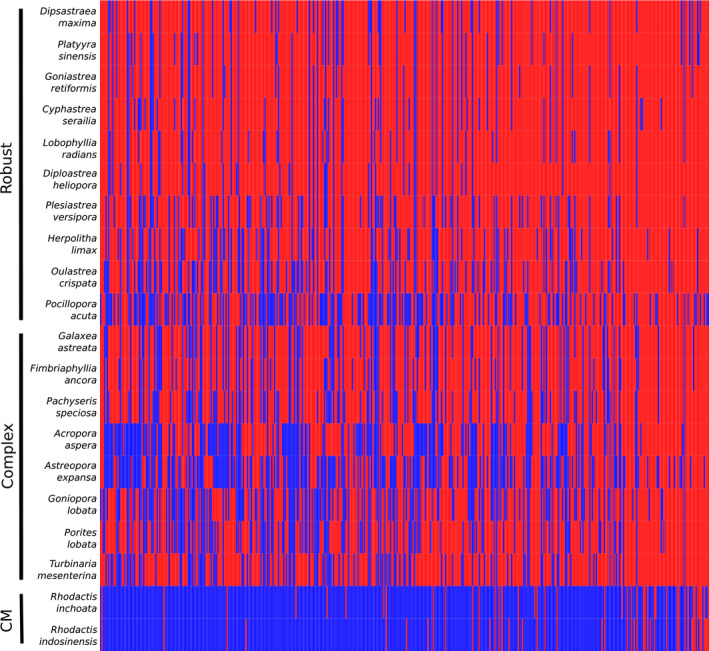
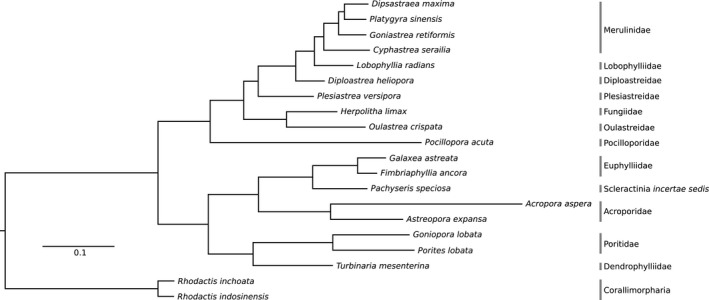
Despite the ecological and economic significance of stony corals (Scleractinia), a robust understanding of their phylogeny remains elusive due to patchy taxonomic and genetic sampling, as well as the limited availability of informative markers. To increase the number of genetic loci available for phylogenomic analyses in Scleractinia, we designed 15,919 DNA enrichment baits targeting 605 orthogroups (mean 565 ± SD 366 bp) over 1,139 exon regions. A further 236 and 62 barcoding baits were designed for COI and histone H3 genes respectively for quality and contamination checks. Hybrid capture using these baits was performed on 18 coral species spanning the presently understood scleractinian phylogeny, with two corallimorpharians as outgroup. On average, 74% of all loci targeted were successfully captured for each species. Barcoding baits were matched unambiguously to their respective samples and revealed low levels of cross-contamination in accordance with expectation. We put the data through a series of stringent filtering steps to ensure only scleractinian and phylogenetically informative loci were retained, and the final probe set comprised 13,479 baits, targeting 452 loci (mean 531 ± SD 307 bp) across 865 exon regions. Maximum likelihood, Bayesian and species tree analyses recovered maximally supported, topologically congruent trees consistent with previous phylogenomic reconstructions. The phylogenomic method presented here allows for consistent capture of orthologous loci among divergent coral taxa, facilitating the pooling of data from different studies and increasing the phylogenetic sampling of scleractinians in the future.
尽管石珊瑚(Scleractinia)具有生态和经济意义,但由于分类学和遗传学采样不完整,以及信息标记有限,其系统发育仍然难以捉摸。为了增加石珊瑚系统发育分析中可用的遗传基因座数量,我们设计了 15919 个针对 605 个直系同源物(平均 565 ± 366bp)的 DNA 富集探针,跨越 1139 个外显子区域。此外,还分别为 COI 和组蛋白 H3 基因设计了 236 个和 62 个条形码探针,用于质量和污染检查。使用这些探针对 18 个珊瑚物种进行杂交捕获,涵盖了目前已知的石珊瑚系统发育,其中两个珊瑚形目动物作为外群。平均而言,每个物种成功捕获的目标基因座数达到 74%。条形码探针与各自的样本匹配,并且与预期一致,显示出低水平的交叉污染。我们通过一系列严格的过滤步骤来处理数据,以确保仅保留石珊瑚和具有系统发育信息的基因座,最终的探针集由 13479 个探针组成,针对 865 个外显子区域的 452 个基因座(平均 531 ± 307bp)。最大似然法、贝叶斯法和种系发生树分析恢复了最大支持的、拓扑一致的树,与以前的基因组重建结果一致。本文提出的基因组方法允许在不同的珊瑚类群中捕获同源基因座,从而方便了不同研究的数据汇总,并增加了石珊瑚的系统发育采样。