Øien Torbjørn, Storrø Ola, Jenssen Jon A, Johnsen Roar
Department of Public Health and General Practice, Faculty of Medicine, Norwegian University of Science and Technology, N-7489 Trondheim, Norway.
BMC Public Health. 2008 Sep 22;8:325. doi: 10.1186/1471-2458-8-325.
There is a demand for strategies to promote smoking cessation in high-risk populations like smoking pregnant women and their partners. The objectives of this study were to investigate parental smoking behaviour during pregnancy after introduction of a prenatal, structured, multi-disciplinary smoking cessation programme in primary care, and to compare smoking behaviour among pregnant women in the city of Trondheim with Bergen and Norway.
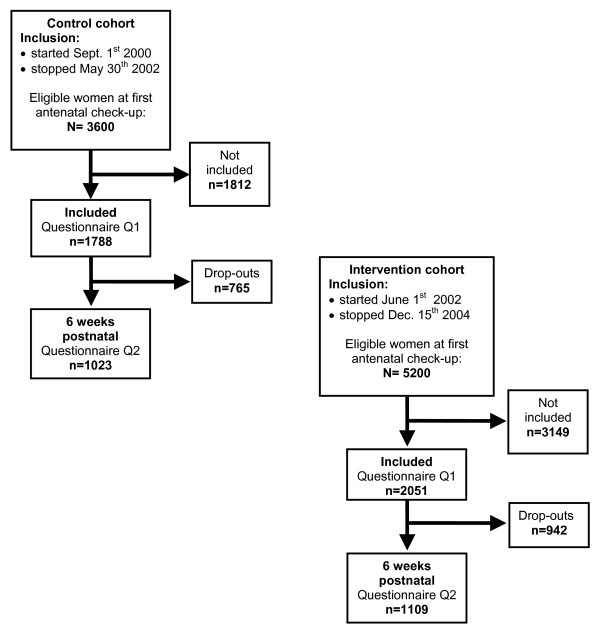
Sequential birth cohorts were established to evaluate the intervention programme from September 2000 to December 2004 in primary care as a part of the Prevention of Allergy among Children in Trondheim study (PACT). The primary outcome variables were self reported smoking behaviour at inclusion and six weeks postnatal. Data from the Medical Birth Registry of Norway (MBR) were used to describe smoking cessation during pregnancy in Trondheim, Bergen and Norway 1999-2004.
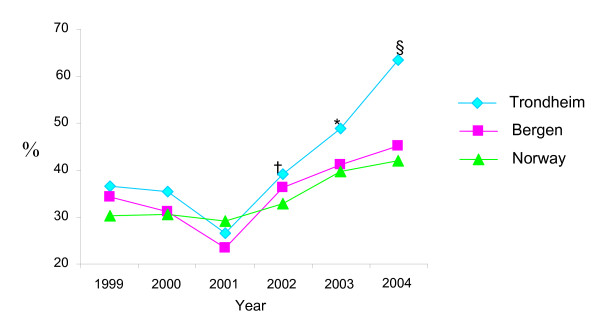
Maternal smoking prevalence at inclusion during pregnancy were 5% (CI 95% 4-6) in the intervention cohort compared to 7% (CI 95% 6-9), p = 0.03, in the control cohort. Of the pre-pregnancy maternal smokers 25% (CI 95% 20-31) and 32% (CI 95% 26-38), p = 0.17, were still smoking at inclusion in the intervention and control cohorts, respectively. Six weeks postnatal 72% (CI 95% 59-83) and 68% (CI 95% 57-77), p = 0.34 of the maternal smokers at inclusion still smoked. No significant difference in paternal smoking between the cohorts was found after the intervention period. Data from the MBR showed a significantly higher proportion of women who stopped smoking during pregnancy in Trondheim than in Bergen in 2003 and 2004, p = 0.03 and < 0.001, respectively.
No impact on parental smoking behaviour between the cohorts was observed after the smoking intervention programme. Of the women who stopped smoking during pregnancy most of them stopped smoking before the intervention. However, we observed a significantly higher quitting rate in Trondheim than in Bergen in 2003 and 2004 which may have been facilitated by the supplemental attention on smoking behaviour the PACT study initiated.
对于在吸烟孕妇及其伴侣等高风险人群中促进戒烟的策略存在需求。本研究的目的是调查在初级保健中引入产前结构化多学科戒烟计划后孕期父母的吸烟行为,并比较特隆赫姆市与卑尔根市及挪威的孕妇吸烟行为。
建立连续出生队列以评估2000年9月至2004年12月在初级保健中作为特隆赫姆儿童过敏预防研究(PACT)一部分的干预计划。主要结局变量是纳入时和产后六周的自我报告吸烟行为。挪威医学出生登记处(MBR)的数据用于描述1999 - 2004年特隆赫姆、卑尔根和挪威孕期戒烟情况。
干预队列中孕期纳入时的孕妇吸烟率为5%(95%CI 4 - 6),而对照队列中为7%(95%CI 6 - 9),p = 0.03。在干预队列和对照队列中,孕前吸烟的孕妇在纳入时仍吸烟的比例分别为25%(95%CI 20 - 31)和32%(95%CI 26 - 38),p = 0.17。产后六周时,纳入时吸烟的孕妇中仍吸烟的比例分别为72%(95%CI 59 - 83)和68%(95%CI 57 - 77),p = 0.34。干预期后各队列间父亲吸烟情况无显著差异。MBR数据显示,2003年和2004年特隆赫姆孕期戒烟的女性比例显著高于卑尔根,p分别为0.03和<0.001。
吸烟干预计划后各队列间父母吸烟行为未受影响。孕期戒烟的女性大多在干预前就已戒烟。然而,我们观察到2003年和2004年特隆赫姆的戒烟率显著高于卑尔根,这可能得益于PACT研究对吸烟行为的额外关注。