Howden-Chapman Philippa, Pierse Nevil, Nicholls Sarah, Gillespie-Bennett Julie, Viggers Helen, Cunningham Malcolm, Phipps Robyn, Boulic Mikael, Fjällström Pär, Free Sarah, Chapman Ralph, Lloyd Bob, Wickens Kristin, Shields David, Baker Michael, Cunningham Chris, Woodward Alistair, Bullen Chris, Crane Julian
He Kainga Oranga/Housing and Health Research Programme, University of Otago, Wellington, PO 7343, Wellington South, New Zealand.
BMJ. 2008 Sep 23;337:a1411. doi: 10.1136/bmj.a1411.
To assess whether non-polluting, more effective home heating (heat pump, wood pellet burner, flued gas) has a positive effect on the health of children with asthma.
Randomised controlled trial.
Households in five communities in New Zealand.
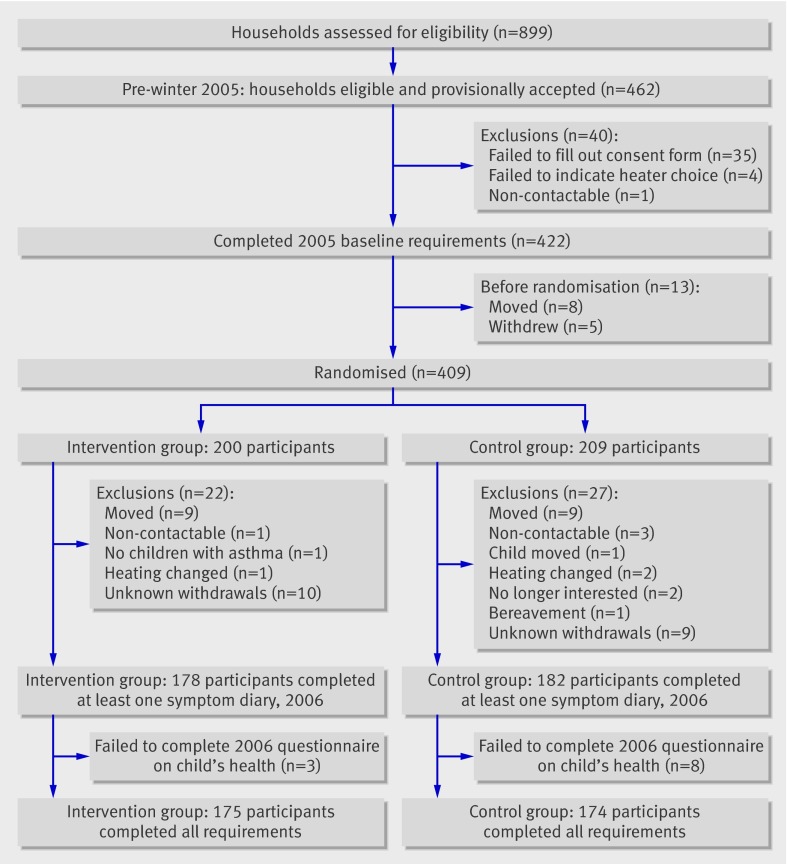
409 children aged 6-12 years with doctor diagnosed asthma.
Installation of a non-polluting, more effective home heater before winter. The control group received a replacement heater at the end of the trial.
The primary outcome was change in lung function (peak expiratory flow rate and forced expiratory volume in one second, FEV(1)). Secondary outcomes were child reported respiratory tract symptoms and daily use of preventer and reliever drugs. At the end of winter 2005 (baseline) and winter 2006 (follow-up) parents reported their child's general health, use of health services, overall respiratory health, and housing conditions. Nitrogen dioxide levels were measured monthly for four months and temperatures in the living room and child's bedroom were recorded hourly.
Improvements in lung function were not significant (difference in mean FEV(1) 130.7 ml, 95% confidence interval -20.3 to 281.7). Compared with children in the control group, however, children in the intervention group had 1.80 fewer days off school (95% confidence interval 0.11 to 3.13), 0.40 fewer visits to a doctor for asthma (0.11 to 0.62), and 0.25 fewer visits to a pharmacist for asthma (0.09 to 0.32). Children in the intervention group also had fewer reports of poor health (adjusted odds ratio 0.48, 95% confidence interval 0.31 to 0.74), less sleep disturbed by wheezing (0.55, 0.35 to 0.85), less dry cough at night (0.52, 0.32 to 0.83), and reduced scores for lower respiratory tract symptoms (0.77, 0.73 to 0.81) than children in the control group. The intervention was associated with a mean temperature rise in the living room of 1.10 degrees C (95% confidence interval 0.54 degrees C to 1.64 degrees C) and in the child's bedroom of 0.57 degrees C (0.05 degrees C to 1.08 degrees C). Lower levels of nitrogen dioxide were measured in the living rooms of the intervention households than in those of the control households (geometric mean 8.5 microg/m(3) v 15.7 microg/m(3), P<0.001). A similar effect was found in the children's bedrooms (7.3 microg/m(3) v 10.9 microg/m(3), P<0.001).
Installing non-polluting, more effective heating in the homes of children with asthma did not significantly improve lung function but did significantly reduce symptoms of asthma, days off school, healthcare utilisation, and visits to a pharmacist.
Clinical Trials NCT00489762.
评估无污染、更高效的家庭供暖方式(热泵、木屑颗粒燃烧器、烟道气供暖)对哮喘儿童健康是否有积极影响。
随机对照试验。
新西兰五个社区的家庭。
409名6至12岁经医生诊断患有哮喘的儿童。
在冬季来临前安装无污染、更高效的家用加热器。对照组在试验结束时更换加热器。
主要观察指标为肺功能变化(呼气峰值流速和一秒用力呼气量,FEV(1))。次要观察指标为儿童报告的呼吸道症状以及预防药物和缓解药物的每日使用情况。在2005年冬季(基线)和2006年冬季(随访)结束时,家长报告孩子的总体健康状况、医疗服务使用情况、整体呼吸道健康状况和住房条件。连续四个月每月测量二氧化氮水平,并每小时记录客厅和儿童卧室的温度。
肺功能改善不显著(FEV(1)均值差异为130.7毫升,95%置信区间为-20.3至281.7)。然而,与对照组儿童相比,干预组儿童缺课天数少1.80天(95%置信区间为0.11至3.13),因哮喘看医生的次数少0.40次(0.11至0.62),因哮喘去药房的次数少0.25次(0.09至0.32)。干预组儿童健康状况不佳的报告也较少(调整后的优势比为0.48,95%置信区间为0.31至0.74),因喘息导致睡眠受干扰的情况较少(0.55,0.35至0.85),夜间干咳较少(0.52,0.32至0.83),下呼吸道症状评分降低(0.77,0.73至0.81)。该干预措施使客厅平均温度升高1.10摄氏度(95%置信区间为0.54摄氏度至1.64摄氏度),儿童卧室平均温度升高0.57摄氏度(0.05摄氏度至1.08摄氏度)。干预家庭客厅的二氧化氮水平低于对照家庭(几何均值8.5微克/立方米对15.7微克/立方米,P<0.001)。在儿童卧室也发现了类似效果(7.3微克/立方米对10.9微克/立方米,P<0.001)。
在哮喘儿童家中安装无污染、更高效的供暖设备并不能显著改善肺功能,但能显著减轻哮喘症状、减少缺课天数、降低医疗服务利用率以及去药房的次数。
临床试验NCT00489762。
