Gualano Bruno, Ugrinowitsch Carlos, Artioli Guilherme G, Benatti Fabiana B, Scagliusi Fernanda B, Harris Roger C, Lancha Antonio H
Laboratory of Applied Nutrition and Metabolism, School of Physical Education and Sport, University of São Paulo, Brazil.
J Int Soc Sports Nutr. 2008 Oct 3;5:16. doi: 10.1186/1550-2783-5-16.
We aimed to investigate the effects of creatine (Cr) supplementation on the plasma lipid profile in sedentary male subjects undergoing aerobic training.
Subjects (n = 22) were randomly divided into two groups and were allocated to receive treatment with either creatine monohydrate (CR) (~20 g.day-1 for one week followed by ~10 g.day-1 for a further eleven weeks) or placebo (PL) (dextrose) in a double blind fashion. All subjects undertook moderate intensity aerobic training during three 40-minute sessions per week, over 3 months. High-density lipoprotein cholesterol (HDL), low-density lipoprotein cholesterol (LDL), very low-density lipoprotein cholesterol (VLDL), total cholesterol (TC), triglyceride (TAG), fasting insulin and fasting glycemia were analyzed in plasma. Thereafter, the homeostasis model assessment (HOMA) was calculated. Tests were performed at baseline (Pre) and after four (Post 4), eight (Post 8) and twelve (Post 12) weeks.
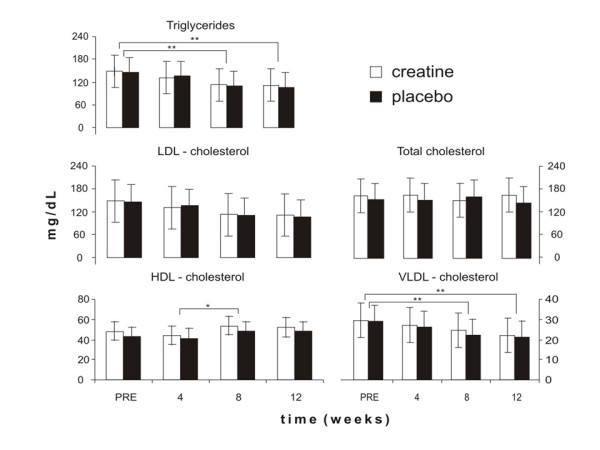
We observed main time effects in both groups for HDL (Post 4 versus Post 8; P = 0.01), TAG and VLDL (Pre versus Post 4 and Post 8; P = 0.02 and P = 0.01, respectively). However, no between group differences were noted in HDL, LDL, CT, VLDL and TAG. Additionally, fasting insulin, fasting glycemia and HOMA did not change significantly.
These findings suggest that Cr supplementation does not exert any additional effect on the improvement in the plasma lipid profile than aerobic training alone.
我们旨在研究补充肌酸(Cr)对进行有氧训练的久坐男性受试者血浆脂质谱的影响。
将受试者(n = 22)随机分为两组,以双盲方式分别给予一水肌酸(CR)(约20克/天,持续一周,随后约10克/天,持续另外十一周)或安慰剂(PL)(葡萄糖)治疗。所有受试者在3个月内每周进行三次40分钟的中等强度有氧训练。分析血浆中的高密度脂蛋白胆固醇(HDL)、低密度脂蛋白胆固醇(LDL)、极低密度脂蛋白胆固醇(VLDL)、总胆固醇(TC)、甘油三酯(TAG)、空腹胰岛素和空腹血糖。此后,计算稳态模型评估(HOMA)。在基线(Pre)以及四周(Post 4)、八周(Post 8)和十二周(Post 12)后进行测试。
我们观察到两组中HDL(Post 4与Post 8相比;P = 0.01)、TAG和VLDL(Pre与Post 4和Post 8相比;分别为P = 0.02和P = 0.01)均有主要的时间效应。然而,在HDL、LDL、CT、VLDL和TAG方面未观察到组间差异。此外,空腹胰岛素、空腹血糖和HOMA没有显著变化。
这些发现表明,与单独进行有氧训练相比,补充Cr对改善血浆脂质谱没有任何额外作用。