Taylor Melanie R, Agho Kingsley E, Stevens Garry J, Raphael Beverley
Science of Mental Health and Adversity Unit, School of Medicine, University of Western Sydney, Australia.
BMC Public Health. 2008 Oct 3;8:347. doi: 10.1186/1471-2458-8-347.
In 2007 Australia experienced its first outbreak of highly infectious equine influenza. Government disease control measures were put in place to control, contain, and eradicate the disease; these measures included movement restrictions and quarantining of properties. This study was conducted to assess the psycho-social impacts of this disease, and this paper reports the prevalence of, and factors influencing, psychological distress during this outbreak.
Data were collected using an online survey, with a link directed to the affected population via a number of industry groups. Psychological distress, as determined by the Kessler 10 Psychological Distress Scale, was the main outcome measure.
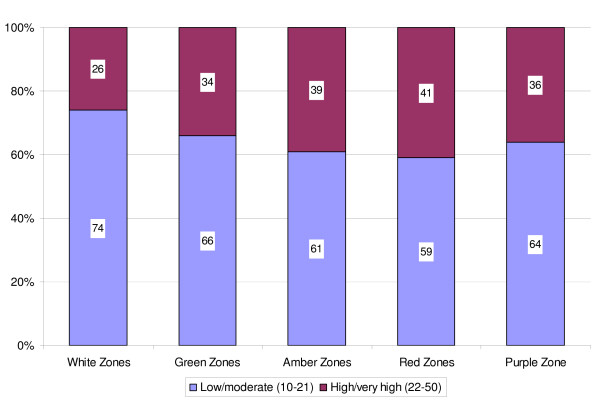
In total, 2760 people participated in this study. Extremely high levels of non-specific psychological distress were reported by respondents in this study, with 34% reporting high psychological distress (K10 > 22), compared to levels of around 12% in the Australian general population. Analysis, using backward stepwise binary logistic regression analysis, revealed that those living in high risk infection (red) zones (OR = 2.00; 95% CI: 1.57-2.55; p < 0.001) and disease buffer (amber) zones (OR = 1.83; 95% CI: 1.36-2.46; p < 0.001) were at much greater risk of high psychological distress than those living in uninfected (white zones). Although prevalence of high psychological distress was greater in infected EI zones and States, elevated levels of psychological distress were experienced in horse-owners nationally. Statistical analysis indicated that certain groups were more vulnerable to high psychological distress; specifically younger people, and those with lower levels of formal educational qualifications. Respondents whose principal source of income was from horse-related industry were more than twice as likely to have high psychological distress than those whose primary source of income was not linked to horse-related industry (OR = 2.23; 95% CI: 1.82-2.73; p < 0.001).
Although, methodologically, this study had good internal validity, it has limited generalisability because it was not possible to identify, bound, or sample the target population accurately. However, this study is the first to collect psychological distress data from an affected population during such a disease outbreak and has potential to inform those involved in assessing the potential psychological impacts of human infectious diseases, such as pandemic influenza.
2007年,澳大利亚首次爆发高传染性马流感。政府采取了疾病控制措施来控制、遏制和根除该疾病;这些措施包括行动限制和对场所进行隔离。开展本研究是为了评估这种疾病的心理社会影响,本文报告了此次疫情期间心理困扰的患病率及其影响因素。
通过在线调查收集数据,通过多个行业组织向受影响人群发送链接。由凯斯勒10项心理困扰量表确定的心理困扰是主要的结局指标。
共有2760人参与了本研究。本研究中的受访者报告了极高水平的非特异性心理困扰,34%的人报告有高度心理困扰(K10>22),而澳大利亚普通人群的这一比例约为12%。使用向后逐步二元逻辑回归分析进行分析发现,生活在高风险感染(红色)区(OR=2.00;95%CI:1.57 - 2.55;p<0.001)和疾病缓冲区(琥珀色)区(OR=1.83;95%CI:1.36 - 2.46;p<0.001)的人出现高度心理困扰的风险比生活在未感染(白色)区的人高得多。尽管在感染马流感的区域和州,高度心理困扰的患病率更高,但全国范围内的马主都经历了较高水平的心理困扰。统计分析表明,某些群体更容易出现高度心理困扰;特别是年轻人以及正规教育程度较低的人。主要收入来源与马匹相关行业的受访者出现高度心理困扰的可能性是主要收入来源与马匹相关行业无关的受访者的两倍多(OR=2.23;95%CI:1.82 - 2.73;p<0.001)。
虽然从方法学上讲,本研究具有良好的内部效度,但由于无法准确识别、界定或抽样目标人群,其普遍性有限。然而,本研究是首次在这样的疾病爆发期间从受影响人群中收集心理困扰数据,有潜力为参与评估人类传染病(如大流行性流感)潜在心理影响的人员提供参考。