Ockhuysen-Vermey Caroline F, Henneman Lidewij, van Asperen Christi J, Oosterwijk Jan C, Menko Fred H, Timmermans Daniëlle R M
Department of Public and Occupational Health, EMGO Institute, VU University Medical Center, Amsterdam, the Netherlands.
BMC Cancer. 2008 Oct 3;8:283. doi: 10.1186/1471-2407-8-283.
Understanding risks is considered to be crucial for informed decision-making. Inaccurate risk perception is a common finding in women with a family history of breast cancer attending genetic counseling. As yet, it is unclear how risks should best be communicated in clinical practice. This study protocol describes the design and methods of the BRISC (Breast cancer RISk Communication) study evaluating the effect of different formats of risk communication on the counsellee's risk perception, psychological well-being and decision-making regarding preventive options for breast cancer.
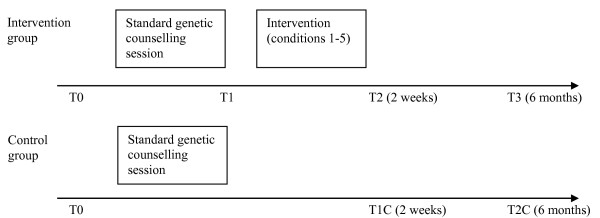
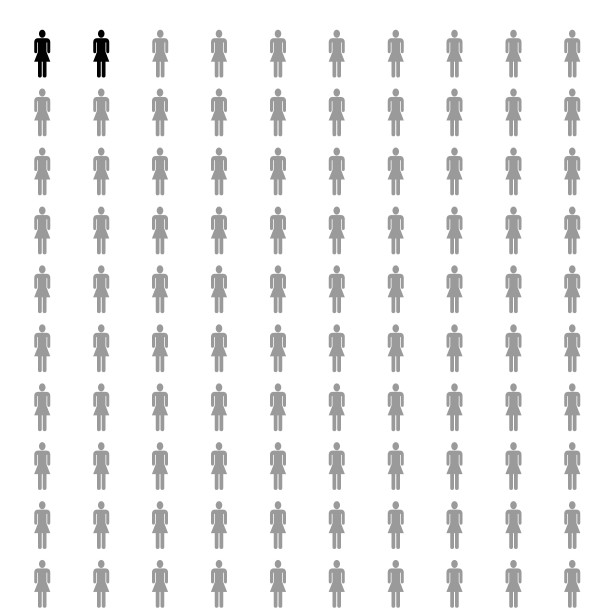
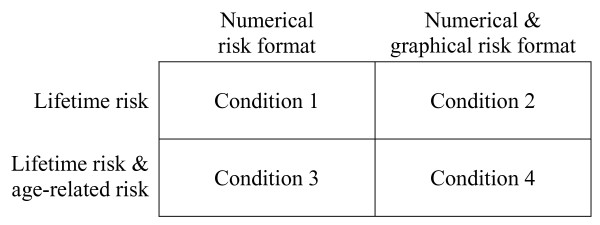
The BRISC study is designed as a pre-post-test controlled group intervention trial with repeated measurements using questionnaires. The intervention-an additional risk consultation-consists of one of 5 conditions that differ in the way counsellee's breast cancer risk is communicated: 1) lifetime risk in numerical format (natural frequencies, i.e. X out of 100), 2) lifetime risk in both numerical format and graphical format (population figures), 3) lifetime risk and age-related risk in numerical format, 4) lifetime risk and age-related risk in both numerical format and graphical format, and 5) lifetime risk in percentages. Condition 6 is the control condition in which no intervention is given (usual care). Participants are unaffected women with a family history of breast cancer attending one of three participating clinical genetic centres in the Netherlands.
The BRISC study allows for an evaluation of the effects of different formats of communicating breast cancer risks to counsellees. The results can be used to optimize risk communication in order to improve informed decision-making among women with a family history of breast cancer. They may also be useful for risk communication in other health-related services.
Current Controlled Trials ISRCTN14566836.
了解风险被认为是做出明智决策的关键。在参加遗传咨询的有乳腺癌家族史的女性中,不准确的风险认知是常见现象。目前尚不清楚在临床实践中应如何最好地传达风险。本研究方案描述了BRISC(乳腺癌风险沟通)研究的设计和方法,该研究评估不同形式的风险沟通对受咨询者的风险认知、心理健康以及关于乳腺癌预防方案的决策的影响。
BRISC研究设计为一项前后测对照组干预试验,使用问卷进行重复测量。干预措施——额外的风险咨询——由5种条件之一组成,这些条件在传达受咨询者乳腺癌风险的方式上有所不同:1)以数字形式呈现的终生风险(自然频率,即100人中的X人),2)数字形式和图形形式(人口数字)的终生风险,3)数字形式的终生风险和与年龄相关的风险,4)数字形式和图形形式的终生风险和与年龄相关的风险,5)百分比形式的终生风险。条件6为对照条件,不进行干预(常规护理)。参与者是在荷兰三个参与研究的临床遗传中心之一就诊的有乳腺癌家族史的未患病女性。
BRISC研究能够评估向受咨询者传达乳腺癌风险的不同形式的效果。研究结果可用于优化风险沟通,以改善有乳腺癌家族史女性的明智决策。这些结果可能对其他健康相关服务中的风险沟通也有用处。
当前受控试验ISRCTN14566836。