Cho Younhee, Zhang Yanjie, Christensen Trine, Sagle Laura B, Chilkoti Ashutosh, Cremer Paul S
Department of Chemistry, Texas A&M University, College Station, TX 77843, USA.
J Phys Chem B. 2008 Nov 6;112(44):13765-71. doi: 10.1021/jp8062977. Epub 2008 Oct 9.
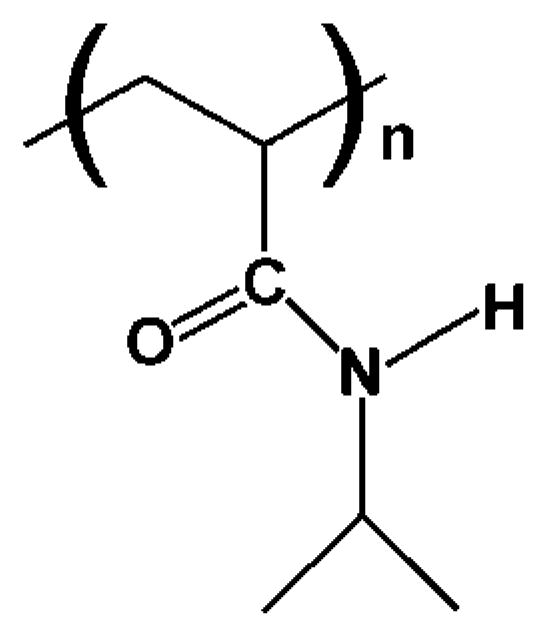
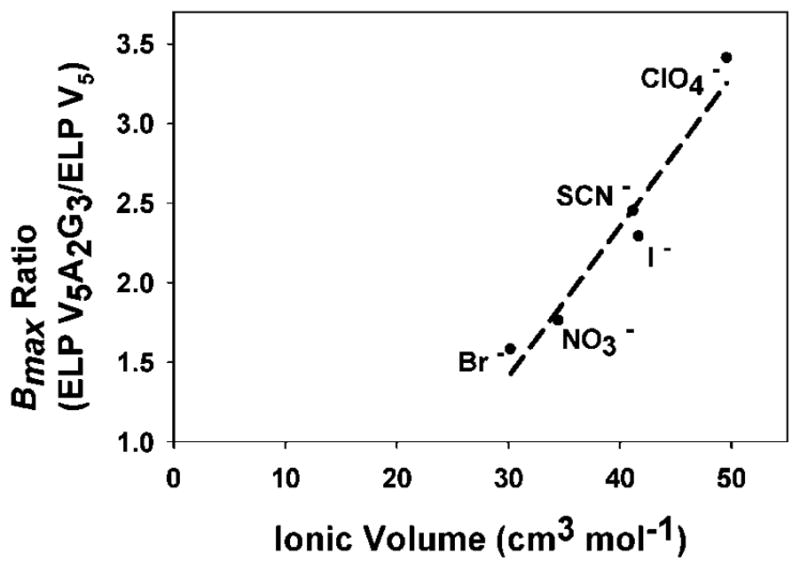
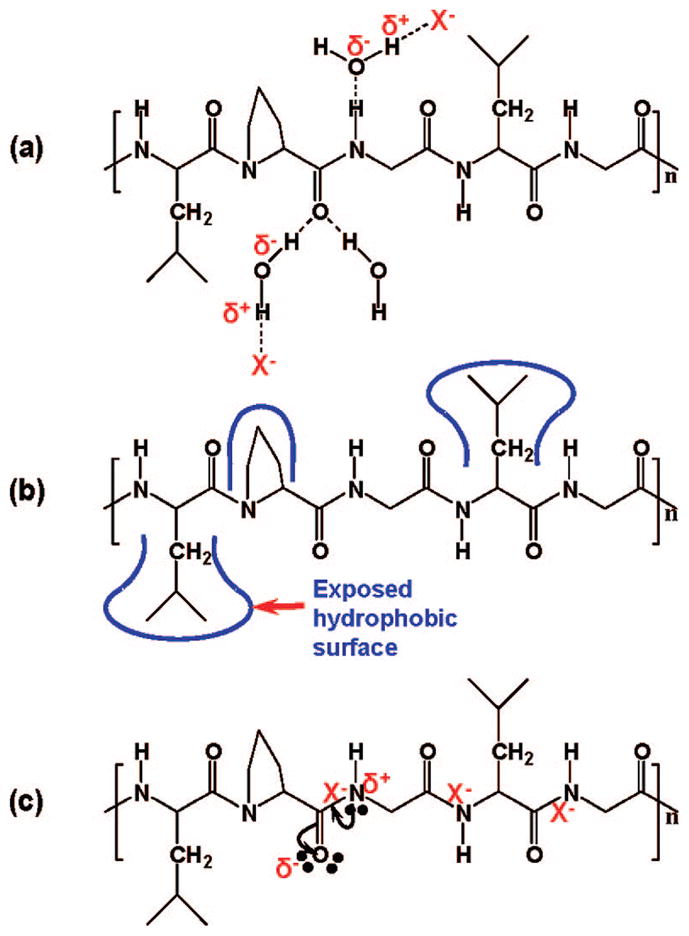
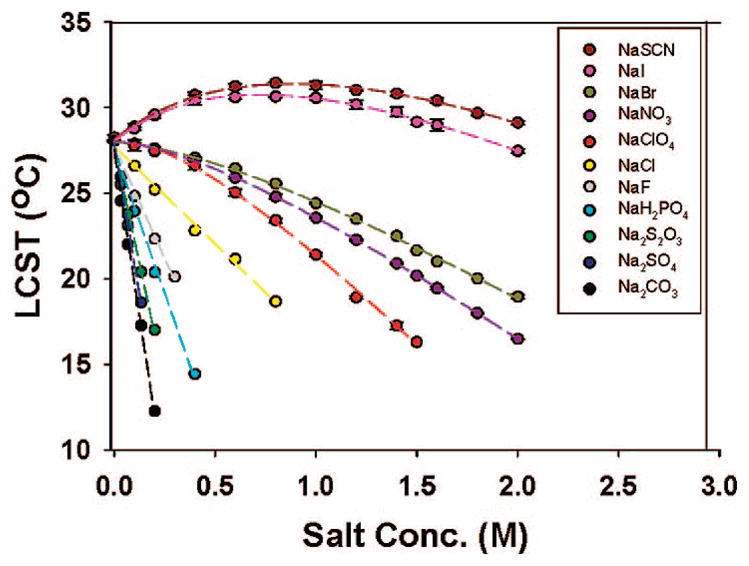
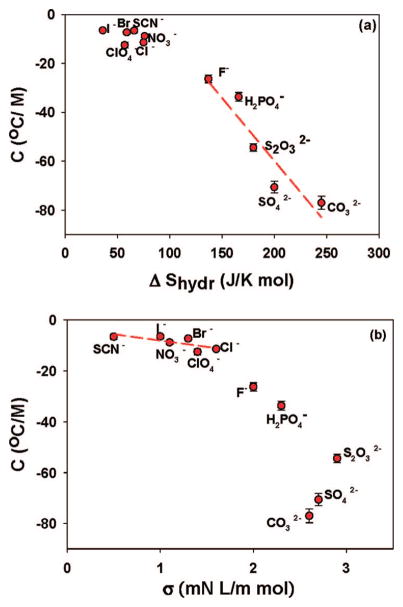
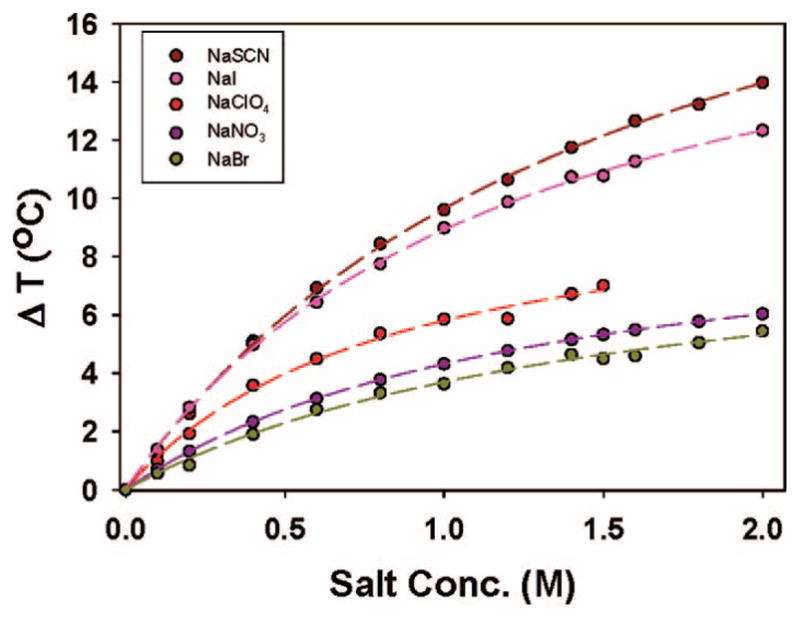
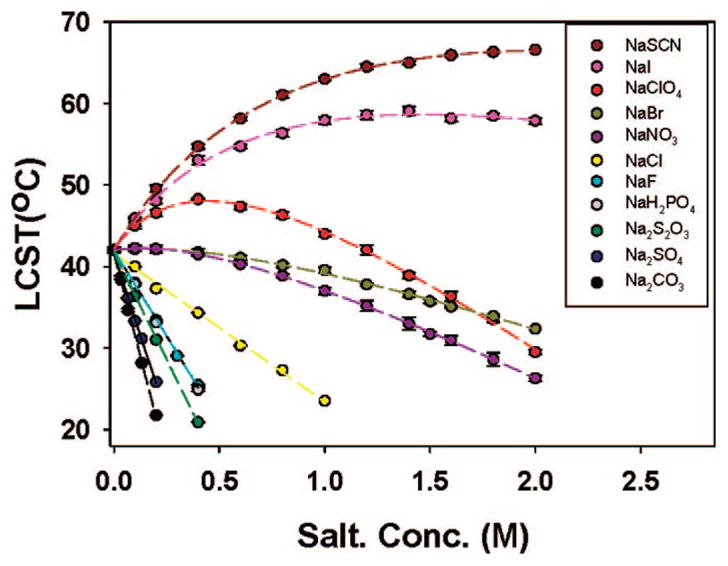
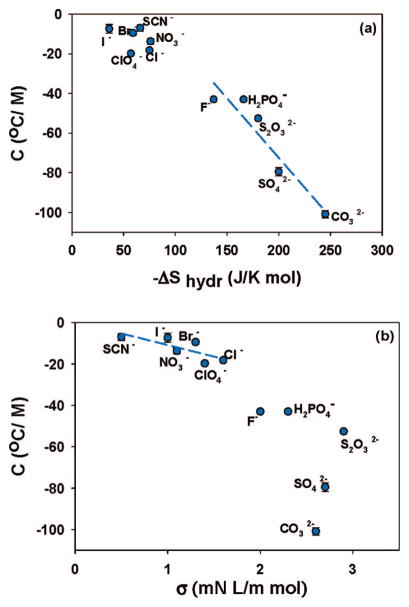
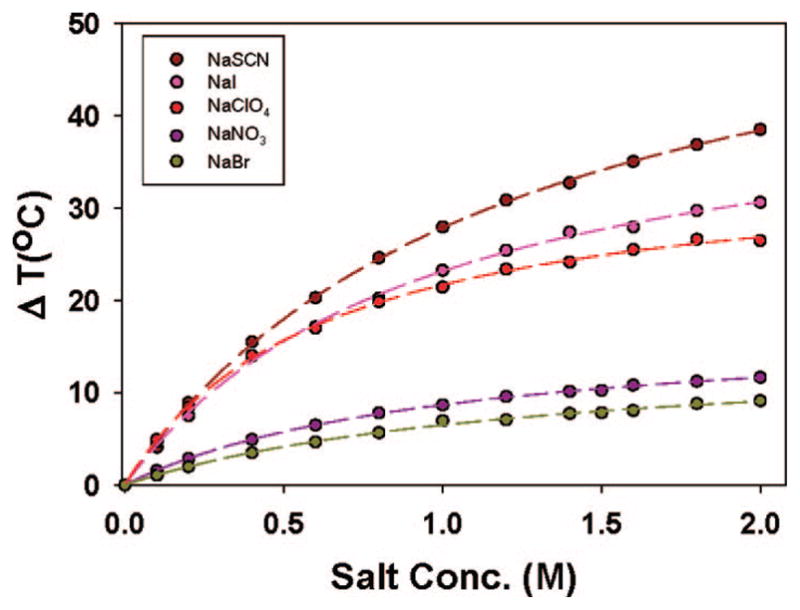
The modulation of the lower critical solution temperature (LCST) of two elastin-like polypeptides (ELPs) was investigated in the presence of 11 sodium salts that span the Hofmeister series for anions. It was found that the hydrophobic collapse/aggregation of these ELPs generally followed the series. Specifically, kosmotropic anions decreased the LCST by polarizing interfacial water molecules involved in hydrating amide groups on the ELPs. On the other hand, chaotropic anions lowered the LCST through a surface tension effect. Additionally, chaotropic anions showed salting-in properties at low salt concentrations that were related to the saturation binding of anions with the biopolymers. These overall mechanistic effects were similar to those previously found for the hydrophobic collapse and aggregation of poly(N-isopropylacrylamide), PNIPAM. There is, however, a crucial difference between PNIPAM and ELPs. Namely, PNIPAM undergoes a two-step collapse process as a function of temperature in the presence of sufficient concentrations of kosmotropic salts. By contrast, ELPs undergo collapse in a single step in all cases studied herein. This suggests that the removal of water molecules from around the amide moieties triggers the removal of hydrophobic hydration waters in a highly coupled process. There are also some key differences between the LCST behavior of the two ELPs. Specifically, the more hydrophilic ELP V5A2G(3)-120 construct displays collapse/aggregation behavior that is consistent with a higher concentration of anions partitioning to polymer/aqueous interface as compared to the more hydrophobic ELP V(5)-120. It was also found that larger anions could bind with ELP V5A2G(3)-120 more readily in comparison with ELP V(5)-120. These latter results were interpreted in terms of relative binding site accessibility of the anion for the ELP.
在11种跨越霍夫迈斯特阴离子序列的钠盐存在的情况下,研究了两种类弹性蛋白多肽(ELP)的下临界溶液温度(LCST)的调制情况。结果发现,这些ELP的疏水塌缩/聚集通常遵循该序列。具体而言,促水合阴离子通过使参与ELP上酰胺基团水合的界面水分子极化来降低LCST。另一方面,离液序列高的阴离子通过表面张力效应降低LCST。此外,离液序列高的阴离子在低盐浓度下表现出盐溶性质,这与阴离子与生物聚合物的饱和结合有关。这些总体机制效应与先前发现的聚(N-异丙基丙烯酰胺)(PNIPAM)的疏水塌缩和聚集效应相似。然而,PNIPAM和ELP之间存在一个关键差异。即,在存在足够浓度的促水合盐的情况下,PNIPAM会随着温度的变化经历两步塌缩过程。相比之下,在本文研究的所有情况下,ELP均经历单步塌缩。这表明从酰胺部分周围去除水分子会在高度耦合的过程中触发疏水水化水的去除。两种ELP的LCST行为之间也存在一些关键差异。具体而言,与疏水性更强的ELP V(5)-120相比,亲水性更强的ELP V5A2G(3)-120构建体表现出的塌缩/聚集行为与更高浓度的阴离子分配到聚合物/水界面一致。还发现,与ELP V(5)-120相比,较大的阴离子更容易与ELP V5A2G(3)-120结合。后一结果是根据阴离子对ELP的相对结合位点可及性来解释的。