Tran Hoa T, Krushkal Julia, Antommattei Frances M, Lovley Derek R, Weis Robert M
Department of Chemistry, University of Massachusetts, Amherst, MA 01003, USA.
BMC Genomics. 2008 Oct 9;9:471. doi: 10.1186/1471-2164-9-471.
Geobacter species are delta-Proteobacteria and are often the predominant species in a variety of sedimentary environments where Fe(III) reduction is important. Their ability to remediate contaminated environments and produce electricity makes them attractive for further study. Cell motility, biofilm formation, and type IV pili all appear important for the growth of Geobacter in changing environments and for electricity production. Recent studies in other bacteria have demonstrated that signaling pathways homologous to the paradigm established for Escherichia coli chemotaxis can regulate type IV pili-dependent motility, the synthesis of flagella and type IV pili, the production of extracellular matrix material, and biofilm formation. The classification of these pathways by comparative genomics improves the ability to understand how Geobacter thrives in natural environments and better their use in microbial fuel cells.
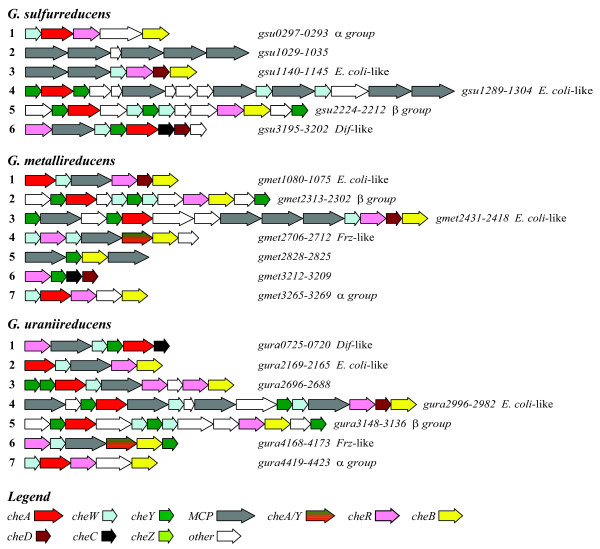
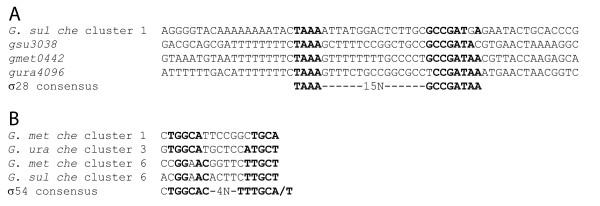
The genomes of G. sulfurreducens, G. metallireducens, and G. uraniireducens contain multiple (approximately 70) homologs of chemotaxis genes arranged in several major clusters (six, seven, and seven, respectively). Unlike the single gene cluster of E. coli, the Geobacter clusters are not all located near the flagellar genes. The probable functions of some Geobacter clusters are assignable by homology to known pathways; others appear to be unique to the Geobacter sp. and contain genes of unknown function. We identified large numbers of methyl-accepting chemotaxis protein (MCP) homologs that have diverse sensing domain architectures and generate a potential for sensing a great variety of environmental signals. We discuss mechanisms for class-specific segregation of the MCPs in the cell membrane, which serve to maintain pathway specificity and diminish crosstalk. Finally, the regulation of gene expression in Geobacter differs from E. coli. The sequences of predicted promoter elements suggest that the alternative sigma factors sigma28 and sigma54 play a role in regulating the Geobacter chemotaxis gene expression.
The numerous chemoreceptors and chemotaxis-like gene clusters of Geobacter appear to be responsible for a diverse set of signaling functions in addition to chemotaxis, including gene regulation and biofilm formation, through functionally and spatially distinct signaling pathways.
地杆菌属细菌属于δ-变形菌纲,在各种铁(III)还原起重要作用的沉积环境中通常是优势菌种。它们修复受污染环境及产生电能的能力使其成为进一步研究的热点。细胞运动性、生物膜形成以及IV型菌毛对于地杆菌在变化环境中的生长及产电似乎都很重要。近期对其他细菌的研究表明,与大肠杆菌趋化作用所建立的范例同源的信号通路可调节IV型菌毛依赖性运动、鞭毛和IV型菌毛的合成、细胞外基质材料的产生以及生物膜形成。通过比较基因组学对这些通路进行分类,有助于提高我们理解地杆菌在自然环境中如何生存以及更好地将其应用于微生物燃料电池的能力。
硫还原地杆菌、金属还原地杆菌和铀还原地杆菌的基因组包含多个(约70个)趋化作用基因的同源物,这些同源物排列在几个主要基因簇中(分别为六个、七个和七个)。与大肠杆菌的单个基因簇不同,地杆菌的基因簇并非都位于鞭毛基因附近。一些地杆菌基因簇的可能功能可通过与已知通路的同源性来确定;其他基因簇似乎是地杆菌属所特有的,包含功能未知的基因。我们鉴定出大量具有不同传感结构域架构的甲基接受趋化蛋白(MCP)同源物,这为感知多种环境信号创造了潜力。我们讨论了细胞膜中MCPs的类别特异性分离机制,该机制有助于维持通路特异性并减少串扰。最后,地杆菌中的基因表达调控与大肠杆菌不同。预测的启动子元件序列表明,替代σ因子σ28和σ54在调节地杆菌趋化作用基因表达中发挥作用。
地杆菌众多的化学感受器和趋化作用样基因簇似乎除了趋化作用外,还通过功能和空间上不同的信号通路负责多种信号功能,包括基因调控和生物膜形成。