Wojnicki F H E, Johnson D S, Corwin R L W
The Pennsylvania State University, Nutritional Sciences Department, 126 S. Henderson, University Park, PA 16802, USA.
Physiol Behav. 2008 Dec 15;95(5):649-57. doi: 10.1016/j.physbeh.2008.09.017. Epub 2008 Sep 26.
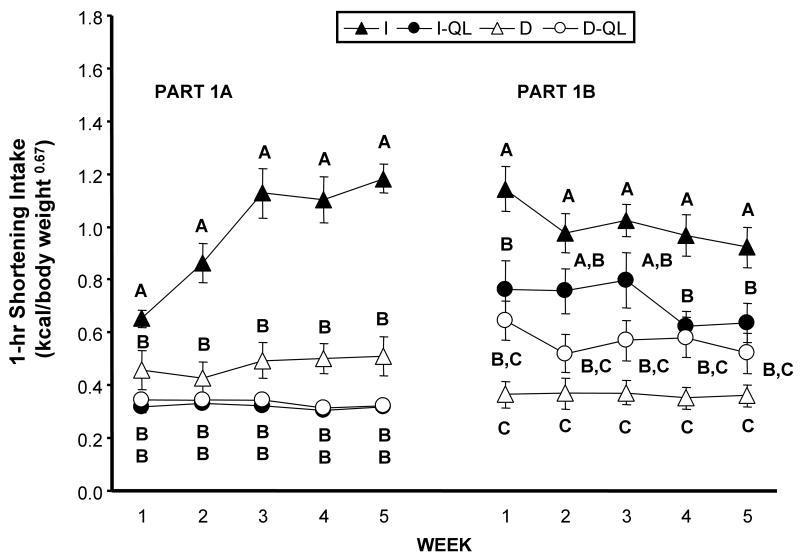
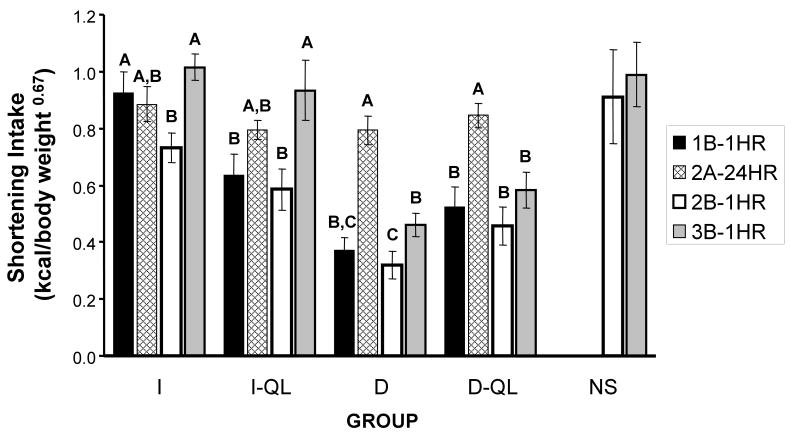
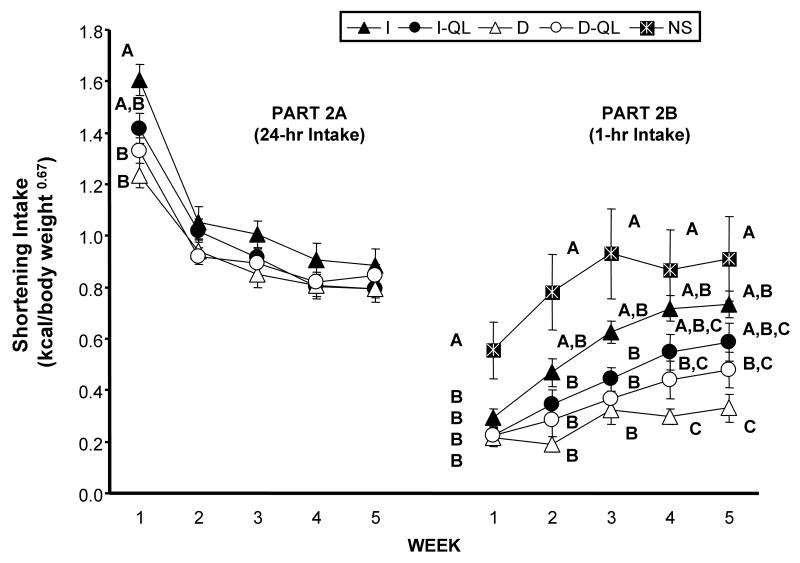
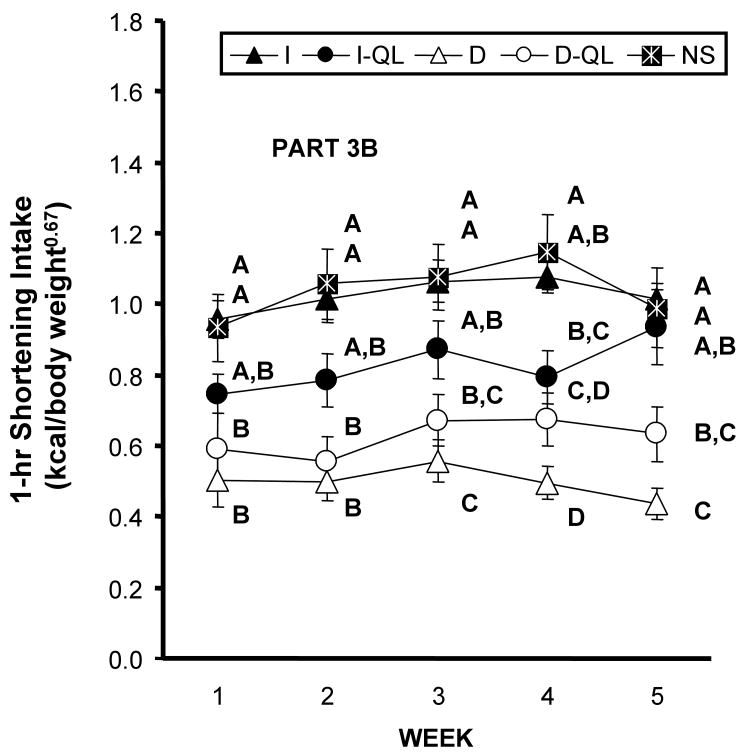
When non-food-deprived rats are given intermittent access to certain substances, consumption of those substances is greater than when more frequent access is provided. The present study examined the effects of three different shortening access conditions on subsequent shortening intake in rats. Each of the three different shortening conditions lasted five weeks and was followed by a five-week period in which shortening access was limited by time (1 h of availability) on either an Intermittent (Monday, Wednesday, Friday) or Daily schedule of access. In Part 1, limiting the quantity of shortening provided during the 1-h period of availability attenuated subsequent 1-h shortening intake in the Intermittent access group, but had no statistically significant effect in the Daily access group. In Part 2, unrestricted availability of shortening (24 h/day-7 days/week) attenuated subsequent 1-h shortening intake in all groups. In Part 3, shortening non-availability for five weeks enhanced subsequent 1-h shortening intake in all groups. It was also shown that rats under an Intermittent, but not a Daily, schedule of access consumed as much shortening during a 1-h period of availability, as was consumed in 24 h when shortening availability was unrestricted. These results demonstrate that while intermittent access is necessary and sufficient to stimulate binge-type eating in rats, the behavioral history can modulate binge size.
当不给食物的大鼠间歇性接触某些物质时,这些物质的摄入量要比给予更频繁接触时多。本研究考察了三种不同的缩短接触条件对大鼠随后缩短剂摄入量的影响。三种不同的缩短条件各持续五周,随后是一个为期五周的阶段,在此期间,缩短剂的接触在间歇性(周一、周三、周五)或每日接触时间表上受到时间限制(可获得1小时)。在第1部分中,在1小时可获得期内限制缩短剂的供应量,减弱了间歇性接触组随后1小时的缩短剂摄入量,但在每日接触组中没有统计学上的显著影响。在第2部分中,缩短剂无限制供应(每天24小时,每周7天)减弱了所有组随后1小时的缩短剂摄入量。在第3部分中,五周不供应缩短剂增加了所有组随后1小时的缩短剂摄入量。研究还表明,在间歇性而非每日接触时间表下的大鼠,在1小时可获得期内消耗的缩短剂与缩短剂无限制供应时24小时内消耗的量一样多。这些结果表明,虽然间歇性接触对于刺激大鼠的暴饮暴食是必要且充分的,但行为史可以调节暴饮暴食的量。