Deng Ye, He Zhili, Van Nostrand Joy D, Zhou Jizhong
Institute for Environmental Genomics, Department of Botany and Microbiology, the University of Oklahoma, Norman, OK 73019, USA.
BMC Genomics. 2008 Oct 17;9:491. doi: 10.1186/1471-2164-9-491.
Nonspecific hybridization is currently a major concern with microarray technology. One of most effective approaches to estimating nonspecific hybridizations in oligonucleotide microarrays is the utilization of mismatch probes; however, this approach has not been used for longer oligonucleotide probes.
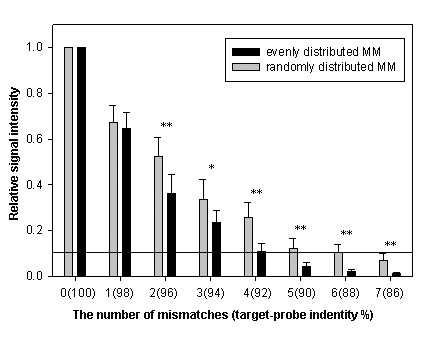
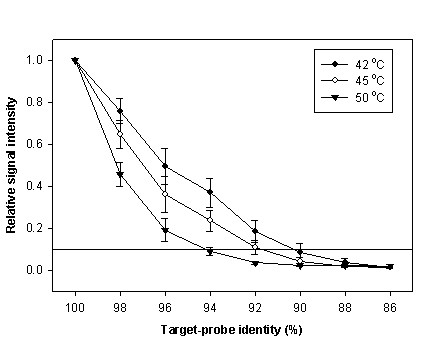
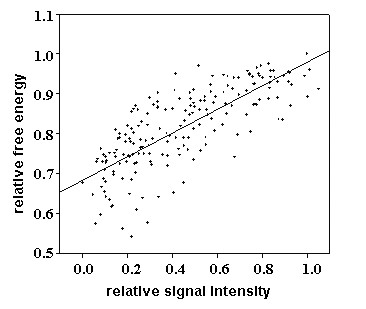
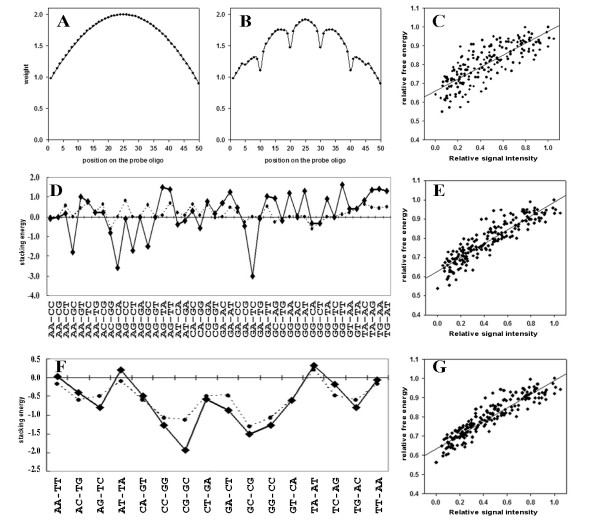
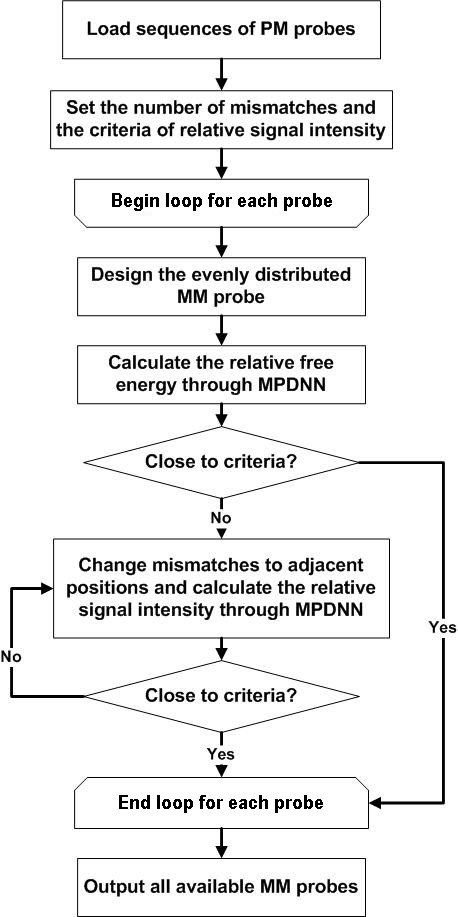
Here, an oligonucleotide microarray was constructed to evaluate and optimize parameters for 50-mer mismatch probe design. A perfect match (PM) and 28 mismatch (MM) probes were designed for each of ten target genes selected from three microorganisms. The microarrays were hybridized with synthesized complementary oligonucleotide targets at different temperatures (e.g., 42, 45 and 50 degrees C). In general, the probes with evenly distributed mismatches were more distinguishable than those with randomly distributed mismatches. MM probes with 3, 4 and 5 mismatched nucleotides were differentiated for 50-mer oligonucleotide probes hybridized at 50, 45 and 42 degrees C, respectively. Based on the experimental data generated from this study, a modified positional dependent nearest neighbor (MPDNN) model was constructed to adjust the thermodynamic parameters of matched and mismatched dimer nucleotides in the microarray environment. The MM probes with four flexible positional mismatches were designed using the newly established MPDNN model and the experimental results demonstrated that the redesigned MM probes could yield more consistent hybridizations.
This study provides guidance on the design of MM probes for long oligonucleotides (e.g., 50 mers). The novel MPDNN model has improved the consistency for long MM probes, and this modeling method can potentially be used for the prediction of oligonucleotide microarray hybridizations.
非特异性杂交是目前微阵列技术的一个主要问题。估计寡核苷酸微阵列中非特异性杂交的最有效方法之一是使用错配探针;然而,这种方法尚未用于较长的寡核苷酸探针。
在此,构建了一个寡核苷酸微阵列,以评估和优化50聚体错配探针设计的参数。针对从三种微生物中选择的十个靶基因中的每一个,设计了一个完全匹配(PM)探针和28个错配(MM)探针。微阵列在不同温度(例如42、45和50摄氏度)下与合成的互补寡核苷酸靶标杂交。一般来说,错配均匀分布的探针比错配随机分布的探针更易于区分。对于在50、45和42摄氏度下杂交的50聚体寡核苷酸探针,分别区分了具有3、4和5个错配核苷酸的MM探针。基于本研究产生的实验数据,构建了一个改进的位置依赖性最近邻(MPDNN)模型,以调整微阵列环境中匹配和错配二聚体核苷酸的热力学参数。使用新建立的MPDNN模型设计了具有四个灵活位置错配的MM探针,实验结果表明,重新设计的MM探针可以产生更一致的杂交。
本研究为长寡核苷酸(例如50聚体)的MM探针设计提供了指导。新型MPDNN模型提高了长MM探针的一致性,这种建模方法有可能用于预测寡核苷酸微阵列杂交。