Agricultural and Biological Engineering, University Park, PA 16802, USA.
J Biol Eng. 2008 Oct 20;2:14. doi: 10.1186/1754-1611-2-14.
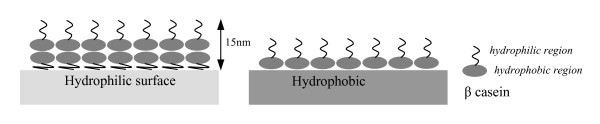
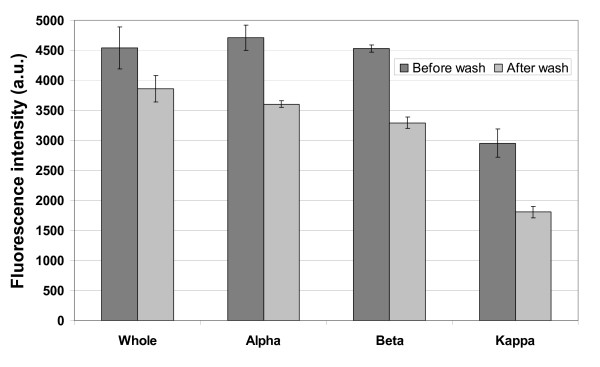
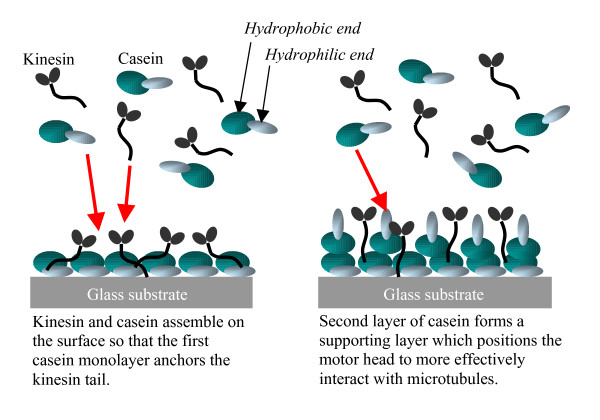
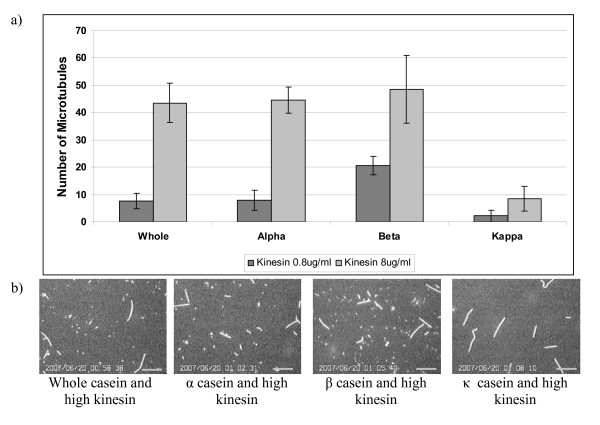
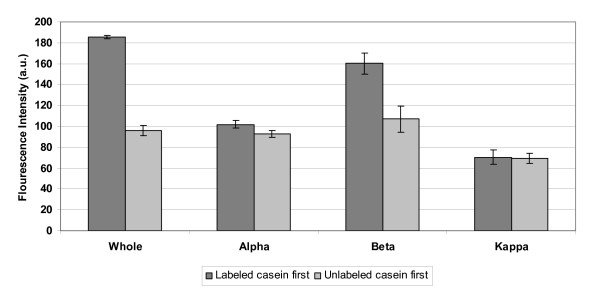
Microtubules and associated motor proteins such as kinesin are envisioned for applications such as bioseparation and molecular sorting to powering hybrid synthetic mechanical devices. One of the challenges in realizing such systems is retaining motor functionality on device surfaces. Kinesin motors adsorbed onto glass surfaces lose their functionality or ability to interact with microtubules if not adsorbed with other supporting proteins. Casein, a milk protein, is commonly used in microtubule motility assays to preserve kinesin functionality. However, the mechanism responsible for this preservation of motor function is unknown. To study casein and kinesin interaction, a series of microtubule motility assays were performed where whole milk casein, or its alphas1 and alphas2, beta or kappa subunits, were introduced or omitted at various steps of the motility assay. In addition, a series of epifluorescence and total internal reflection microscopy (TIRF) experiments were conducted where fluorescently labeled casein was introduced at various steps of the motility assay to assess casein-casein and casein-glass binding dynamics. From these experiments it is concluded that casein forms a bi-layer which supports the operation of kinesin. The first tightly bound layer of casein mainly performs the function of anchoring the kinesin while the second more loosely bound layer of casein positions the head domain of the kinesin to more optimally interact with microtubules. Studies on individual casein subunits indicate that beta casein was most effective in supporting kinesin functionality while kappa casein was found to be least effective.
微管和与之相关的马达蛋白,如驱动蛋白,被设想用于生物分离和分子分拣等应用,为混合合成机械装置提供动力。实现这些系统的挑战之一是在器件表面保留马达功能。如果没有其他支持蛋白吸附,吸附在玻璃表面的驱动蛋白会失去其功能或与微管相互作用的能力。酪蛋白是一种牛奶蛋白,常用于微管运动分析,以保持驱动蛋白的功能。然而,这种对马达功能的保护机制尚不清楚。为了研究酪蛋白和驱动蛋白的相互作用,进行了一系列微管运动分析实验,在运动分析的各个步骤中引入或省略全脂牛奶酪蛋白或其αs1 和αs2、β或κ亚基。此外,还进行了一系列荧光和全内反射显微镜(TIRF)实验,在运动分析的各个步骤中引入荧光标记的酪蛋白,以评估酪蛋白-酪蛋白和酪蛋白-玻璃结合动力学。从这些实验中得出结论,酪蛋白形成了一个支持驱动蛋白运作的双层结构。酪蛋白的第一层紧密结合,主要起到锚定驱动蛋白的作用,而第二层较松散结合的酪蛋白将驱动蛋白的头部结构定位,以更优化地与微管相互作用。对单个酪蛋白亚基的研究表明,β酪蛋白在支持驱动蛋白功能方面最为有效,而κ酪蛋白则效果最差。