Global Health. 2008 Oct 21;4:10. doi: 10.1186/1744-8603-4-10.
In a restricted sense, the resource curse is a theory that explains the inverse relationship classically seen between dependence on natural resources and economic growth. It defines a peculiar economic and political environment, epitomized by oil extraction in sub-Saharan Africa.
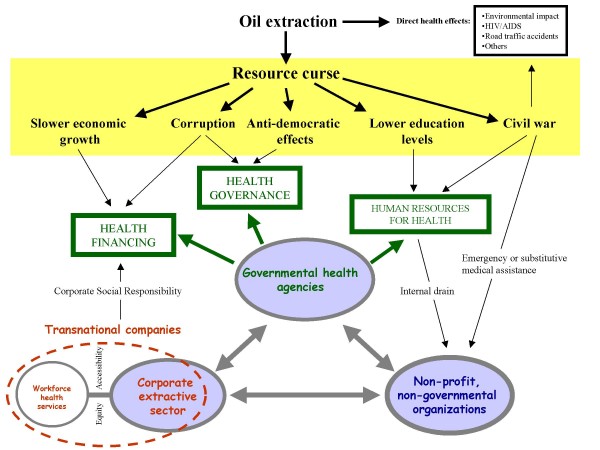
Based on secondary research and illustrations from four oil-rich geographical areas (the Niger Delta region of Nigeria, Angola, southern Chad, Southern Sudan), I propose a framework for analysing the effects of the resource curse on the structure of health systems at sub-national levels. Qualitative attributes are emphasised. The role of the corporate sector, the influence of conflicts, and the value of classical mitigation measures (such as health impact assessments) are further examined.
Health systems in a resource curse environment are classically fractured into tripartite components, including governmental health agencies, non-profit non-governmental organisations, and the corporate extractive sector. The three components entertain a range of contractual relationships generally based on operational considerations which are withdrawn from social or community values. Characterisation of agencies in this system should also include: values, operating principles, legitimacy and operational spaces. From this approach, it appears that community health is at the same time marginalized and instrumentalized toward economic and corporate interests in resource curse settings.
From a public health point of view, the resource curse represents a fundamental failure of dominant development theories, rather than a delay in creating the proper economy and governance environment for social progress. The scope of research on the resource curse should be broadened to include more accurate or comprehensive indicators of destitution (including health components) and more open perspectives on causal mechanisms.
在狭义上,资源诅咒是一种理论,经典地解释了对自然资源的依赖与经济增长之间的反比关系。它定义了一种特殊的经济和政治环境,以撒哈拉以南非洲的石油开采为代表。
基于二次研究和来自四个石油丰富地区(尼日利亚的尼日尔三角洲地区、安哥拉、乍得南部、南苏丹)的例证,我提出了一个分析资源诅咒对国家以下各级卫生系统结构影响的框架。强调定性属性。进一步考察了企业部门的作用、冲突的影响以及经典缓解措施(如健康影响评估)的价值。
资源诅咒环境中的卫生系统经典地分为三部分,包括政府卫生机构、非营利性非政府组织和企业采掘部门。这三个组成部分之间存在一系列基于运营考虑的合同关系,这些关系脱离了社会或社区价值。该系统中机构的特征还应包括:价值观、运作原则、合法性和运作空间。从这种方法来看,在资源诅咒环境中,社区卫生同时被边缘化并被工具化,以服务于经济和企业利益。
从公共卫生的角度来看,资源诅咒代表了主导发展理论的根本失败,而不是创造适当的经济和治理环境以促进社会进步的延迟。资源诅咒研究的范围应该扩大,包括更准确或全面的贫困(包括健康组成部分)指标,以及更开放的因果机制观点。