Richman Sarah A, Aggen David H, Dossett Michelle L, Donermeyer David L, Allen Paul M, Greenberg Philip D, Kranz David M
Department of Biochemistry, University of Illinois at Urbana-Champaign, 600 S. Mathews Ave., Urbana, IL 61801, USA.
Mol Immunol. 2009 Feb;46(5):902-16. doi: 10.1016/j.molimm.2008.09.021. Epub 2008 Oct 29.
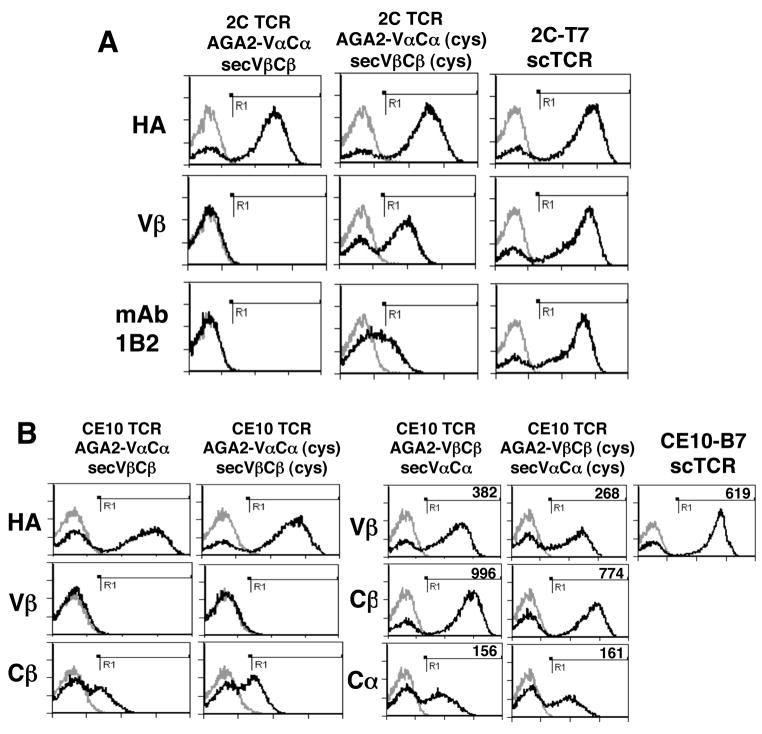
The variable (V) domains of antibodies and T cell receptors (TCRs) share sequence homology and striking structural similarity. Single-chain antibody V domain constructs (scFv) are routinely expressed in a variety of heterologous systems, both for production of soluble protein as well as for in vitro engineering. In contrast, single-chain T cell receptor V domain constructs (scTCR) are prone to aggregation and misfolding and are refractory to display on phage or yeast in their wild-type form. However, through random mutagenesis and yeast display engineering, it has been possible to isolate scTCR mutants that are properly folded and displayed on the yeast surface. These displayed mutants can serve not only as a scaffold for further engineering but also as scTCR variants that exhibit favorable biophysical properties in Escherichia coli expression. Thus, a more comprehensive understanding of the V domain mutations that allowed display would be beneficial. Our goal here was to identify generalizable patterns of important mutations that can be applied to different TCRs. We compared five different scTCRs, four from mice and one from a human, for yeast surface display. Analysis of a collection of mutants revealed four distinct regions of TCR V domains that were most important for enabling surface expression: the Valpha-Vbeta interface, the HV4 of Vbeta, and the region of the Valpha and Vbeta domains normally apposed against the constant (C) domains. Consistent with the role of the V-C interface in surface display, reconstitution of this interface, by including the constant domains of each chain, allowed V domain display and alphabeta chain association on the yeast surface, thus providing an alternative TCR scaffold. However, the surface levels of TCR achieved with engineered scTCR mutants were superior to that of the ValphaCalpha/VbetaCbeta constructs. Therefore, we describe further optimization of the current strategy for surface display of the single-chain format in order to facilitate yeast display engineering of a broader range of scTCRs.
抗体和T细胞受体(TCR)的可变(V)结构域具有序列同源性和显著的结构相似性。单链抗体V结构域构建体(scFv)通常在多种异源系统中表达,用于生产可溶性蛋白以及体外工程改造。相比之下,单链T细胞受体V结构域构建体(scTCR)易于聚集和错误折叠,并且以野生型形式难以在噬菌体或酵母上展示。然而,通过随机诱变和酵母展示工程,已能够分离出正确折叠并展示在酵母表面的scTCR突变体。这些展示的突变体不仅可以作为进一步工程改造的支架,还可以作为在大肠杆菌表达中表现出良好生物物理特性的scTCR变体。因此,更全面地了解允许展示的V结构域突变将是有益的。我们这里的目标是确定可应用于不同TCR的重要突变的通用模式。我们比较了五种不同的scTCR,其中四种来自小鼠,一种来自人类,用于酵母表面展示。对一组突变体的分析揭示了TCR V结构域中对表面表达最重要的四个不同区域:Vα-Vβ界面、Vβ的HV4以及Vα和Vβ结构域通常与恒定(C)结构域相对的区域。与V-C界面在表面展示中的作用一致,通过包含每条链的恒定结构域来重建该界面,可实现V结构域在酵母表面的展示以及αβ链的缔合,从而提供了一种替代的TCR支架。然而,工程化scTCR突变体在酵母表面实现的TCR水平优于VαCα/VβCβ构建体。因此,我们描述了进一步优化当前单链形式表面展示策略,以促进更广泛范围的scTCR的酵母展示工程。