Natarajan Deepa, de Vries Han, Saaltink Dirk-Jan, de Boer Sietse F, Koolhaas Jaap M
Department of Behavior Physiology, University of Groningen, Kerklaan 30, 9751 NN, Haren, The Netherlands.
Behav Genet. 2009 Jan;39(1):73-90. doi: 10.1007/s10519-008-9230-3. Epub 2008 Oct 23.
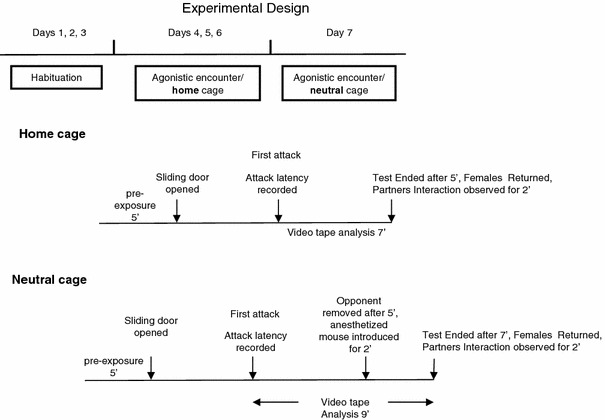
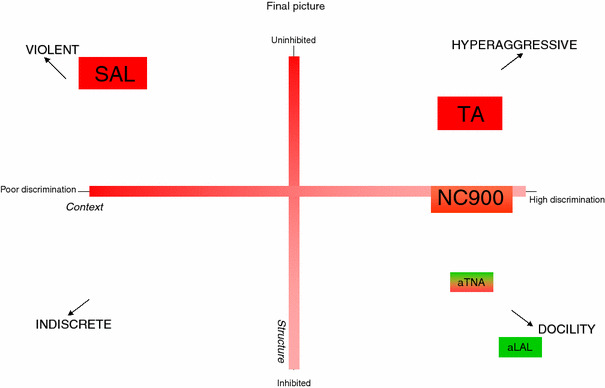
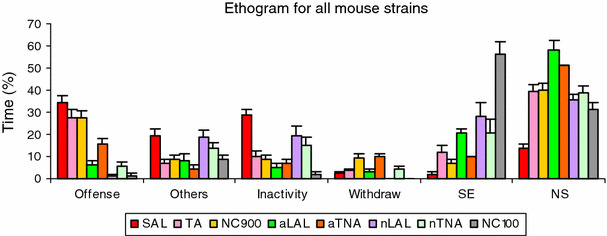
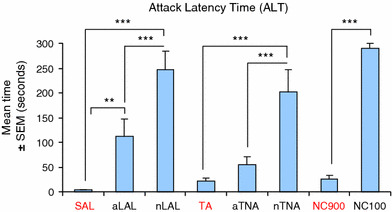
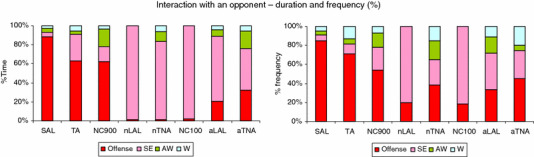
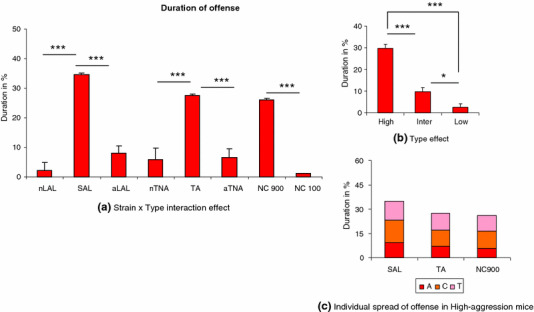
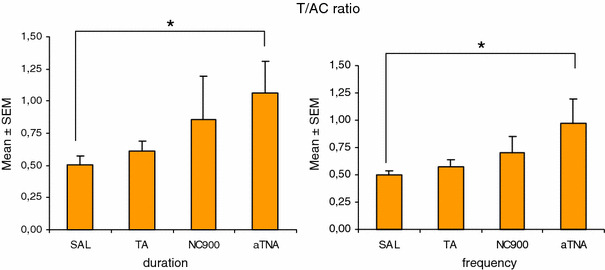
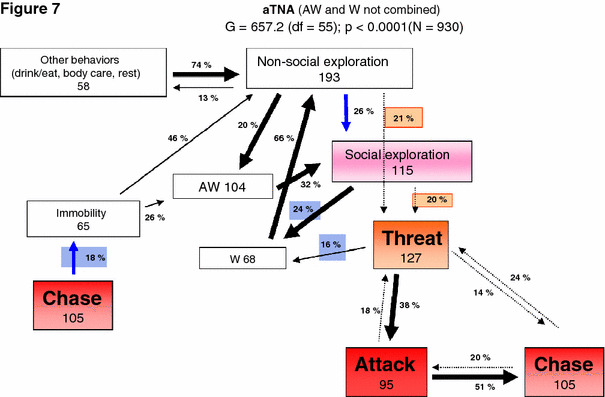
The present study aims at delineating violence from aggression, using genetically selected high (SAL, TA, NC900) and low (LAL, TNA NC100) aggressive mouse strains. Unlike aggression, violence lacks intrinsic control, environmental constraints as well as functional endpoints. Conventional measures namely latency, frequency and duration were used initially to accomplish the objective of delineation using the above strains. However, these quantitative measures fail to reveal further details beyond the magnitude of differential aggression, especially within the high aggressive mouse strains. Hence, it was necessary to analyze further, the behavioral sequences that make up the agonistic encounter. Novel measures such as threat/(attack + chase) (T/AC) and offense/withdrawal (O/W) ratios, context dependency and first-order Markov chain analysis were used for the above purpose. Our present analyses reveal clear qualitative behavioral differences between the three high aggressive selection strains based on the following facets namely structure and context in an agonistic interaction. Structure refers to a detailed study of the agonistic interaction components (ritualistic display, offense and sensitivity to the opponent submission cues) between any two subjects (inter-male interaction for the present study). Context refers to the capacity to identify an opponent by nature of its state (free moving/anesthetized), sex and the environment (home/neutral territory). NC900 displayed context dependency and structurally a rich repertoire of agonistic interaction components with an opponent. SAL failed to show discrimination and its inter-male agonistic behavior is restricted to a repetitive and an opponent-insensitive pattern of attack and chase. TA was comparable to SAL in terms of the structure but sensitive to context variables. Thus, SAL seems to display a violent form of aggressive behavior, while NC900 display 'functional' hyperaggression against a docile opponent in an inter-male agonistic interaction.
本研究旨在利用基因筛选出的高攻击性(SAL、TA、NC900)和低攻击性(LAL、TNA、NC100)小鼠品系来区分暴力与攻击行为。与攻击行为不同,暴力行为缺乏内在控制、环境约束以及功能性终点。最初使用传统的测量方法,即潜伏期、频率和持续时间,来实现利用上述品系进行区分的目标。然而,这些定量测量方法无法揭示超出攻击差异程度之外的更多细节,尤其是在高攻击性小鼠品系内部。因此,有必要进一步分析构成争斗相遇的行为序列。为此使用了诸如威胁/(攻击 + 追逐)(T/AC)和攻击/撤退(O/W)比率、情境依赖性和一阶马尔可夫链分析等新的测量方法。我们目前的分析揭示了三种高攻击性选择品系在以下方面存在明显的定性行为差异,即在争斗互动中的结构和情境。结构是指对任意两个个体(本研究中的雄性间互动)之间争斗互动成分(仪式性展示、攻击以及对对手屈服信号的敏感性)的详细研究。情境是指根据对手的状态(自由活动/麻醉)、性别和环境(家/中性领地)来识别对手的能力。NC900表现出情境依赖性,并且在结构上与对手有丰富的争斗互动成分。SAL没有表现出辨别能力,其雄性间争斗行为局限于重复且对对手不敏感的攻击和追逐模式。TA在结构方面与SAL相当,但对情境变量敏感。因此,SAL似乎表现出一种暴力形式的攻击行为,而NC900在雄性间争斗互动中对温顺对手表现出“功能性”过度攻击。