Suppr超能文献

动物暴力揭秘。

Animal violence demystified.

作者信息

Natarajan Deepa, Caramaschi Doretta

机构信息

Department of Behavioral Physiology, Biological Center, University of Groningen Haren, Netherlands.

出版信息

Front Behav Neurosci. 2010 Apr 5;4:9. doi: 10.3389/fnbeh.2010.00009. eCollection 2010.

Abstract

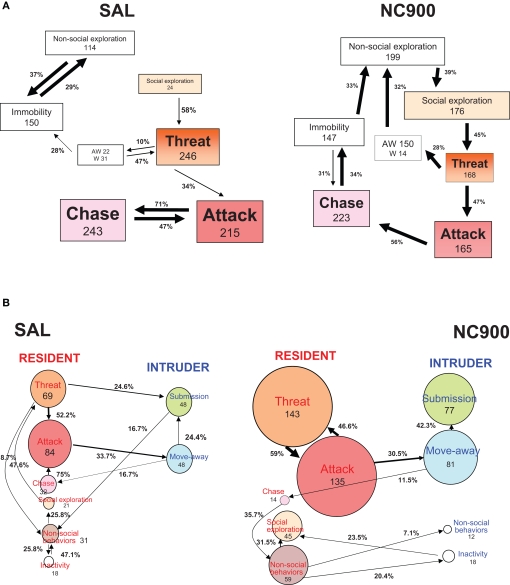
Violence has been observed in humans and animals alike, indicating its evolutionary/biological significance. However, violence in animals has often been confounded with functional forms of aggressive behavior. Currently, violence in animals is identified primarily as either a quantitative behavior (an escalated, pathological and abnormal form of aggression characterized primarily by short attack latencies, and prolonged and frequent harm-oriented conflict behaviors) or a qualitative one (characterized by attack bites aimed at vulnerable parts of the opponent's body and context independent attacks regardless of the environment or the sex and type of the opponent). Identification of an operational definition for violence thus not only helps in understanding its potential differences from adaptive forms of aggression but also in the selection of appropriate animal models for both. We address this issue theoretically by drawing parallels from research on aggression and appeasement in humans and other animals. We also provide empirical evidences for violence in mice selected for high aggression by comparing our findings with other currently available potentially violent rodent models. The following violence-specific features namely (1) Display of low levels of pre-escalatory/ritualistic behaviors. (2) Immediate and escalated offense durations with low withdrawal rates despite the opponent's submissive supine and crouching/defeat postures. (3) Context independent indiscriminate attacks aimed at familiar/unfamiliar females, anaesthetized males and opponents and in neutral environments. (4) Orientation of attack-bites toward vulnerable body parts of the opponent resulting in severe wounding. (5) Low prefrontal serotonin (5-HT) levels upon repeated aggression. (6) Low basal heart rates and hyporesponsive hypothalamus-pituitary-adrenocortical (HPA) axis were identified uniquely in the short attack latency (SAL) mice suggesting a qualitative difference between violence and adaptive aggression in animals.

摘要

在人类和动物中均观察到了暴力行为,这表明其具有进化/生物学意义。然而,动物的暴力行为常常与攻击性的功能性形式相混淆。目前,动物的暴力行为主要被认定为定量行为(一种升级的、病理性且异常的攻击形式,其主要特征为攻击潜伏期短,以及长期且频繁的以伤害为导向的冲突行为)或定性行为(其特征为攻击咬伤对手身体的脆弱部位,且无论环境或对手的性别及类型如何,均进行与环境无关的攻击)。因此,确定暴力行为的操作性定义不仅有助于理解其与适应性攻击形式的潜在差异,还有助于为两者选择合适的动物模型。我们通过借鉴人类和其他动物攻击性及安抚行为的研究,从理论上探讨了这个问题。我们还通过将我们的研究结果与其他目前可用的潜在暴力啮齿动物模型进行比较,为高攻击性小鼠的暴力行为提供了实证证据。以下是暴力行为特有的特征,即:(1)预升级/仪式性行为水平较低;(2)尽管对手呈现顺从的仰卧和蹲伏/战败姿势,但攻击持续时间立即升级且撤离率低;(3)在中性环境中,对熟悉/不熟悉的雌性、麻醉的雄性及对手进行与环境无关的无差别攻击;(4)攻击咬伤朝向对手的脆弱身体部位,导致严重受伤;(5)反复攻击后前额叶血清素(5-HT)水平较低;(6)在短攻击潜伏期(SAL)小鼠中独特地发现基础心率较低且下丘脑-垂体-肾上腺皮质(HPA)轴反应低下,这表明动物的暴力行为与适应性攻击之间存在质的差异。

https://cdn.ncbi.nlm.nih.gov/pmc/blobs/1a7c/2854525/d020899cf840/fnbeh-04-00009-g001.jpg

相似文献

1
Animal violence demystified.
Front Behav Neurosci. 2010 Apr 5;4:9. doi: 10.3389/fnbeh.2010.00009. eCollection 2010.
2
Development of violence in mice through repeated victory along with changes in prefrontal cortex neurochemistry.
Behav Brain Res. 2008 Jun 3;189(2):263-72. doi: 10.1016/j.bbr.2008.01.003. Epub 2008 Jan 15.
3
Delineation of violence from functional aggression in mice: an ethological approach.
Behav Genet. 2009 Jan;39(1):73-90. doi: 10.1007/s10519-008-9230-3. Epub 2008 Oct 23.
4
The vicious cycle towards violence: focus on the negative feedback mechanisms of brain serotonin neurotransmission.
Front Behav Neurosci. 2009 Nov 20;3:52. doi: 10.3389/neuro.08.052.2009. eCollection 2009.
5
Violent phenotype in SAL mice is inflexible and fixed in adulthood.
Aggress Behav. 2009 Sep-Oct;35(5):430-6. doi: 10.1002/ab.20312.
6
Away game or home match: the influence of venue and serotonin transporter genotype on the display of offensive aggression.
Behav Brain Res. 2011 Jun 1;219(2):291-301. doi: 10.1016/j.bbr.2011.01.029. Epub 2011 Jan 22.
10
Behavioral characterization of escalated aggression induced by GABA(B) receptor activation in the dorsal raphe nucleus.
Psychopharmacology (Berl). 2012 Nov;224(1):155-66. doi: 10.1007/s00213-012-2654-8. Epub 2012 Mar 7.

引用本文的文献

1
Serotonin drives aggression and social behaviors of laboratory male mice in a semi-natural environment.
Front Behav Neurosci. 2024 Sep 18;18:1450540. doi: 10.3389/fnbeh.2024.1450540. eCollection 2024.
2
Addressing Combative Behaviour in Spanish Bulls by Measuring Hormonal Indicators.
Vet Sci. 2024 Apr 22;11(4):182. doi: 10.3390/vetsci11040182.
3
Aggression, Aggression-Related Psychopathologies and Their Models.
Front Behav Neurosci. 2022 Jul 4;16:936105. doi: 10.3389/fnbeh.2022.936105. eCollection 2022.
4
The Brain Emotional Systems in Addictions: From Attachment to Dominance/Submission Systems.
Front Hum Neurosci. 2021 Jan 15;14:609467. doi: 10.3389/fnhum.2020.609467. eCollection 2020.
5
Aberrant aggressive behavior in a mouse model of Angelman syndrome.
Sci Rep. 2021 Jan 8;11(1):47. doi: 10.1038/s41598-020-79984-7.
6
Serotonergic Modulation of Aggression in Drosophila Involves GABAergic and Cholinergic Opposing Pathways.
Curr Biol. 2019 Jul 8;29(13):2145-2156.e5. doi: 10.1016/j.cub.2019.05.070. Epub 2019 Jun 20.
8
Distinct effects of early-life experience and trait aggression on cardiovascular reactivity and recovery.
Physiol Behav. 2019 Feb 1;199:375-385. doi: 10.1016/j.physbeh.2018.12.005. Epub 2018 Dec 4.
9
The Role of the Lateral Hypothalamus in Violent Intraspecific Aggression-The Glucocorticoid Deficit Hypothesis.
Front Syst Neurosci. 2018 Jun 8;12:26. doi: 10.3389/fnsys.2018.00026. eCollection 2018.
10
Independent effects of early-life experience and trait aggression on cardiovascular function.
Am J Physiol Regul Integr Comp Physiol. 2016 Aug 1;311(2):R272-86. doi: 10.1152/ajpregu.00505.2015. Epub 2016 Jun 8.

本文引用的文献

1
Passage of an Iron Rod through the Head.
Northwest Med Surg J. 1849 Feb-Mar;1(6):513-518.
2
A psychobiological theory of attachment.
Behav Brain Sci. 1992 Sep;15(3):493-511. doi: 10.1017/S0140525X00069752.
3
Associated Facial, Vocal and Respiratory Components of Emotional Expression: An Experimental Study.
J Neurol Psychopathol. 1937 Jan;17(67):241-55. doi: 10.1136/jnnp.s1-17.67.241.
4
The vicious cycle towards violence: focus on the negative feedback mechanisms of brain serotonin neurotransmission.
Front Behav Neurosci. 2009 Nov 20;3:52. doi: 10.3389/neuro.08.052.2009. eCollection 2009.
5
Lack of differential serotonin biosynthesis capacity in genetically selected low and high aggressive mice.
Physiol Behav. 2009 Oct 19;98(4):411-5. doi: 10.1016/j.physbeh.2009.07.009. Epub 2009 Jul 24.
6
Understanding human aggression: New insights from neuroscience.
Int J Law Psychiatry. 2009 Jul-Aug;32(4):209-15. doi: 10.1016/j.ijlp.2009.06.001. Epub 2009 Jul 12.
7
Violent phenotype in SAL mice is inflexible and fixed in adulthood.
Aggress Behav. 2009 Sep-Oct;35(5):430-6. doi: 10.1002/ab.20312.
8
The relation of ADHD and violent aggression: What can we learn from epidemiological and genetic studies?
Int J Law Psychiatry. 2009 Jul-Aug;32(4):235-43. doi: 10.1016/j.ijlp.2009.04.006. Epub 2009 May 2.
9
Early life stress, the development of aggression and neuroendocrine and neurobiological correlates: what can we learn from animal models?
Front Neuroendocrinol. 2009 Oct;30(4):497-518. doi: 10.1016/j.yfrne.2009.03.003. Epub 2009 Mar 31.
10
Influence of functional variant of neuronal nitric oxide synthase on impulsive behaviors in humans.
Arch Gen Psychiatry. 2009 Jan;66(1):41-50. doi: 10.1001/archgenpsychiatry.2008.510.

文献AI研究员

20分钟写一篇综述,助力文献阅读效率提升50倍。

立即体验

用中文搜PubMed

大模型驱动的PubMed中文搜索引擎

马上搜索

文档翻译

学术文献翻译模型,支持多种主流文档格式。

立即体验